What this calculator does
The Fertilizer Nitrogen Calculator tells you how much of a fertilizer product to apply so that a field or lawn receives a specific amount of nitrogen. Fertilizer bags list a guaranteed nitrogen content as a percentage (the first number in an N-P-K grade), so the same nitrogen target requires very different amounts of product depending on that percentage.
The formula explained
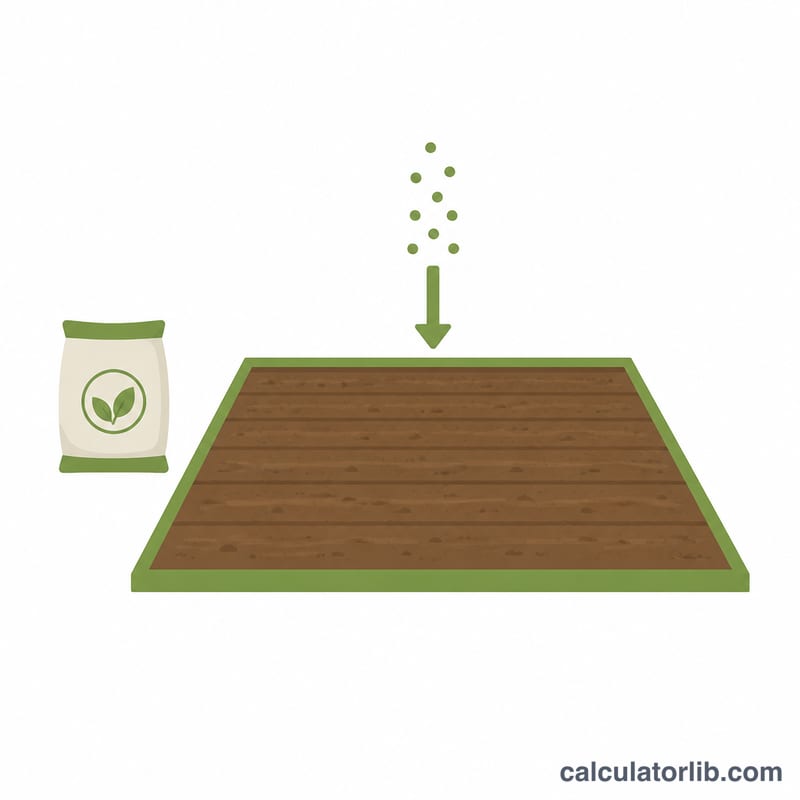
First find the total nitrogen the area requires, where \(N_{\text{rate}}\) = target nitrogen rate in kg N per hectare and \(A\) = area in hectares:
$$N_{\text{total}} = N_{\text{rate}} \times A$$Then convert that nitrogen demand into product weight, where \(\%N\) = the nitrogen content of the fertilizer:
$$\text{Fertilizer} = \frac{ {N_{\text{total}}}}{\%N / 100}$$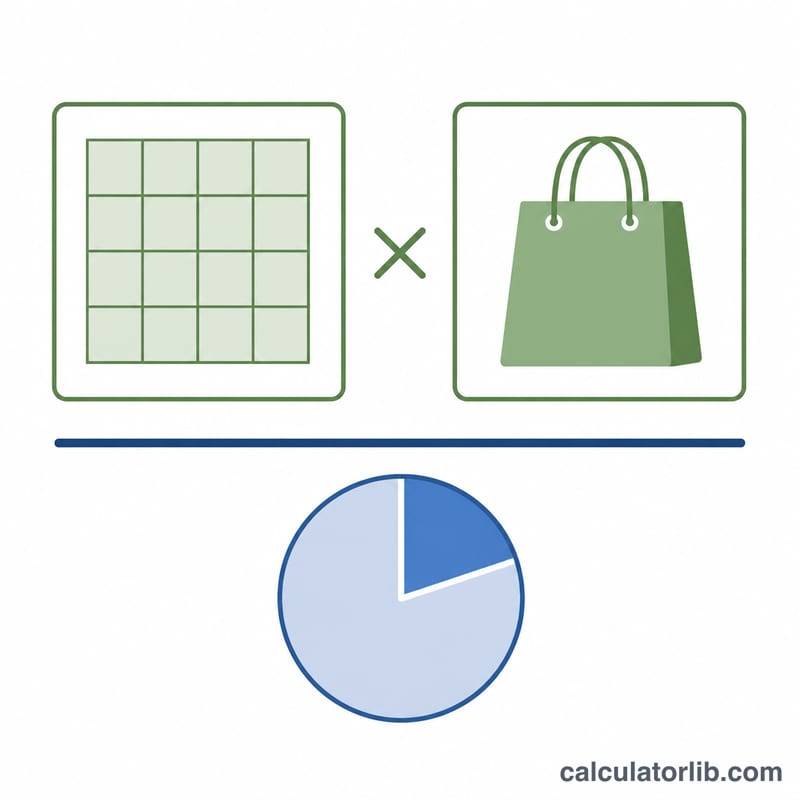
How to use it
Enter your target nitrogen rate, the area to be treated, and the nitrogen percentage printed on the fertilizer label. The calculator returns the total nitrogen required and the weight of product you must spread to deliver it.
Worked example
Suppose you want \(100\) kg N per hectare across \(2\) hectares using urea at \(46\%\) N. The total nitrogen is:
$$N_{\text{total}} = 100 \times 2 = 200\ \text{kg N}$$The product needed is:
$$\text{Fertilizer} = \frac{ {200}}{46 / 100} = 434.78\ \text{kg}$$Common Fertilizer Nitrogen Contents
Fertilizers are labelled with three numbers (N-P-K). The first number is the percent nitrogen (%N) by weight — that is the value to enter as N Content (%) in this calculator. The table below lists typical guaranteed nitrogen contents; always confirm against the analysis printed on your product's label, since blends and regional formulations vary.
| Fertilizer | Typical grade (N-P-K) | Nitrogen content (%N) |
|---|---|---|
| Urea | 46-0-0 | 46% |
| Ammonium nitrate | 34-0-0 | 34% |
| UAN solution | — | 28–32% |
| Calcium ammonium nitrate (CAN) | ~27-0-0 | ~27% |
| Ammonium sulfate | 21-0-0 | 21% |
| Diammonium phosphate (DAP) | 18-46-0 | 18% |
| Potassium nitrate | 13-0-46 | 13% |
| Blood meal | ~12-0-0 | ~12% |
| Monoammonium phosphate (MAP) | 11-52-0 | 11% |
For example, urea (46-0-0) contains 46% N, so enter 46. UAN and calcium ammonium nitrate are sold in a range of grades, so read the exact figure from your label.
Typical Nitrogen Application Rates
The ranges below are general agronomic guidance drawn from land-grant university extension and agronomic recommendations (for example, US Cooperative Extension and similar services). Actual optimum rates depend heavily on crop variety, yield goal, soil type, prior crop, and manure history, and they differ by country and region. The lb N/1000 sq ft column uses US customary units (about 1 lb N/1000 sq ft ≈ 48.8 kg N/ha) and is most often used for turf in North America.
| Use | Typical seasonal N rate (kg N/ha) | ≈ lb N/1000 sq ft |
|---|---|---|
| Cereals / wheat | ~90–160 | ~1.8–3.3 |
| Maize / corn | ~150–220 | ~3.1–4.5 |
| Cool-season lawn turf (annual) | ~100–200 | ~2–4 |
These figures are illustrative ranges, not a prescription. Let a current soil test, your yield goal, and any local nutrient-management regulations set the final rate — several regions cap N application or require certified nutrient plans, and over-application wastes money and can pollute groundwater and surface water.
Practical Application Tips
Once the calculator gives you a product weight, a few practical steps turn that number into an accurate, safe application.
Worked example. To supply a target of 120 kg N/ha over a 2 ha field using urea at 46% N:
$$\text{Fertilizer} = \frac{\text{Target N} \times \text{Area}}{\text{N content} / 100} = \frac{120 \times 2}{46 / 100} = \frac{240}{0.46} \approx 521.74\ \text{kg}$$So you need about 521.74 kg of urea. Use that figure with the steps below.
- Convert to bags and round up. Divide the product weight by your bag size and round up to the next whole bag so you never run short. With 25 kg bags: 521.74 ÷ 25 = 20.9, so buy 21 bags (525 kg).
- Add ~5–10% for overlap and edge loss. Spreader passes overlap and headlands get double-covered, so real usage exceeds the theoretical figure. Here 521.74 kg × 1.075 ≈ 561 kg, i.e. about 23 bags to have enough on hand.
- Split high rates into multiple applications. Applying a large N dose all at once risks foliar/root burn (especially on turf) and leaching losses. Where the target rate is high, divide it into two or more passes across the season rather than one heavy application.
- Calibrate the spreader first. Before treating the whole area, set and check the spreader to deliver the calculated kilograms per unit area (for this example, 521.74 kg ÷ 2 ha ≈ 261 kg/ha) over a measured test strip, then adjust the setting until the measured output matches.
This is general agronomic information, not professional advice. For field-specific rates, timing, and compliance with local regulations, base decisions on a current soil test and consult your local extension service or a qualified agronomist.
FAQ
Where do I find the nitrogen percentage? It is the first number of the N-P-K grade on the bag, so 46-0-0 means 46% nitrogen.
Can I use other units? Yes, as long as the rate and area units match; the product weight comes out in the same weight unit as your nitrogen inputs.
Why does low-nitrogen fertilizer need more product? A smaller \(\%N\) means each kilogram of product carries less nitrogen, so more product is required to reach the same total.