What This Calculator Does
The Mass From Molar Concentration Calculator finds how many grams of a solute are present in a solution when you know the solution's molar concentration (molarity), its volume, and the molar mass of the dissolved substance. It is a core tool for preparing standard solutions, dosing reagents, and checking laboratory calculations.
The Formula
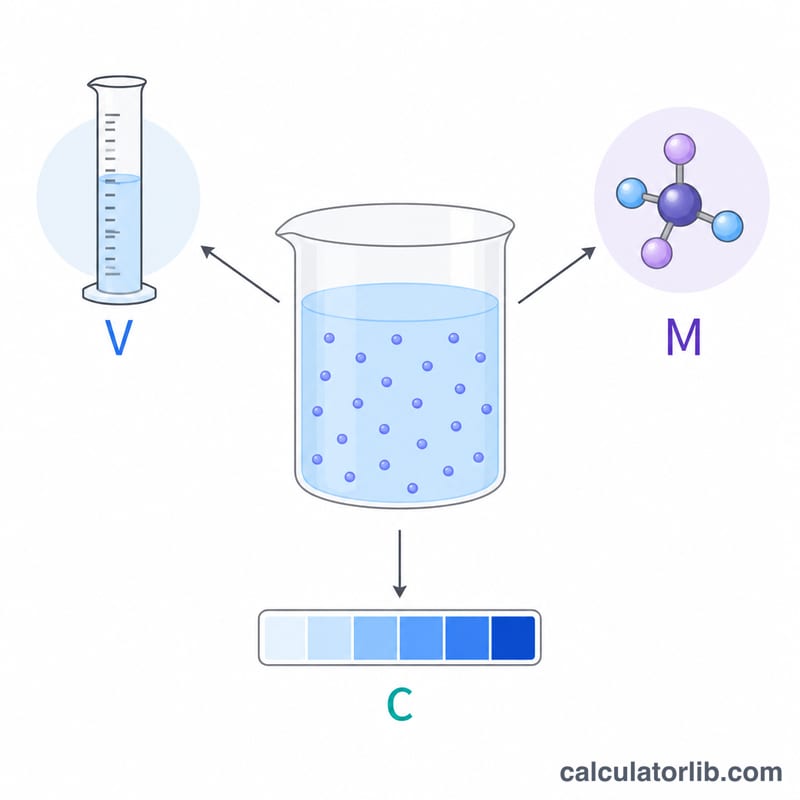
The mass of solute follows directly from the definition of molarity:
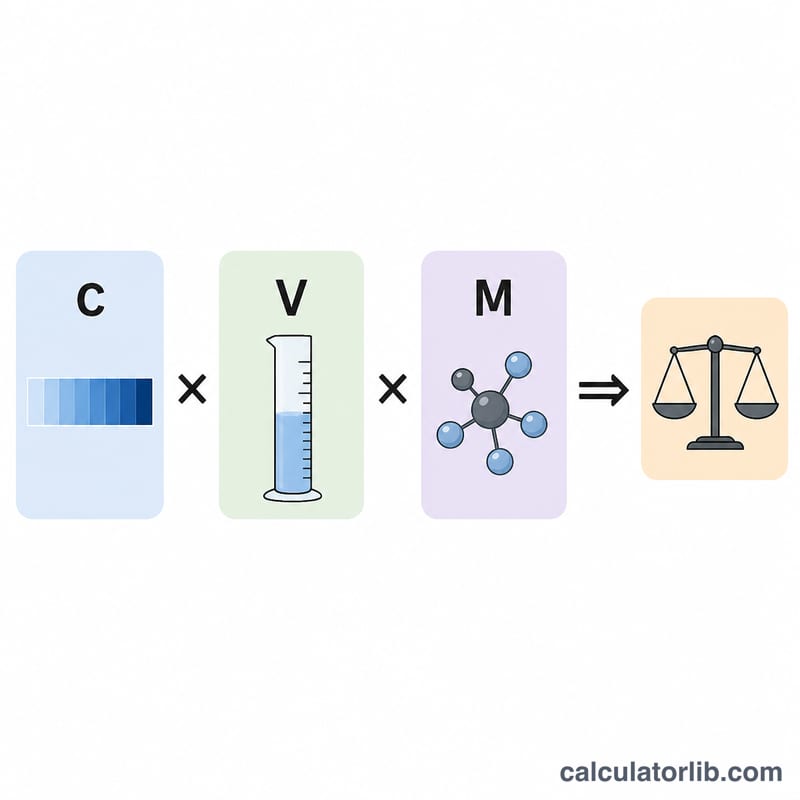
$$m = c \times V \times M$$where \(m\) = mass of solute in grams, \(c\) = molar concentration in mol/L, \(V\) = solution volume in liters, and \(M\) = molar mass in g/mol. The product \(c \times V\) gives the number of moles, and multiplying by \(M\) converts moles to grams.
How To Use It
Enter the molar concentration in mol/L, the volume of solution in liters, and the molar mass of your compound in g/mol. The calculator returns the required mass in grams. Make sure the volume is in liters and the molar mass matches the exact chemical formula you are using.
Worked Example
Suppose you want a \(1\ \text{mol/L}\) sodium chloride solution in a volume of \(1\ \text{L}\), where \(M = 58.44\ \text{g/mol}\):
$$m = 1 \times 1 \times 58.44 = 58.44\,\text{g}$$So you would weigh out 58.44 grams of NaCl and dissolve it to make one liter of solution.
Common Molar Masses
The molar mass (\(M\), in g/mol) is a required input for calculating solute mass from molar concentration using \(\text{Mass (g)} = c \times V \times M\). The values below are standard molar masses for common laboratory solutes, calculated from standard atomic weights. Molar mass equals the numerical value of the substance's relative molecular (or formula) mass expressed in g/mol.
| Substance | Chemical Formula | Molar Mass (g/mol) |
|---|---|---|
| Water | H2O | 18.02 |
| Sodium hydroxide | NaOH | 40.00 |
| Sodium chloride | NaCl | 58.44 |
| Potassium chloride | KCl | 74.55 |
| Sodium bicarbonate | NaHCO3 | 84.01 |
| Calcium chloride | CaCl2 | 110.98 |
| Glucose | C6H12O6 | 180.16 |
| Sucrose | C12H22O11 | 342.30 |
These molar masses are derived from the standard atomic weights recommended by IUPAC (the International Union of Pure and Applied Chemistry) and are rounded to two decimal places, which is sufficient for most laboratory preparations. Values may differ slightly if you use more precise atomic weights or account for hydrated forms of a salt (for example, CaCl2·2H2O has a higher molar mass than anhydrous CaCl2 shown here).
FAQ
What units should I use? Concentration in mol/L, volume in liters, and molar mass in g/mol, giving mass in grams.
How do I find molar mass? Add the atomic masses of every atom in the compound's formula; for example water \(H_2O\) is about \(18.02\ \text{g/mol}\).
Can I use milliliters? Convert to liters first by dividing by 1000, since the formula expects volume in liters.