What is a repo rate calculator?
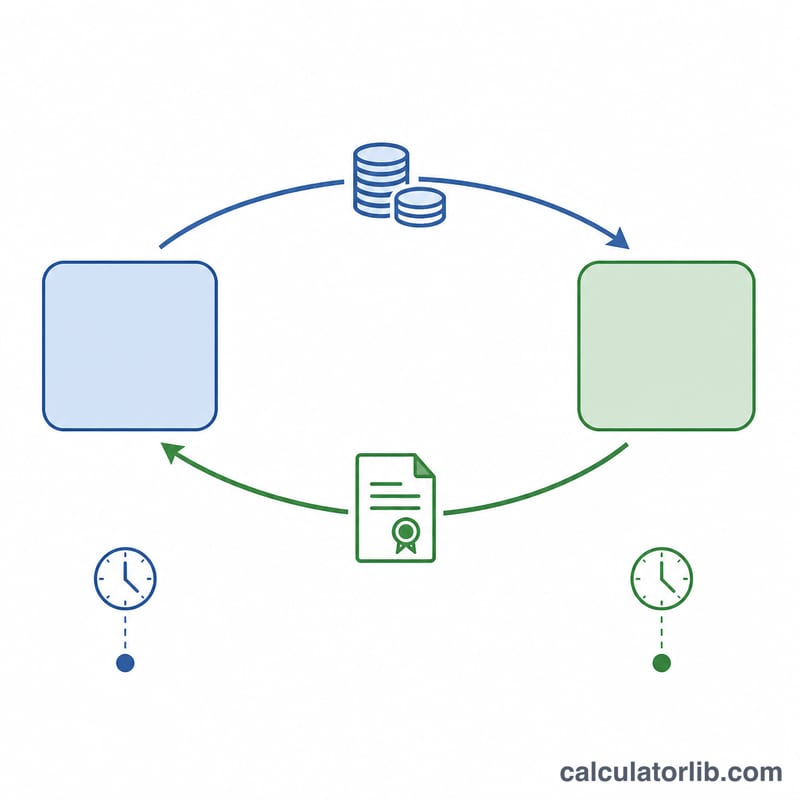
A repurchase agreement, or repo, is a short-term secured loan: one party sells securities and agrees to buy them back later at a slightly higher price. That price difference is the interest, expressed as an annualized repo rate. This calculator converts the principal, the repo rate, and the term into the actual cash interest and the final repurchase price.
The formula explained
Repo interest uses simple money-market interest, prorated by a day-count basis:
$$\text{Interest} = P \times \frac{r}{100} \times \frac{d}{B}$$where \(P\) = principal (purchase price of the securities), \(r\) = annual repo rate in percent, \(d\) = term in days, and \(B\) = day-count basis (360 or 365). The repurchase price is then:
$$\text{Repurchase Price} = P + \text{Interest}$$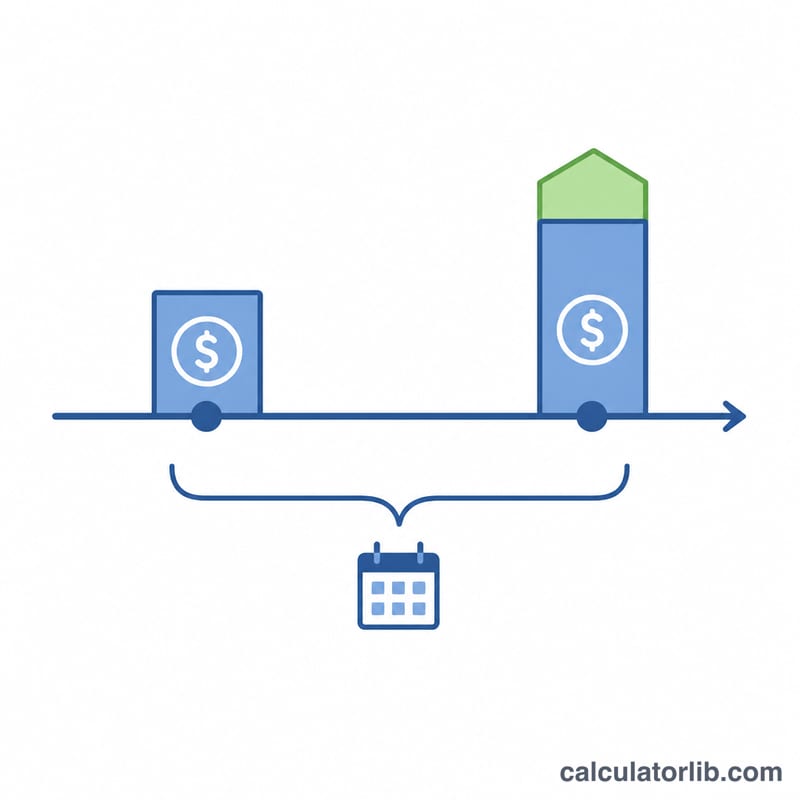
How to use it
Enter the principal (the cash amount lent against the collateral), the annual repo rate, and the number of days until the securities are repurchased. Choose Actual/360, the common money-market convention, or Actual/365. The result shows the interest and the total repurchase amount.
Worked example
Suppose \(P = 1{,}000{,}000\), \(r = 5\%\), \(d = 30\) days, on an Actual/360 basis:
$$\text{Interest} = 1{,}000{,}000 \times \frac{5}{100} \times \frac{30}{360} = 4{,}166.67$$The repurchase price is \(1{,}000{,}000 + 4{,}166.67 = 1{,}004{,}166.67\).
Repo Interest Across Scenarios
The table below applies the repo interest formula \(\text{Interest} = \text{Principal} \times \frac{\text{Repo Rate}}{100} \times \frac{\text{Term (days)}}{\text{Basis}}\) and the repurchase price \(\text{Repurchase Price} = \text{Principal} + \text{Interest}\). All amounts are shown in a generic currency unit ($); the arithmetic is identical for any currency. Note the day-count convention: Actual/360 is the standard money-market convention for US dollar repurchase agreements, while Actual/365 is used in some markets (for example sterling money markets). Because 360 is the smaller denominator, Actual/360 produces slightly more interest than Actual/365 on identical inputs.
| Principal | Repo rate | Term (days) | Basis | Interest | Repurchase price |
|---|---|---|---|---|---|
| $10,000,000 | 5.00% | 1 | Actual/360 | $1,388.89 | $10,001,388.89 |
| $5,000,000 | 4.50% | 7 | Actual/360 | $4,375.00 | $5,004,375.00 |
| $1,000,000 | 5.25% | 30 | Actual/360 | $4,375.00 | $1,004,375.00 |
| $2,000,000 | 3.75% | 14 | Actual/365 | $2,876.71 | $2,002,876.71 |
| $10,000,000 | 5.00% | 90 | Actual/360 | $125,000.00 | $10,125,000.00 |
| $10,000,000 | 5.00% | 90 | Actual/365 | $123,287.67 | $10,123,287.67 |
The last two rows are a paired comparison on identical inputs — $10,000,000 at 5.00% for 90 days. Under Actual/360 the interest is \(10{,}000{,}000 \times \frac{5}{100} \times \frac{90}{360} = 125{,}000\), while under Actual/365 it is \(10{,}000{,}000 \times \frac{5}{100} \times \frac{90}{365} = 123{,}287.67\). The convention alone changes the interest by $1,712.33 on this trade, so always confirm which day-count basis your counterparty uses before agreeing a repurchase price.
Central bank policy rates today
The latest official policy rates of major central banks, updated automatically — the benchmark that bank deposit and loan rates follow.
- Federal Reserve · United States
- 3.88%
- As of
- 2026-11-13
- Change in 1 year
- 0 pp
Latest change Up +25 bp Federal Reserve changed its rate on 2026-09-17: from 3.50–3.75% to 3.75–4.00%.
| Central bank | Policy rate | As of | Change in 1 year |
|---|---|---|---|
| Banco Central do Brasil (Selic) · Brazil | 13.75% | 2026-11-16 | −1.25 pp |
| Banco de México · Mexico | 6.25% | 2026-11-10 | −1.00 pp |
| Federal Reserve · United States | 3.88% | 2026-11-13 | 0 pp |
| ECB | 2.50% | 2026-11-16 | +0.50 pp |
| Sveriges Riksbank · Sweden | 2.00% | 2026-11-16 | +0.25 pp |
| Saudi Central Bank (SAMA) · Saudi Arabia | 4.50% | 2026-10-29 | 0 pp |
| Reserve Bank of Australia · Australia | 4.60% | 2026-10-31 | +1.00 pp |
| Central Bank of the Republic of Türkiye · Türkiye | 36.00% | 2026-11-06 | −3.50 pp |
| Bank of Russia · Russia | 14.00% | 2026-11-10 | −2.50 pp |
| People’s Bank of China · China | 3.00% | 2026-11-10 | 0 pp |
| Bank of Canada · Canada | 2.50% | 2026-11-13 | +0.25 pp |
| Reserve Bank of India · India | 5.50% | 2026-10-19 | 0 pp |
| Bank of England · United Kingdom | 4.00% | 2026-11-16 | 0 pp |
| Bank of Japan · Japan | 1.25% | 2026-11-10 | +0.75 pp |
| Bank of Korea · South Korea | 3.00% | 2026-11-02 | +0.50 pp |
Federal Reserve: key rates and overnight market rates
The rates that frame monetary policy and the overnight market rate they steer, each with the date of its latest published value.
| Rate | Level | As of | Change in 1 year |
|---|---|---|---|
| Federal funds target range | 3.75–4.00% | 2026-11-13 | 0 pp |
| Effective federal funds rate (EFFR) | 3.88% | 2026-11-13 | 0 pp |
| Secured Overnight Financing Rate (SOFR) | 3.90% | 2026-11-13 | −0.10 pp |
Each rate keeps the date of its own latest published value; overnight market rates are published on the next business day.
Latest figure: 2026-11-13 Data last updated 2026-11-16 · current
Source: Banco Central do Brasil ODbL; Bank for International Settlements (BIS) Terms of permitted use of BIS statistics; Federal Reserve Bank of New York New York Fed Terms of Use; Board of Governors of the Federal Reserve System Public domain (U.S. government work); European Central Bank ECB reuse policy; Sveriges Riksbank Riksbank open data terms; The World Bank Group CC BY 4.0; Reserve Bank of Australia 2026 RBA copyright terms (Cash Rate); Bank of Canada Bank of Canada terms of use; Bank of England Open Government Licence v3.0
The one-year change is computed by CalculatorLib from these data. The EFFR and SOFR are subject to the Terms of Use posted at newyorkfed.org. The New York Fed is not responsible for publication of the EFFR and SOFR by CalculatorLib, does not sanction or endorse any particular republication, and has no liability for your use.
Source details and methodology
- Banco Central do Brasil
- Bank for International Settlements (BIS) — Central bank policy rates
- Federal Reserve Bank of New York — Reference rates (EFFR, SOFR)
- Board of Governors of the Federal Reserve System
- European Central Bank
- Sveriges Riksbank
- The World Bank Group — World Development Indicators (FR.INR.LEND, FR.INR.RINR)
- Reserve Bank of Australia 2026
- Bank of Canada
- Bank of England
FAQ
Why 360 days? Most money markets quote repo on an Actual/360 basis, so a 30-day repo accrues 30/360 of the annual rate. Government-bond markets in some countries use Actual/365.
Who earns the interest? The cash lender (the buyer of the securities) earns the repo interest; the borrower who sold the collateral pays it.
Is compounding included? No. Repos are short-term, so interest is computed on a simple, non-compounded basis over the term.