
What Is the Grams to Milliliters Calculator?
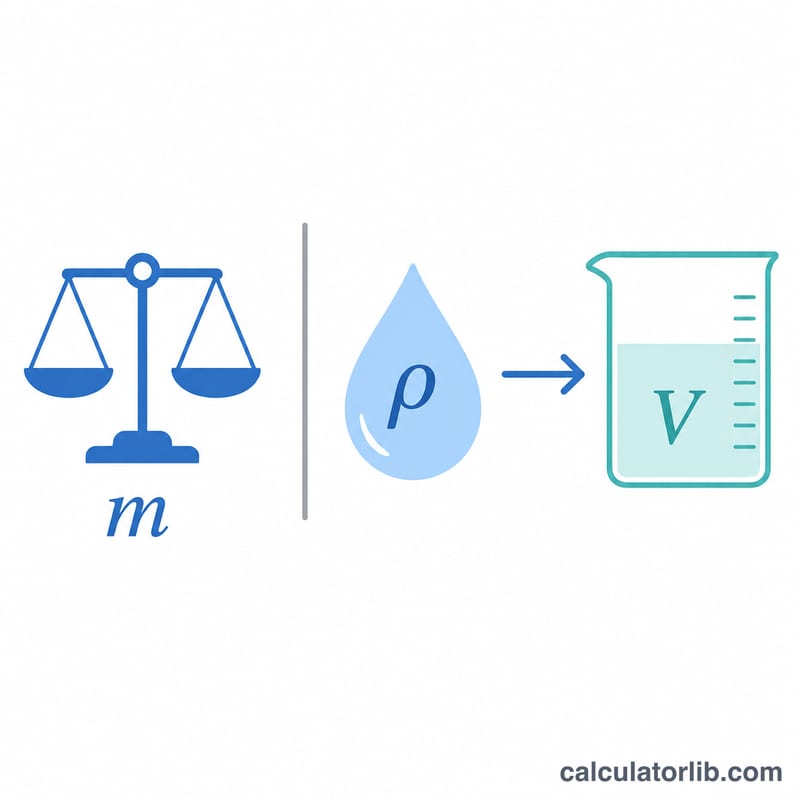
Grams (g) measure mass, while milliliters (mL) measure volume. You cannot convert directly between them without knowing the density of the substance, because the same mass occupies a different volume depending on how dense the material is. This calculator does the conversion for you using the simple relationship between mass, volume, and density.
How to Use It
Enter the mass in grams and the density of your substance in grams per milliliter (g/mL). The calculator returns the equivalent volume in milliliters. Pure water has a density of about 1 g/mL, so 100 g of water equals 100 mL. Other substances differ: cooking oil is roughly 0.92 g/mL, milk about 1.03 g/mL, and honey around 1.42 g/mL.
The Formula Explained
The conversion uses the rearranged density equation. Since density \(\rho = \text{mass} \div \text{volume}\), solving for volume gives:
$$\text{Volume (mL)} = \frac{\text{Mass (g)}}{\text{Density (g/mL)}}$$
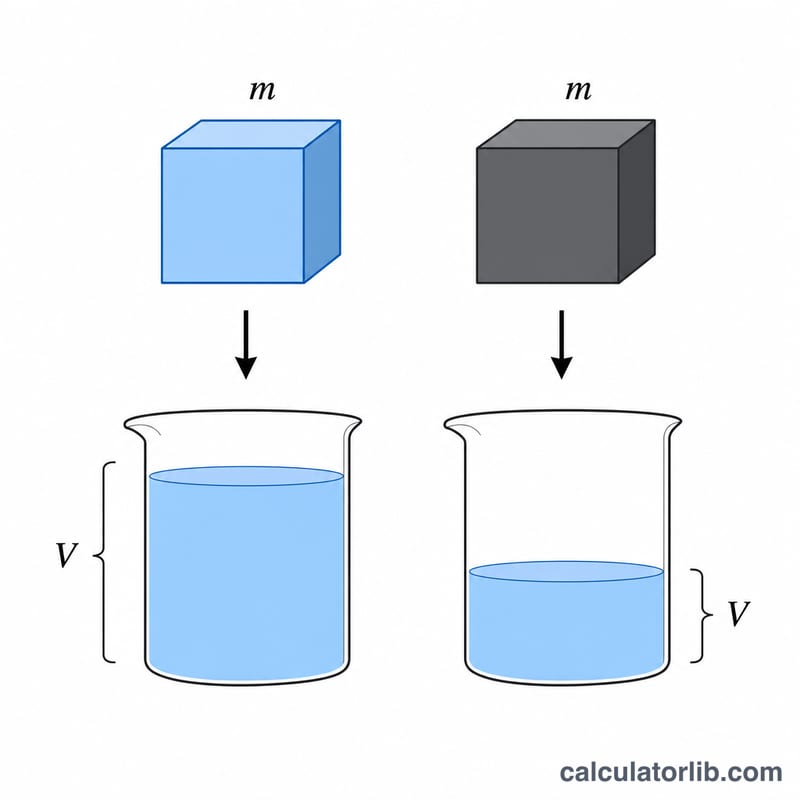
Higher density means less volume for the same mass, while lower density means more volume.
Worked Example
Suppose you have 200 grams of vegetable oil with a density of 0.92 g/mL. The volume is:
$$V = \frac{200}{0.92} = 217.39 \text{ mL}$$
So 200 g of this oil fills about 217 milliliters.
FAQ
Are grams and milliliters always equal? Only when density equals 1 g/mL, as with pure water at 4°C. For everything else you must divide by the actual density.
Where do I find density values? Check the product label, a reference table, or measure it yourself by dividing a known mass by its measured volume.
Can I use this for any substance? Yes, as long as you provide an accurate density in g/mL for that material at the relevant temperature.