
What is the mL to Grams Calculator?
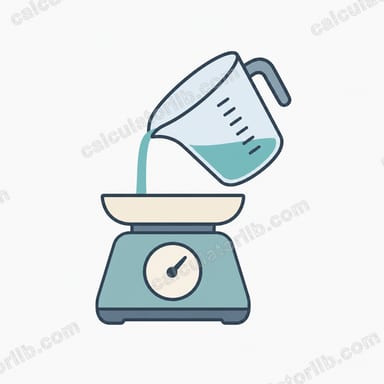
Milliliters (mL) measure volume while grams (g) measure mass, so you can't convert between them without knowing the substance's density. This calculator multiplies the volume you enter by the density (in grams per milliliter) to give the weight in grams. It's perfect for cooking, baking, chemistry homework and lab work where a recipe or method lists volume but your scale reads in grams.
How to use it
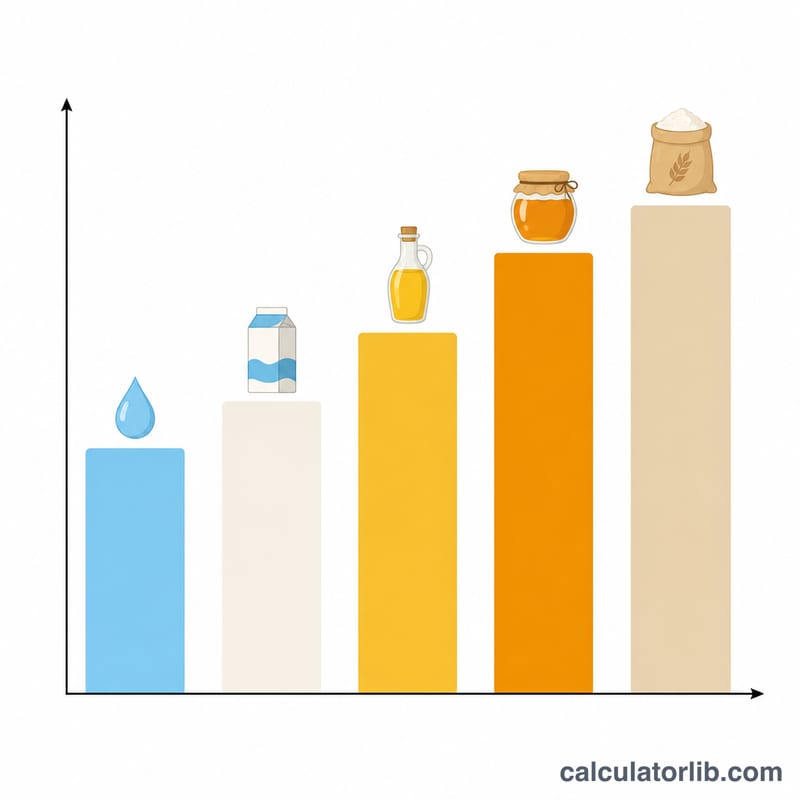
Enter the volume in milliliters, then type the density of your substance in g/mL or pick one from the preset list (water, milk, oil, honey, ethanol, flour, sugar). The result instantly shows the equivalent weight in grams, kilograms and ounces.
The formula explained
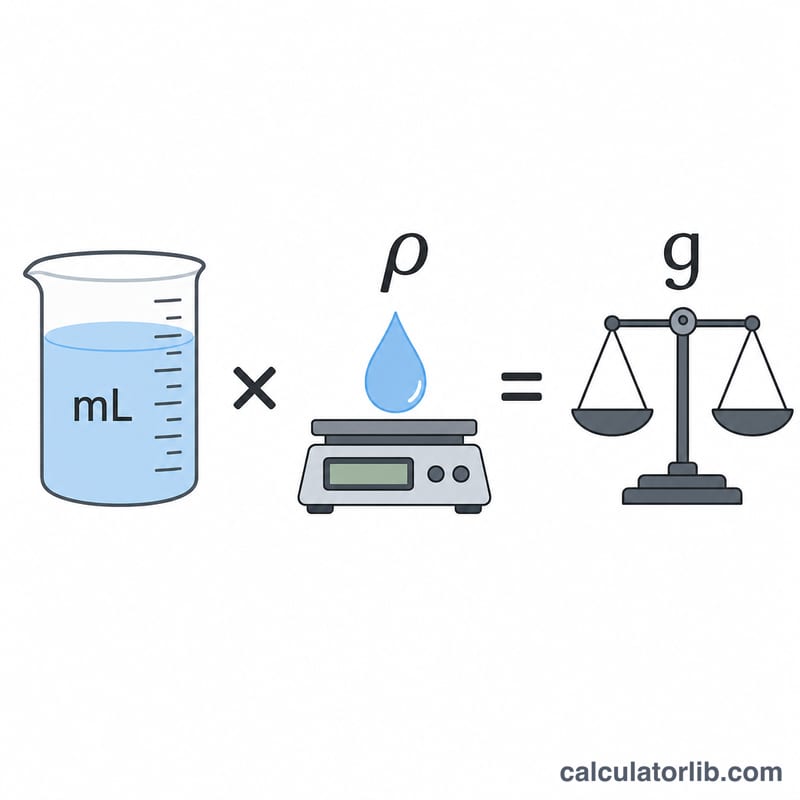
The conversion is simply:
$$\text{grams} = \text{mL} \times \text{density (g/mL)}$$
Pure water has a density of about \(1.00\) g/mL, which is why 100 mL of water weighs 100 g. Denser liquids like honey (\(\approx 1.42\) g/mL) weigh more per mL, while lighter ones like oil (\(\approx 0.92\) g/mL) weigh less.
Worked example
Suppose you have 250 mL of milk with a density of 1.03 g/mL. The weight is $$250 \times 1.03 = 257.5 \text{ g}$$ (about 0.2575 kg or 9.08 oz).
FAQ
Is 1 mL always 1 gram? Only for substances with a density of exactly 1 g/mL, such as pure water at 4°C. Other materials differ.
Where do I find the density? Check a reference table or the product label. The presets above cover common kitchen ingredients.
Does temperature matter? Yes, density changes slightly with temperature, but for everyday cooking the listed values are accurate enough.