
What this calculator does
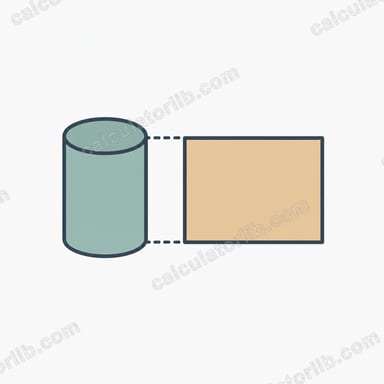
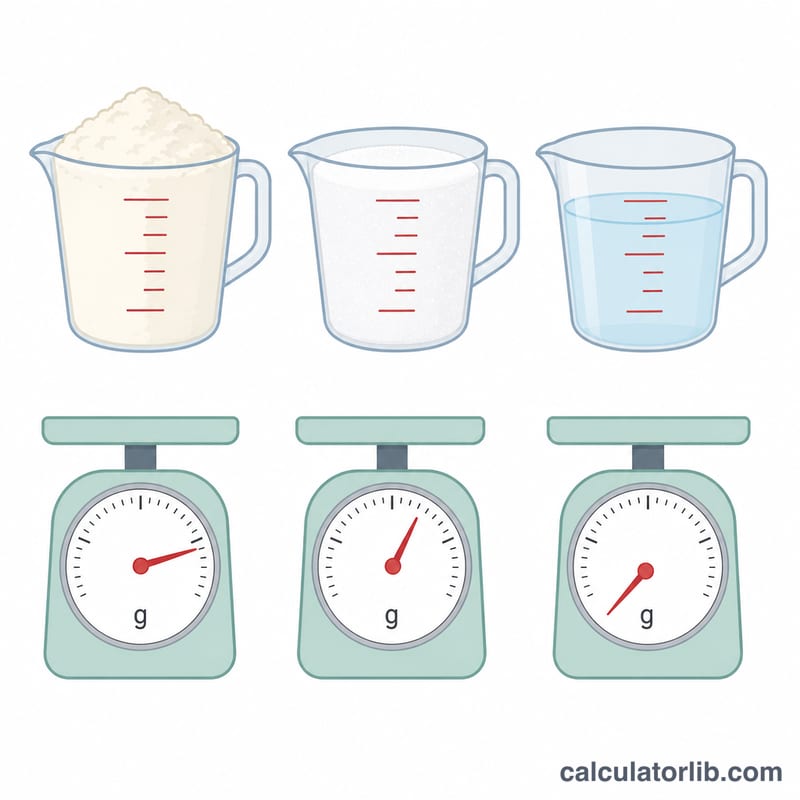
The Cups to Grams Calculator converts a volume measured in US cups into a weight in grams. Because a cup is a measure of volume and grams measure mass, the conversion depends entirely on the ingredient's density. A cup of flour weighs far less than a cup of honey, so this tool lets you select common baking ingredients or enter your own density in grams per milliliter.
How to use it
Enter the number of cups, choose your ingredient from the list, and read off the weight in grams. If your ingredient is not listed, choose "Custom density" and type its density (g/mL). The result also shows the equivalent in ounces and the raw volume in milliliters.
The formula explained
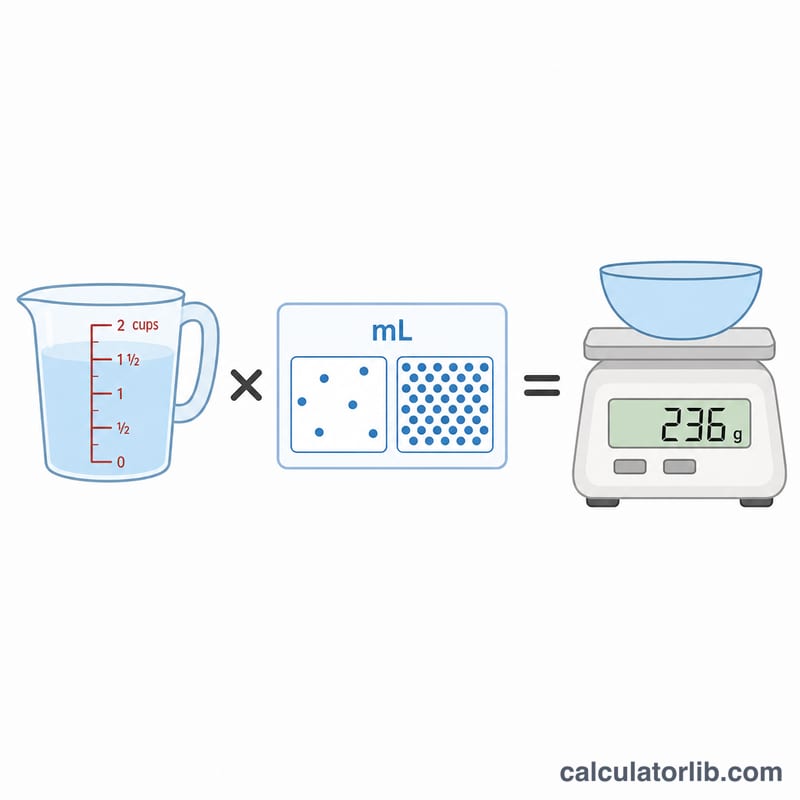
The calculation is $$\text{Grams} = \text{Cups} \times 236.588 \times \text{Density}$$ The constant \(236.588\) is the number of milliliters in one US customary cup. Multiplying cups by this constant gives the volume in mL, and multiplying that by the density (g/mL) converts volume to mass in grams.
Worked example
Suppose you need 2 cups of all-purpose flour. Flour has a density of about \(0.529\) g/mL. Volume $$= 2 \times 236.588 = 473.176 \text{ mL}.$$ Weight $$= 473.176 \times 0.529 \approx 250.3 \text{ grams}.$$ So 2 cups of flour is roughly 250 g.
FAQ
Why isn't 1 cup always the same grams? Different ingredients pack differently. A cup of water is 236.6 g, but a cup of flour is only about 125 g because flour is much less dense.
Is this US or metric cups? This tool uses the US customary cup of 236.588 mL. A metric cup is 250 mL and a UK imperial cup is about 284 mL.
How accurate is it for baking? Density values are typical averages; sifted vs. packed flour and humidity can vary results by 5–10%. For precision baking, a kitchen scale is best.