
What Is the Dilution Volume Calculator?
This calculator solves the classic dilution equation \(C_1 V_1 = C_2 V_2\) for the volume of stock (concentrated) solution you need to prepare a target dilution. It works with any consistent set of units — molarity (M), percent, mg/mL, ppm — as long as both concentrations share the same unit and both volumes share the same unit. The tool is universal and not tied to any country or standard.
How to Use It
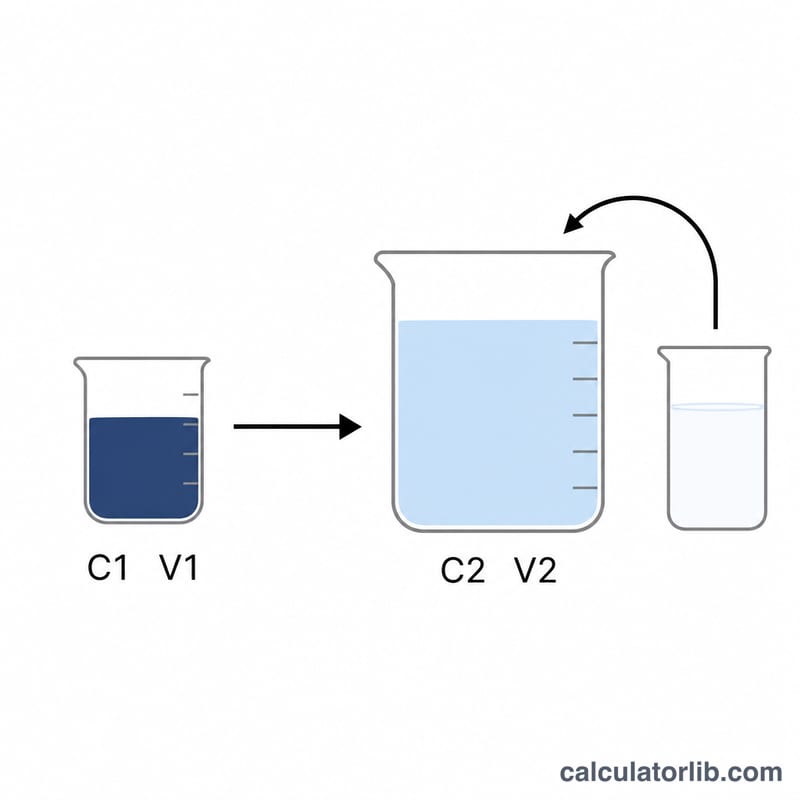
Enter three values: the stock concentration (C1) of your concentrated source, the final concentration (C2) you want, and the final volume (V2) you want to end up with. The calculator returns V1, the volume of stock you must measure out, plus the amount of solvent (e.g. water or buffer) to add so the totals reach V2.
The Formula Explained
The dilution principle states that the moles of solute stay constant when you add solvent: concentration times volume before equals concentration times volume after, so \(C_1 \cdot V_1 = C_2 \cdot V_2\). Solving for the unknown stock volume gives $$V_1 = \frac{\text{C2} \times \text{V2}}{\text{C1}}$$ The solvent you add is simply $$\text{Solvent} = \text{V2} - V_1$$
Worked Example
Suppose you have a 10 M stock and need 100 mL of a 1 M solution. Then $$V_1 = \frac{1 \times 100}{10} = 10 \text{ mL}$$ of stock. Add \(100 - 10 = 90\) mL of solvent to reach the final 100 mL volume.
FAQ
What units should I use? Any units work, but keep C1 and C2 in the same unit and V1, V2 in the same unit. The result V1 comes out in the same unit as V2.
Why must C1 be larger than C2? Dilution only reduces concentration. If C1 is smaller than C2 you cannot dilute up — you would need a more concentrated stock.
What is the solvent value? It is \(\text{V2} - V_1\), the volume of diluent (water, buffer, etc.) to add to your measured stock to reach the final volume.