What is radiometric dating?
Radiometric dating estimates how old a rock, mineral or fossil is by measuring how much of a radioactive parent isotope has decayed into its stable daughter isotope. Because the half-life of each isotope is constant, the parent/daughter ratio acts as a natural clock. Common systems include carbon-14 (half-life about 5,730 years), potassium-40 to argon-40 (about 1.25 billion years) and uranium-238 to lead-206 (about 4.47 billion years).
How to use this calculator
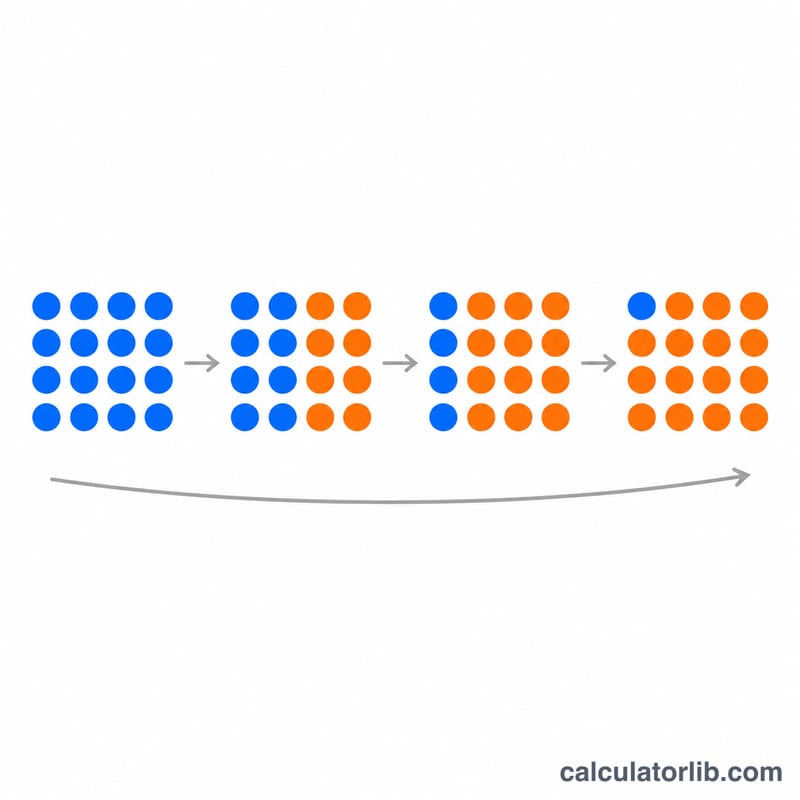
Enter the amount of parent isotope still present and the amount of daughter isotope measured, both in the same unit (atoms, moles or mass-equivalent). Enter the half-life and choose its unit. If the sample started with some daughter isotope, enter that in the optional field and it will be subtracted. The calculator returns the age in years, in the half-life unit, the number of half-lives elapsed and the fraction of parent remaining.
The formula explained
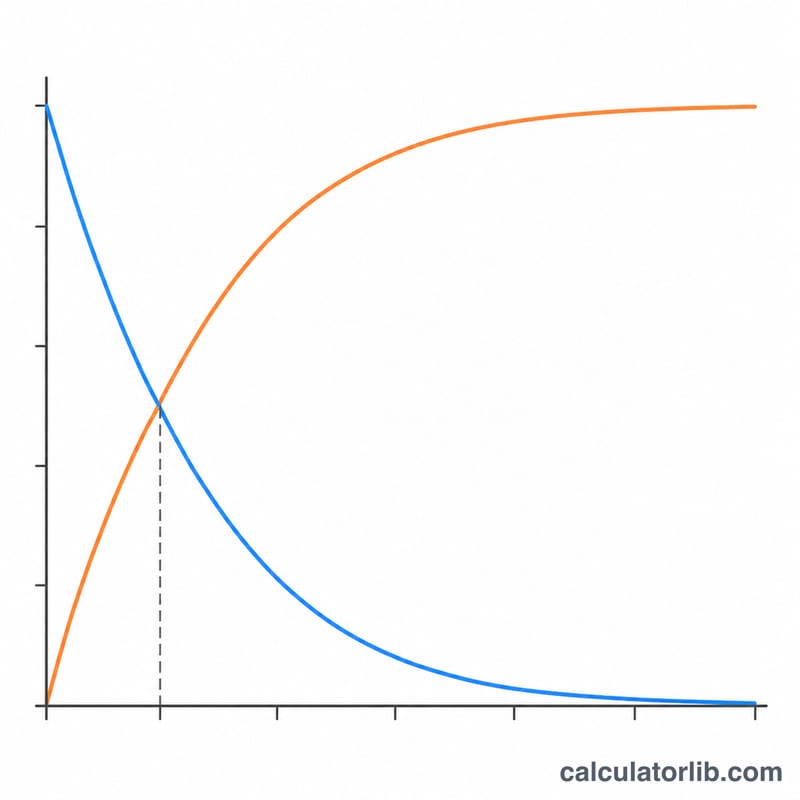
Decay follows \(P = P_0 e^{-\lambda t}\) with decay constant \(\lambda = \ln 2 / T_{1/2}\). Since every decayed parent atom becomes one daughter atom, \(P_0 = P + D\), and solving for time gives:
$$t = \frac{T_{1/2}}{\ln 2} \ln\left(1 + \frac{D}{P}\right)$$Here \(t\) is age, \(T_{1/2}\) is half-life, \(P\) is parent remaining and \(D\) is radiogenic daughter.
Worked example
A rock contains 1 part potassium-40 for every 3 parts of its decay product (ignoring the branching ratio for simplicity), with \(T_{1/2} = 1.25\) billion years.
$$t = \frac{1.25}{\ln 2} \ln(1 + 3) = \frac{1.25 \times 1.3863}{0.6931} = 2.5\ \text{billion years}$$This equals two half-lives, and only \(1/4\) of the parent remains.
Common Radiometric Isotope Systems and Half-Lives
Each system pairs a radioactive parent isotope with a stable daughter isotope. A system is only useful when its half-life is comparable to the age of the sample. Values below are rounded, widely cited figures.
| Parent isotope | Daughter isotope | Half-life (years) | Typical dating range / materials |
|---|---|---|---|
| Carbon-14 (¹⁴C) | Nitrogen-14 (¹⁴N) | 5,730 | Up to about 50,000 years; organic material such as wood, bone, charcoal and shell |
| Potassium-40 (⁴⁰K) | Argon-40 (⁴⁰Ar) | 1.25 billion | Volcanic rocks and potassium-bearing minerals (e.g. micas, feldspars) |
| Uranium-238 (²³⁸U) | Lead-206 (²⁰⁶Pb) | 4.47 billion | Zircon and other uranium-bearing minerals; very old rocks |
| Uranium-235 (²³⁵U) | Lead-207 (²⁰⁷Pb) | 704 million | Zircon and other uranium-bearing minerals, often paired with U-238 |
| Rubidium-87 (⁸⁷Rb) | Strontium-87 (⁸⁷Sr) | about 49 billion | Very old igneous and metamorphic rocks, meteorites |
| Samarium-147 (¹⁴⁷Sm) | Neodymium-143 (¹⁴³Nd) | about 106 billion | Very old rocks and meteorites |
Note on K-40: only about 10.7% of potassium-40 decays to argon-40 (most of the rest becomes calcium-40). The simple equation used by this calculator assumes every decayed parent atom becomes the measured daughter. For K-Ar dating you must therefore use the branching-corrected form of the equation or adjust your inputs accordingly. The ¹⁴C age is also usually calibrated against known atmospheric records, so a raw decay age can differ from a calendar age.
Age by Parent Fraction Remaining
For a closed system with no initial daughter, the fraction of parent left after n half-lives is \(2^{-n}\), and the daughter-to-parent ratio is \(D/P = 2^{n} - 1\). The age is \(t = n \cdot T_{1/2}\). The table compares carbon-14 (T½ = 5,730 years) with uranium-238 (T½ = 4.47 billion years).
| Half-lives (n) | Parent remaining | D/P ratio | Age, carbon-14 (years) | Age, uranium-238 (years) |
|---|---|---|---|---|
| 0.5 | 70.7% | 0.414 | 2,865 | 2.235 billion |
| 1 | 50% | 1 | 5,730 | 4.47 billion |
| 2 | 25% | 3 | 11,460 | 8.94 billion |
| 3 | 12.5% | 7 | 17,190 | 13.41 billion |
| 5 | 3.125% | 31 | 28,650 | 22.35 billion |
| 10 | about 0.098% | 1023 | 57,300 | 44.7 billion |
Example check for n = 3: \(t = \dfrac{\ln(1 + 7)}{\ln 2} \times 5{,}730 = 3 \times 5{,}730 = 17{,}190\) years.
Practical limits: after about 10 half-lives so little carbon-14 remains that measurement becomes impractical, so the 57,300-year carbon-14 entry is theoretical. Likewise, the larger uranium-238 ages exceed the age of the Earth (about 4.54 billion years) and are shown only to illustrate the scaling.
FAQ
Does it work for any isotope?
Yes, if you know the half-life and the system stayed closed, meaning no parent or daughter atoms entered or left the sample.
What if the sample began with daughter isotope?
Enter the initial daughter amount; for isochron-style work this is estimated separately. Otherwise the age is overestimated.
Why is carbon-14 limited to about 50,000 years?
After roughly nine half-lives too little carbon-14 remains to measure reliably, so other isotope systems are used for older samples.