What this calculator does
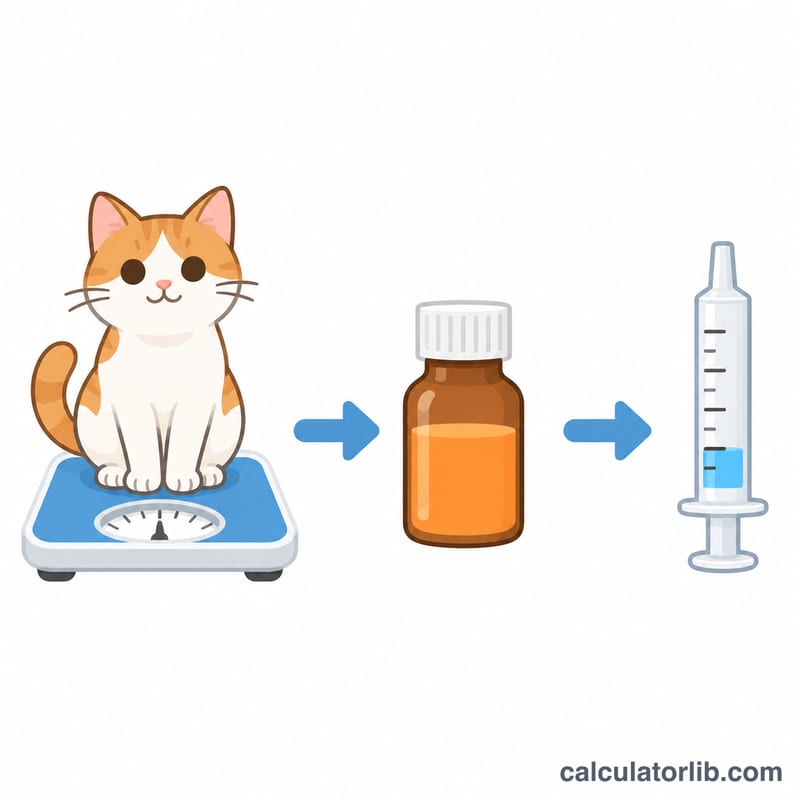
Many liquid medications for cats are prescribed as a dose per kilogram of body weight, but are dispensed as a suspension or solution with a stated strength in mg per mL. This calculator converts between the two: it works out how many milligrams your cat needs and how many millilitres to draw into the syringe. It is a arithmetic aid only and does not replace your veterinarian.
How to use it
Enter your cat weight in kilograms or pounds, the prescribed dose in mg per kg, the concentration printed on the bottle in mg per mL, and the number of doses per day. The tool shows the volume per dose, the dose in mg, and the total daily drug and volume.
The formula explained
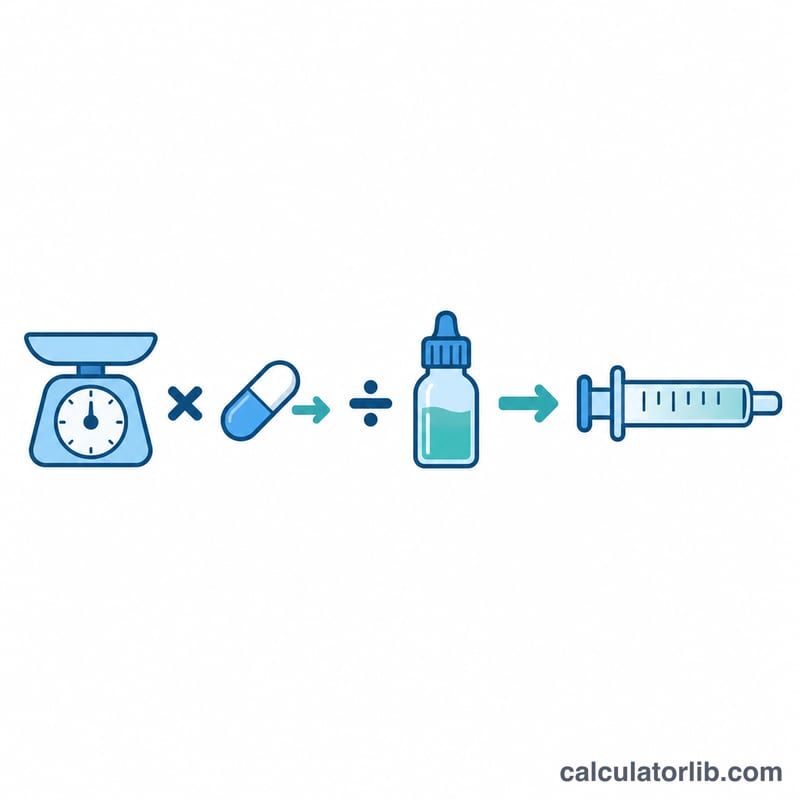
First the weight is converted to kilograms if needed (\(1\,\text{lb} = 0.45359237\,\text{kg}\)). Then the dose in mg is found, and finally the volume:
$$\text{Dose (mg)} = W_{kg} \times D \qquad \text{Volume (mL)} = \frac{\text{Dose (mg)}}{C}$$Here \(W_{kg}\) is the weight in kg, \(D\) is the dose in mg per kg and \(C\) is the concentration in mg per mL.
Worked example
A 4 kg cat is prescribed 5 mg/kg twice daily, and the liquid contains 50 mg/mL.
$$\text{Dose} = 4 \times 5 = 20\,\text{mg}$$$$\text{Volume} = \frac{20}{50} = 0.4\,\text{mL per dose}$$$$\text{Daily volume} = 0.4 \times 2 = 0.8\,\text{mL}$$Concentration and Unit Conversions for Liquid Medications
Dose calculations only work when weight, dose and concentration are in compatible units. Dosing is based on kilograms, so a cat weighed in pounds must be converted first, using 1 lb = 0.45359237 kg (and 1 kg ≈ 2.20462 lb).
Weight: pounds to kilograms
| Cat weight (lb) | Cat weight (kg, rounded to 3 decimals) |
|---|---|
| 5 | 2.268 |
| 6 | 2.722 |
| 7 | 3.175 |
| 8 | 3.629 |
| 9 | 4.082 |
| 10 | 4.536 |
| 12 | 5.443 |
| 14 | 6.350 |
| 16 | 7.257 |
| 17 | 7.711 |
Concentration
| Expression | Equivalent |
|---|---|
| 1% w/v | 10 mg/mL (1 g per 100 mL) |
| 5% w/v | 50 mg/mL |
| 0.1% w/v | 1 mg/mL |
| 1 mg/mL | 1000 mcg/mL (µg/mL) |
Volume
| Unit | Equivalent |
|---|---|
| 1 mL | 1 cc (cubic centimetre) |
| 5 mL | about 1 teaspoon (approximate; a US teaspoon is about 4.93 mL) |
Do not convert mL to drops. A figure such as "1 mL = 20 drops" is not reliable, because drop size varies with the dropper, the liquid’s thickness and the angle held. Household spoons also vary. Use an oral syringe marked in mL for accurate measuring.
Example Volumes Across Different Cat Weights and Concentrations
The table below uses an illustrative dose of 5 mg/kg given 2 times daily. Every value is weight × dose ÷ concentration; daily volume is the per-dose volume × 2. It is an arithmetic illustration only, not a recommended dose for any drug.
| Cat weight | Dose (mg per dose) | Concentration | Volume per dose | Volume per day (2 doses) |
|---|---|---|---|---|
| 2 kg | 10 mg | 25 mg/mL | 0.4 mL | 0.8 mL |
| 2 kg | 10 mg | 50 mg/mL | 0.2 mL | 0.4 mL |
| 2 kg | 10 mg | 100 mg/mL | 0.1 mL | 0.2 mL |
| 4 kg | 20 mg | 25 mg/mL | 0.8 mL | 1.6 mL |
| 4 kg | 20 mg | 50 mg/mL | 0.4 mL | 0.8 mL |
| 4 kg | 20 mg | 100 mg/mL | 0.2 mL | 0.4 mL |
| 6 kg | 30 mg | 25 mg/mL | 1.2 mL | 2.4 mL |
| 6 kg | 30 mg | 50 mg/mL | 0.6 mL | 1.2 mL |
| 6 kg | 30 mg | 100 mg/mL | 0.3 mL | 0.6 mL |
Example: a 4 kg cat at 5 mg/kg needs 4 × 5 = 20 mg per dose. With a 50 mg/mL liquid, the volume is 20 ÷ 50 = 0.4 mL per dose, or 0.8 mL per day over 2 doses.
The same dose in mg needs a smaller volume as the concentration rises. A small error in a very small volume, such as 0.1 mL, is a large percentage of the dose, so a 1 mL syringe is preferable for volumes under 1 mL. Always follow your veterinarian’s prescription and the pharmacy label. This is general information, not veterinary advice.
Key Terms: mg/kg, mg/mL, Suspension and Dose Frequency
- mg/kg
- The dose expressed as milligrams of drug per kilogram of body weight. Multiplying by the cat’s weight in kg gives the dose in mg.
- mg/mL
- The concentration or strength of a liquid: how many milligrams of drug are in each millilitre. Dividing the dose in mg by this value gives the volume to draw up.
- Solution vs suspension
- In a solution the drug is fully dissolved and the liquid is uniform. In a suspension, solid drug particles are dispersed in the liquid and can settle, so the bottle must be shaken well before each dose to give an even concentration.
- Per-dose vs daily dose
- The per-dose amount is what is given at one time. The daily amount is the per-dose amount multiplied by the number of doses per day. Make sure a prescribed mg/kg figure is not confused with a per-day total.
- Frequency abbreviations
- SID or q24h = once every 24 hours (once daily). BID or q12h = twice daily, about every 12 hours. TID or q8h = three times daily, about every 8 hours. Check the label, since abbreviations vary between clinics.
- Oral syringe mL marking
- The graduation lines on an oral syringe show volume in mL (1 mL = 1 cc). Read the volume at the edge of the plunger tip closest to the tip of the syringe, not the cone-shaped end, and choose a syringe size close to the volume you need for better accuracy.
This is general information, not professional advice. Never give a cat a medication made for people or dogs unless your veterinarian directs it, as some are toxic to cats.
FAQ
Can I use this for any cat medication?
It performs the math for any drug dosed in mg/kg, but safe dose ranges vary widely and some human drugs are toxic to cats. Use only the dose your vet prescribed.
What if my pet label shows mg per tablet?
This tool is for liquids measured in mg per mL. For tablets, divide the dose in mg by the tablet strength.
Should I round the volume?
Measure with an oral syringe marked in 0.1 mL or finer and ask your vet how to round very small volumes.