What this calculator does
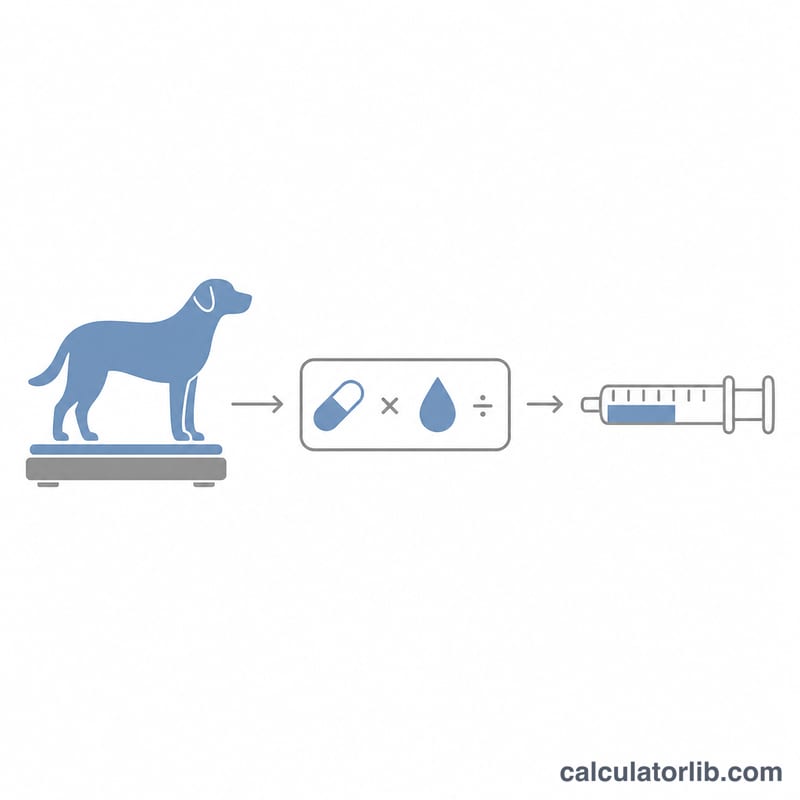
Veterinary medicines are prescribed by body weight, usually as milligrams of active drug per kilogram of dog (mg/kg). The bottle or blister pack, however, is labelled in milligrams per millilitre or milligrams per tablet. This calculator bridges the two: you enter your dog weight, the dose rate your veterinarian gave you, the strength printed on the label and how many doses per day, and it returns the exact volume or number of tablets per dose plus the daily totals. It is a unit-conversion aid, not a prescribing tool, and it applies to any country because milligrams and kilograms are universal.
The formula explained
With \(W\) = body weight in kilograms, \(D\) = prescribed dose rate in mg/kg, \(S\) = product strength (mg per mL or mg per tablet) and \(n\) = doses per day:
$$M = W \times D \qquad V = \frac{M}{S} \qquad M_{\text{day}} = M \times n$$If you enter pounds, the weight is converted first with \(W = \text{lb} \times 0.45359237\).
Worked example
A 20 kg Labrador is prescribed 5 mg/kg twice daily of a suspension containing 50 mg/mL.
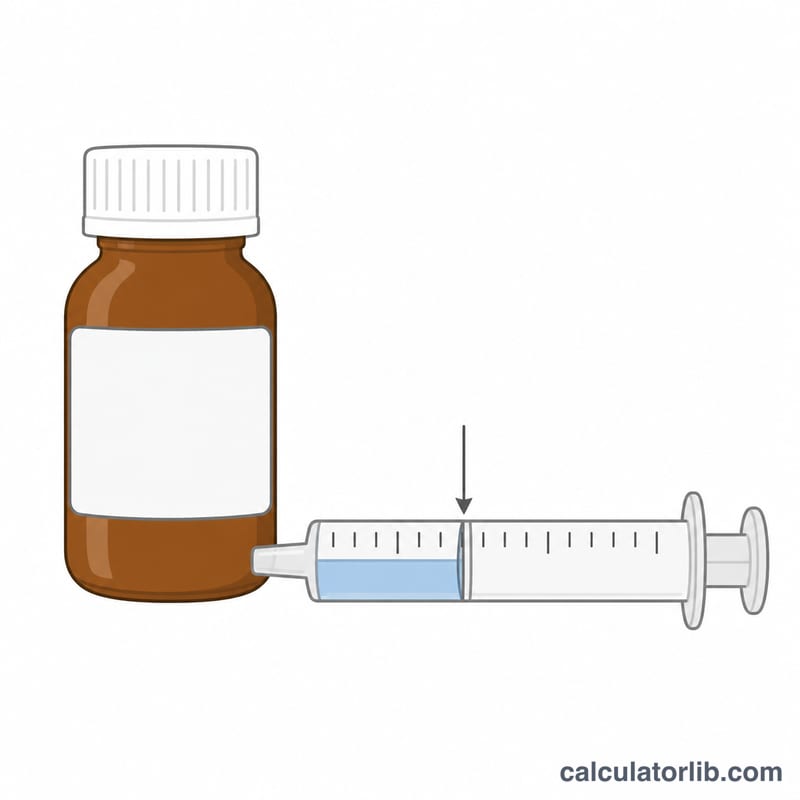
$$M = 20 \times 5 = 100\,\text{mg}$$$$V = \frac{100}{50} = 2\,\text{mL per dose}$$Over a day that is \(100 \times 2 = 200\) mg, or 4 mL total. Draw the 2 mL into an oral syringe rather than a kitchen spoon, which can be off by 30 percent or more.
Weight and Concentration Conversion Table
Dog medication doses are almost always prescribed in milligrams per kilogram of body weight (mg/kg), but many owners weigh their dog in pounds and most liquid products are labelled by concentration. The two tables below cover both conversions. The pound-to-kilogram figures use the exact international factor 1 lb = 0.45359237 kg, rounded to 0.1 kg.
| Weight (lb) | Weight (kg) |
|---|---|
| 5 | 2.3 |
| 10 | 4.5 |
| 15 | 6.8 |
| 20 | 9.1 |
| 30 | 13.6 |
| 40 | 18.1 |
| 50 | 22.7 |
| 60 | 27.2 |
| 80 | 36.3 |
| 100 | 45.4 |
The conversion itself is simply \( W_{\text{kg}} = W_{\text{lb}} \times 0.45359237 \). For example, a 40 lb dog weighs \( 40 \times 0.45359237 = 18.14 \) kg, which rounds to 18.1 kg.
| Label strength (% w/v) | Concentration (mg/mL) |
|---|---|
| 0.5% | 5 mg/mL |
| 1% | 10 mg/mL |
| 2% | 20 mg/mL |
| 5% | 50 mg/mL |
| 10% | 100 mg/mL |
A percentage strength written as % w/v means grams of drug per 100 mL of product, so 1% = 1 g per 100 mL = 1000 mg per 100 mL = 10 mg/mL. The general rule is \( \text{mg/mL} = \% \times 10 \).
Other units you will meet on labels and syringes:
- 1 g = 1000 mg, and 1 mg = 0.001 g. A tablet marked 0.5 g contains 500 mg.
- 1 mcg (microgram, µg) = 0.001 mg, so 1 mg = 1000 mcg. Some small-dog and cardiac medications are dosed in mcg — check which unit the label uses before dividing.
- 1 cc = 1 mL exactly. Syringes marked "cc" and syringes marked "mL" are the same scale; a 3 cc syringe is a 3 mL syringe.
- 1 US teaspoon ≈ 4.93 mL and is commonly rounded to 5 mL. Do not dose with kitchen spoons. Real household teaspoons vary from roughly 2.5 mL to 7 mL, which can mean giving double the intended dose. Use the oral syringe or dosing cup supplied with the medicine, or ask the pharmacy for one.
This tool is a unit-conversion aid only. The mg/kg dose rate, the product and the dosing interval must come from your veterinarian — this is general information, not veterinary advice.
Key Terms and Variables Explained
| Term | Unit | Meaning |
|---|---|---|
| Dose rate | mg/kg | Milligrams of active drug per kilogram of body weight, set by the veterinarian for that drug and condition. It is a rate, not an amount — it becomes an amount only after multiplying by weight. |
| Dose | mg | The milligrams of drug given at one administration: weight × dose rate. |
| Product strength / concentration | mg/mL or mg/tablet | How much drug is packed into each millilitre of liquid or each tablet. The same drug is often sold in several strengths, so the bottle in your hand — not a remembered figure — decides the volume. |
| Volume per dose | mL (or number of tablets) | The amount of product to measure out: dose in mg ÷ strength. |
| Doses per day (n) | count/day | How many administrations in 24 hours: once = 1, twice = 2, three times = 3. |
| Dosing interval | hours | The gap between doses. q12h = every 12 hours, q24h = every 24 hours, q8h = every 8 hours. SID = once daily, BID = twice daily, TID = three times daily, QID = four times daily. These are the abbreviations conventionally used on veterinary prescriptions in English-speaking countries; an interval (q12h) is stricter than a frequency (BID) because it also fixes the spacing. |
| Total daily dose | mg/day | Dose × doses per day. Used to check the 24-hour amount stays within the safe range — a per-dose figure alone can look fine while the daily total is too high. |
| Solution | — | Drug fully dissolved in the liquid; it stays evenly mixed and looks clear. |
| Suspension | — | Drug particles suspended in liquid, which settle out on standing. A suspension must be shaken well before every dose, or the early doses are too weak and the last doses too strong. |
| Oral syringe / dosing cup | mL | The graduated device supplied for measuring liquid medicine. Choose the smallest syringe the dose fits so the graduation marks are fine enough to read. |
| Kitchen spoon | — | Not a measuring device. Household spoons vary widely in capacity and should never be used for medication. |
| Scored tablet | — | A tablet with a moulded groove intended to be split. Even scored tablets split unevenly, so halves are approximate; unscored tablets should not be split at all without veterinary direction. |
| Extended-release / enteric-coated | — | Formulations designed to release drug slowly or past the stomach. Splitting, crushing or opening them destroys that control and can release a whole day's drug at once. Never divide them to reach a calculated fraction — ask for a different strength or formulation. |
| Current body weight | kg | What the dog weighs today. The default basis for most dose calculations. |
| Lean body weight | kg | Body weight excluding excess fat. Some drugs — particularly certain sedatives and chemotherapy agents — are dosed on lean weight in obese patients, because fat tissue takes up little of the drug. Only the veterinarian should decide which weight applies. |
| mg vs mL | — | The most important distinction here: mg measures the drug, mL measures the liquid carrying it. "Give 2 mL" is meaningless without the concentration — 2 mL of a 10 mg/mL suspension is 20 mg, while 2 mL of a 100 mg/mL suspension is 200 mg, a tenfold difference. |
These definitions are general educational information about dosage arithmetic, not veterinary advice. Terminology, abbreviations and available product strengths differ between countries and manufacturers. Always follow the dose, strength and interval on your own veterinarian's prescription, and contact them or an animal poison control service immediately if you suspect an overdose.
FAQ
My result is 1.317 tablets. What do I do? Never round on your own. Ask your veterinarian whether the tablet is scored and safe to split, or whether a different strength should be dispensed. Many coated and extended-release tablets must not be broken.
Should I use current weight or ideal weight? Most dose rates use current body weight, but for obese dogs and for some drugs with a narrow safety margin the veterinarian may specify lean body weight. Follow the prescription.
Can I use this for cats or humans? The arithmetic is identical, but dose rates and drug safety differ enormously between species. Many drugs that are routine for dogs are toxic to cats, so use species-specific advice.