What this calculator does
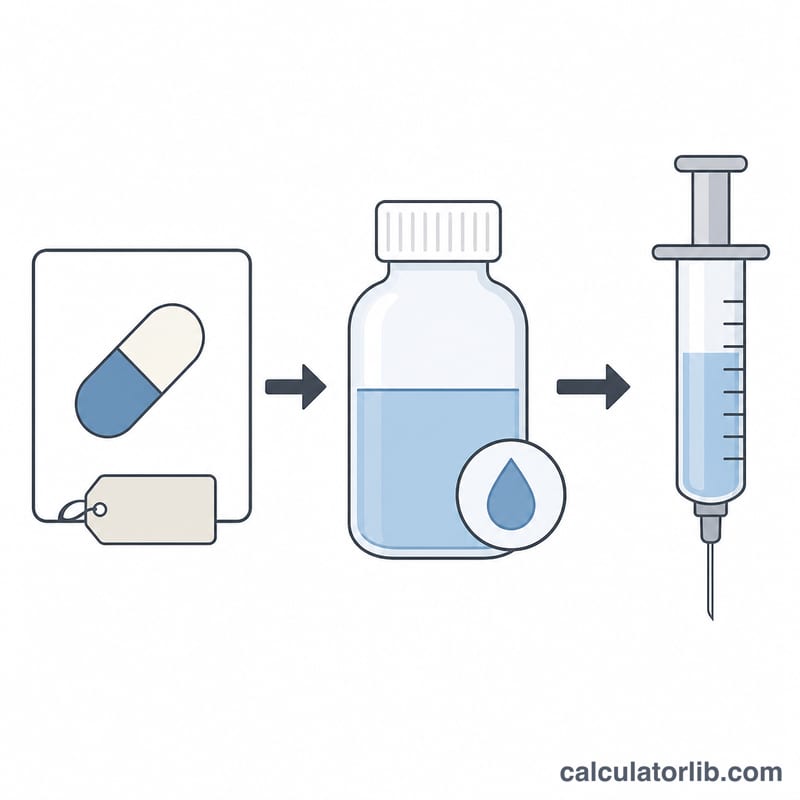
The Dog Drug Dosage Calculator converts a veterinary dosing instruction into a concrete, ready-to-give amount. Most canine medications are prescribed as a rate in milligrams per kilogram of body weight (mg/kg). This tool multiplies that rate by your dog's weight to give the total dose in milligrams, and, if you enter the drug concentration, it also tells you how many milliliters of liquid to draw up.
The formula explained
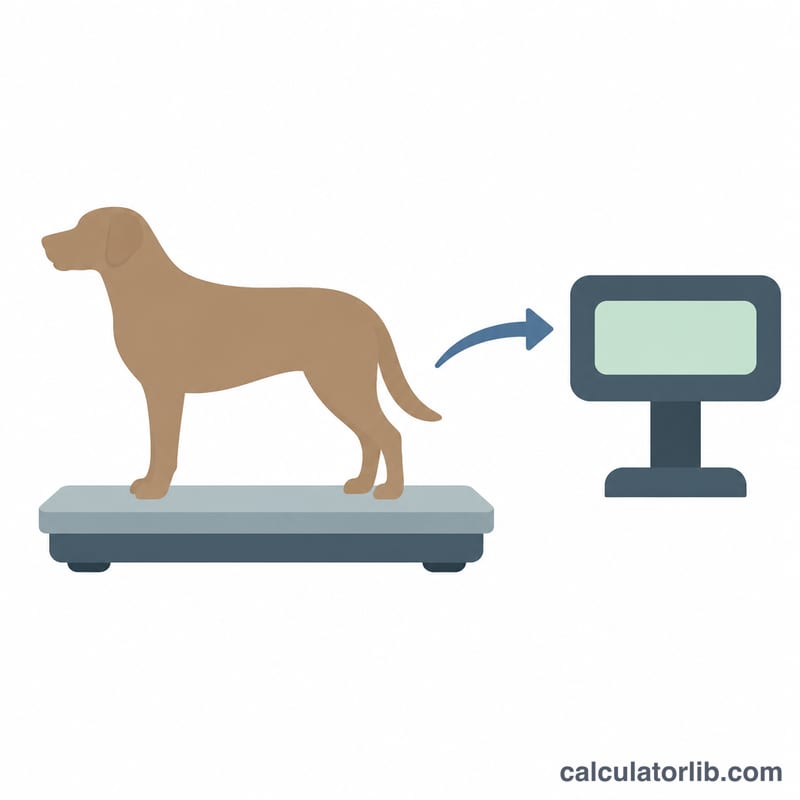
The core relationship is a simple multiplication. Let \(W\) = body weight in kg and \(R\) = dosing rate in mg/kg. The total dose \(D\) in mg is:
$$D = W \times R$$If the medication is a liquid with concentration \(C\) in mg/mL, the volume \(V\) to administer is:
$$V = \frac{D}{C}$$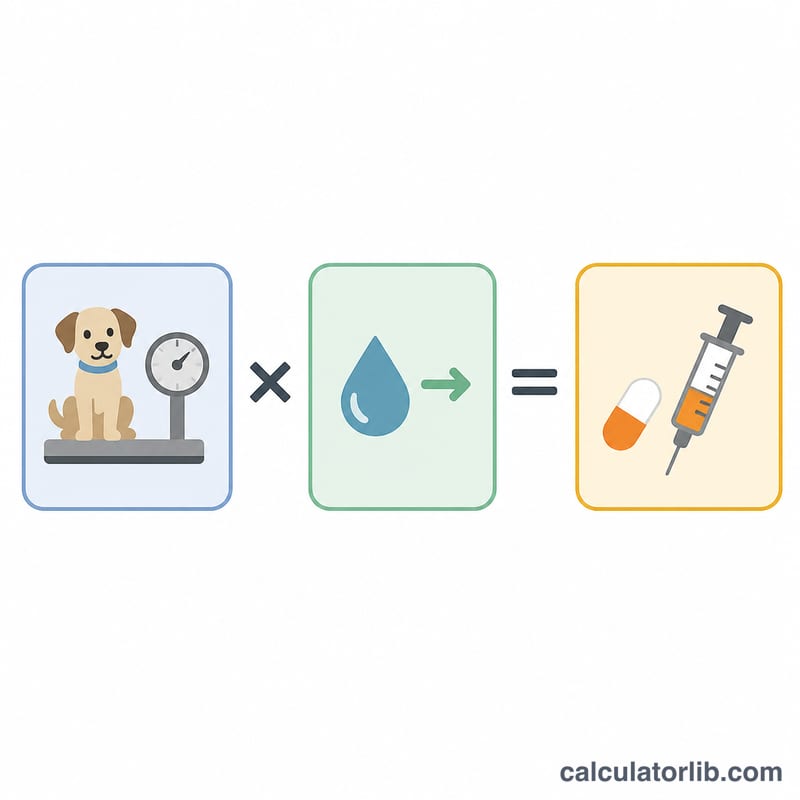
How to use it
Enter your dog's weight in kilograms and the dosing rate from the label or your veterinarian. If you have a liquid or injectable, add the concentration in mg/mL to get the exact volume. Leave concentration blank or zero if you only need the milligram amount, for example when using tablets.
Worked example
A \(10\,\text{kg}\) dog is prescribed a drug at \(5\,\text{mg/kg}\), supplied at \(50\,\text{mg/mL}\):
$$D = 10 \times 5 = 50\,\text{mg}$$$$V = \frac{50}{50} = 1\,\text{mL}$$So you would give a 50 mg dose, which equals 1 mL of the liquid.
More Worked Examples
The dosing rates below are made-up example numbers chosen to show the arithmetic. They are not recommendations for any drug or dog. Always use the rate on the product label or the one your veterinarian prescribes.
Example 1: Dog weighed in pounds
A dog weighs 22 lb, and the example rate is 2 mg/kg. The calculator uses kilograms, so convert the weight first (1 kg = 2.2046 lb):
$$W = \frac{22\ \text{lb}}{2.2046\ \text{lb/kg}} = 9.979\ \text{kg} \approx 9.98\ \text{kg}$$Then multiply the weight by the dose rate:
$$D = W \times R = 9.98\ \text{kg} \times 2\ \text{mg/kg} = 19.96\ \text{mg}$$Total dose: 19.96 mg. If you skip the conversion and enter 22 as kilograms, the result is 44 mg, about 2.2 times too much.
Example 2: Tablets only (concentration left at 0)
A 15 kg dog, an example rate of 5 mg/kg, and no liquid concentration entered (0):
$$D = 15\ \text{kg} \times 5\ \text{mg/kg} = 75\ \text{mg}$$Total dose: 75 mg. No volume is calculated because there is no mg/mL value. To compare this with a tablet's fixed strength, divide the dose by the tablet's mg:
$$\frac{75\ \text{mg}}{50\ \text{mg/tablet}} = 1.5\ \text{tablets}$$With 50 mg tablets, that works out to one and a half tablets. Only split a tablet if it is scored and your veterinarian or pharmacist confirms it can be split. Some tablets, such as coated or extended-release ones, must not be split.
Example 3: Liquid with a fractional volume
A 7 kg dog, an example rate of 0.5 mg/kg, and a liquid containing 10 mg/mL:
$$D = 7\ \text{kg} \times 0.5\ \text{mg/kg} = 3.5\ \text{mg}$$$$V = \frac{D}{C} = \frac{3.5\ \text{mg}}{10\ \text{mg/mL}} = 0.35\ \text{mL}$$Volume to give: 0.35 mL. A 1 mL oral or tuberculin-style syringe marked in 0.01 mL steps can measure 0.35 mL directly. A 3 mL or 5 mL syringe marked in 0.1 mL steps cannot, because 0.35 falls between the 0.3 and 0.4 marks. Ask your veterinarian or pharmacist for a syringe that fits the volume.
Dog Weight Conversion: Pounds to Kilograms
The table divides each weight in pounds by 2.2046 (1 kg = 2.2046 lb) and rounds to 2 decimals. Use the kilogram value as the calculator's weight input.
$$\text{kg} = \frac{\text{lb}}{2.2046}$$| Weight (lb) | Weight (kg) |
|---|---|
| 5 | 2.27 |
| 10 | 4.54 |
| 15 | 6.80 |
| 20 | 9.07 |
| 25 | 11.34 |
| 30 | 13.61 |
| 40 | 18.14 |
| 50 | 22.68 |
| 60 | 27.22 |
| 70 | 31.75 |
| 80 | 36.29 |
| 100 | 45.36 |
Related units
- Mass: 1 g = 1000 mg. A label that says 0.05 g means 50 mg.
- Volume: 1 mL = 1 cc (cubic centimetre). Syringes may be marked in either unit.
- Liquid amount: concentration × volume = mass, so \(\text{mg/mL} \times \text{mL} = \text{mg}\). For example, 2 mL of a 25 mg/mL liquid contains 50 mg.
Interpreting Your Result
The total mg is one dose. The calculator multiplies weight by the rate you enter. If that rate is per dose (for example, "mg/kg every 12 hours"), the result is the amount for a single administration. A dog dosed twice a day gets that amount twice. The result is a daily total only if the rate you entered was a daily rate (for example, "mg/kg/day"). If you are giving divided doses, split that daily amount as the prescription directs.
The mL figure only applies to the concentration you entered. The volume is \(V = D / C\), so it changes whenever the concentration changes. The same drug can be sold in different strengths, such as different mg/mL suspensions or injectables, or a compounded product. For a 20 mg dose, 2 mL of a 10 mg/mL liquid gives the same amount of drug as 0.4 mL of a 50 mg/mL liquid. If you switch bottles, check the concentration on the new label and recalculate. Never reuse an old mL volume.
Tablets come in fixed strengths. If you use tablets, compare the total mg with the mg per tablet. The result rarely matches a whole tablet exactly. Your veterinarian decides whether to round to the nearest practical portion, which tablet strength to use, or whether a liquid would be better. Not every tablet can be split.
The calculator does not check the rate. Dosing rates depend on the drug, the condition, the species and often the individual dog. Age, kidney or liver function, other medications and breed sensitivities can all matter. The tool does not know which drug you mean and does not check whether a rate is safe or appropriate. It only does the multiplication and division. Some human medicines are toxic to dogs at any dose.
This is general information, not veterinary advice. Use the dosing rate, frequency and duration on the product label or prescribed by your veterinarian, and contact your veterinarian if the result looks different from what you expected.
FAQ
Can I use pounds instead of kilograms? No. Convert first by dividing pounds by 2.2046 to get kilograms, then enter that value.
What if I do not know the concentration? Leave it as zero. You will still get the total dose in milligrams, which is enough for tablets sold by mg strength.
Is this a substitute for veterinary advice? No. Always confirm the dose, frequency, and drug choice with your veterinarian before treating your dog.