What Is the Brewing Water Calculator?
The Brewing Water Calculator estimates how common brewing salts change the mineral content of your water. Starting from soft or reverse-osmosis water, brewers add gypsum, calcium chloride, epsom salt, table salt and baking soda to hit a target ion profile. This tool reports the resulting calcium, magnesium, sodium, sulfate, chloride and bicarbonate concentrations in parts per million (ppm) and the all-important sulfate-to-chloride ratio.
How to Use It
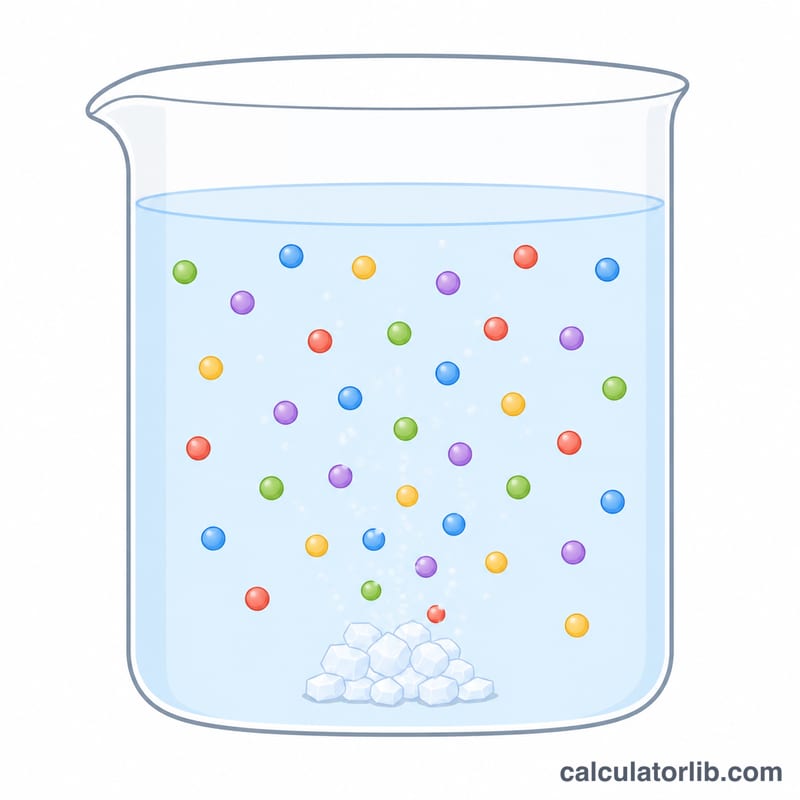
Enter your total water volume in liters, then the weight in grams of each salt you plan to add. Leave any salt at zero if you are not using it. The calculator sums each ion contribution across all salts and divides by the volume, so the numbers scale directly with batch size.
The Formula Explained
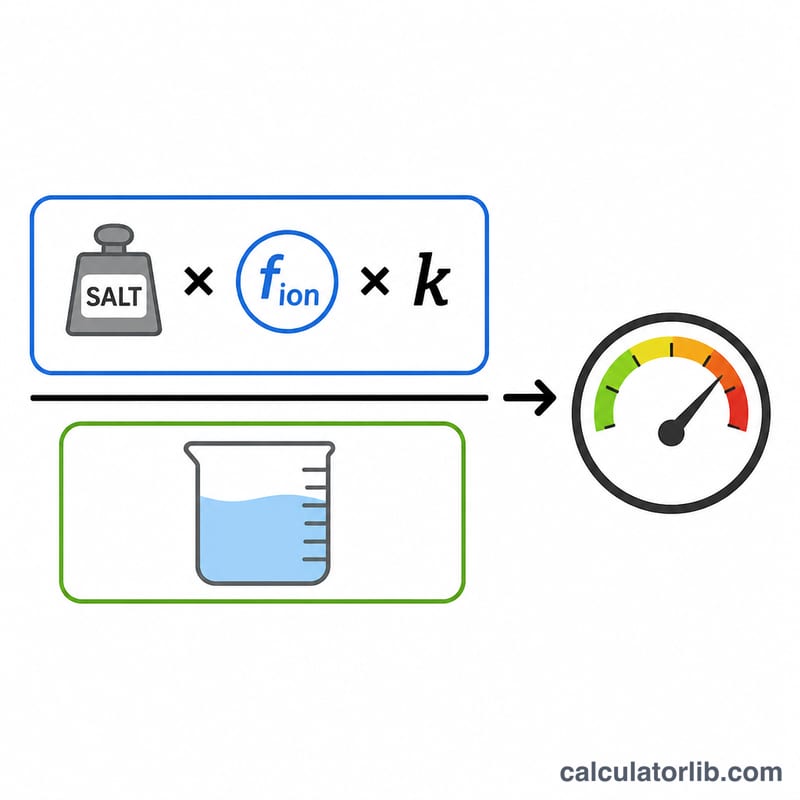
Each salt donates ions in fixed mass fractions. For a salt mass \(m_{\text{salt}}\) in grams dissolved in a volume \(V\) in liters, the concentration of a given ion is:
$$\text{ppm} = \frac{m_{\text{salt}} \times f_{\text{ion}} \times 1000}{V}$$Here \(f_{\text{ion}}\) is the ion mass fraction, for example \(0.2328\) for calcium from gypsum and \(0.5580\) for sulfate from gypsum. Contributions from every salt are added per ion.
Worked Example
Add 5 g of gypsum to 20 L of RO water. The calcium contribution is:
$$\text{Ca} = \frac{5 \times 0.2328 \times 1000}{20} = 58.2\ \text{ppm}$$The sulfate from the same gypsum is \(\frac{5 \times 0.5580 \times 1000}{20} = 139.5\ \text{ppm}\). Combine with other salts to reach your target profile.
Ion Contribution Factors for Common Brewing Salts
Each brewing salt adds a fixed fraction of its weight as each ion. That fraction is the ion's share of the salt's molar mass. Dissolving 1 gram of a salt in 1 litre of water adds that fraction × 1000 mg/L (ppm) of each ion. The calculator divides these ppm-per-g/L factors by your water volume in litres:
$$\text{ion (ppm)} = \frac{\text{factor} \times \text{salt (g)}}{\text{volume (L)}}$$The factors below assume the hydrated forms named here. Anhydrous calcium chloride (CaCl2, about 110.98 g/mol) and anhydrous magnesium sulfate are stronger per gram, so check which form you have.
| Salt | Formula | Molar mass (g/mol) | Ion | Mass fraction | ppm per 1 g in 1 L |
|---|---|---|---|---|---|
| Gypsum (calcium sulfate dihydrate) | CaSO4·2H2O | 172.17 | Ca2+ | 0.2328 | 232.8 |
| SO42− | 0.5580 | 558.0 | |||
| Calcium chloride dihydrate | CaCl2·2H2O | 147.01 | Ca2+ | 0.2726 | 272.6 |
| Cl− | 0.4823 | 482.3 | |||
| Epsom salt (magnesium sulfate heptahydrate) | MgSO4·7H2O | 246.47 | Mg2+ | 0.0986 | 98.6 |
| SO42− | 0.3897 | 389.7 | |||
| Table salt (sodium chloride, non-iodized) | NaCl | 58.44 | Na+ | 0.3934 | 393.4 |
| Cl− | 0.6066 | 606.6 | |||
| Baking soda (sodium bicarbonate) | NaHCO3 | 84.01 | Na+ | 0.2737 | 273.7 |
| HCO3− | 0.7263 | 726.3 |
Example: You add 5 g of gypsum to 20 L of water. The calcium increase is:
$$\text{Ca}^{2+} = \frac{232.8 \times 5}{20} = \frac{1164}{20} = 58.2\ \text{ppm}$$So gypsum raises calcium by 58.2 ppm. Sulfate rises by \(558.0 \times 5 / 20 = 139.5\) ppm. These increases are added to whatever ions your source water already contains. With distilled or reverse-osmosis water, they are close to the final values.
Typical Ion Ranges for Brewing Water
The ranges below are commonly cited general guidelines. They come from brewing literature such as John Palmer and Colin Kaminski's Water: A Comprehensive Guide for Brewers. They are not legal or regulatory limits. The right target depends on beer style, grain bill and taste, and many good beers fall outside these ranges.
| Ion | Typical range (ppm) | Main role in brewing |
|---|---|---|
| Calcium (Ca2+) | about 50–150 | Lowers mash pH, helps enzymes and yeast, aids clarity and protects against beerstone |
| Magnesium (Mg2+) | about 10–30 | Yeast nutrient; above roughly 30 ppm it can taste sour or bitter |
| Sodium (Na+) | 0–150 | Rounds out malt sweetness at low levels; tastes salty or harsh when high |
| Sulfate (SO42−) | 50–350 | Makes hop bitterness drier and crisper; higher levels suit hoppy pale beers |
| Chloride (Cl−) | 0–250 | Gives a fuller, rounder, maltier mouthfeel |
| Bicarbonate (HCO3−) | 0–250 | Raises alkalinity and mash pH; useful for dark, acidic roasted grists and kept low for pale beers |
Brewers often compare the sulfate-to-chloride ratio. A higher ratio leans toward a bitter, dry finish, and a lower ratio leans toward a malty, full one. Treat it as a rough flavour guide and use it together with the absolute levels, not instead of them.
Classic regional water profiles (approximate)
Some famous brewing cities are linked with distinctive water. Published figures vary a lot between sources and sampling points, so treat the descriptions below as approximate:
- Burton-on-Trent (England): very hard, gypsum-rich water with very high sulfate, often quoted in the several-hundred-ppm range, plus high calcium. It is linked with crisp, bitter pale ales.
- Pilsen (Plzeň, Czech Republic): extremely soft water with very low levels of all ions, typically single-digit to low-teens ppm. It is linked with delicate pale lagers.
- Dublin (Ireland): moderately hard water with fairly high bicarbonate (alkalinity) and modest sulfate and chloride. It suits dark, roasted stouts, whose acidic malts offset the alkalinity.
To match a profile, start from a known base water (ideally distilled or RO water, or a recent water report). Then use the calculator to add salts in small steps, and check your mash pH separately. Salt additions alone do not set pH.
FAQ
What sulfate-to-chloride ratio should I aim for? Ratios above about 2 emphasize hop bitterness and dryness, while ratios below 1 favor a rounder, maltier balance.
Does this account for my starting water? The calculator assumes near-zero mineral base water such as distilled or RO. If your source water already carries minerals, add those ppm values to the results.
Which calcium chloride is assumed? The dihydrate form (CaCl2 with 2 water molecules), the most common home-brewing product.