What is mash efficiency?
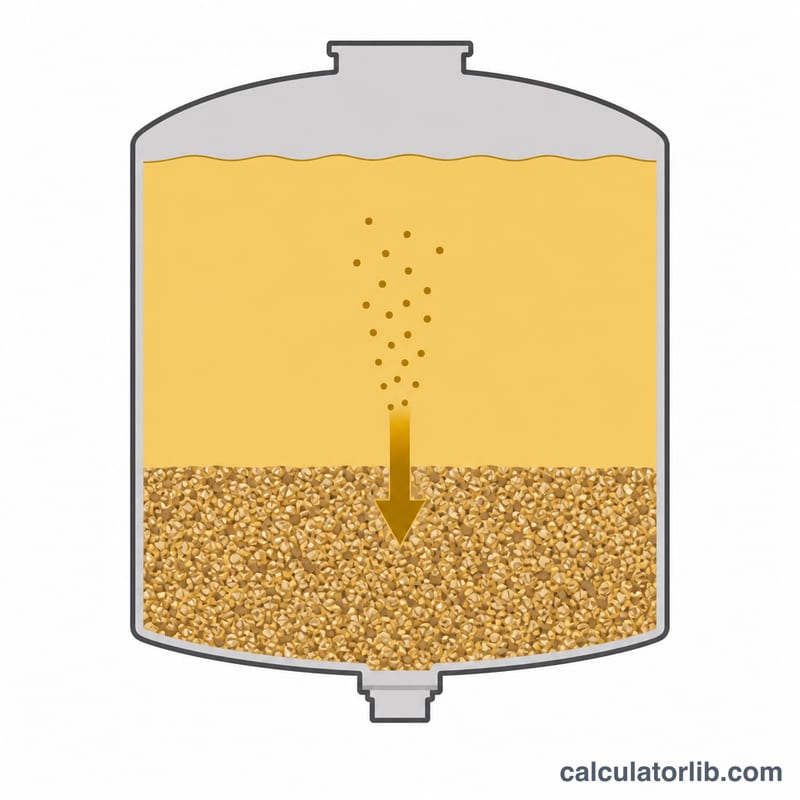
Mash efficiency measures how much of the fermentable sugar locked in your grain actually ended up in the wort after mashing and lautering. It compares the gravity points you really collected against the theoretical maximum the grain bill could yield, expressed as a percentage. Most all-grain homebrewers see mash (or conversion + lauter) efficiencies of roughly 65–80%, and tracking this number helps you hit target gravities consistently.
The formula explained
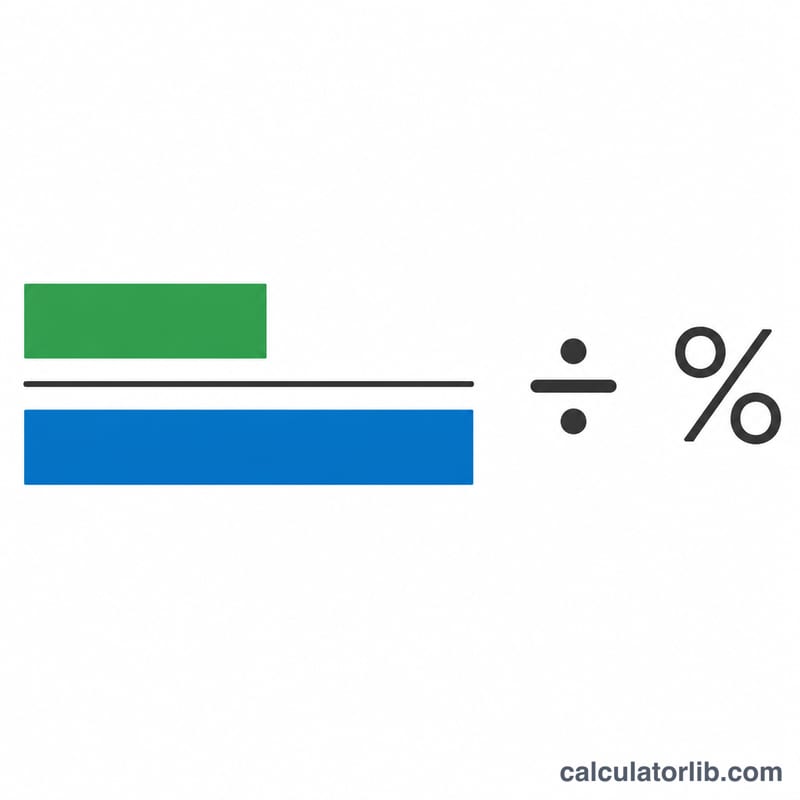
The calculator uses the standard gravity-point method:
$$E = \frac{(\text{OG}-1)\times 1000 \times V}{W \times P}\times 100$$where \(\text{OG}\) = measured original gravity, \(V\) = wort volume in US gallons, \(W\) = total grain weight in pounds, and \(P\) = grain potential in points per pound per gallon (PPG, about 37 for base malt). The numerator, \((\text{OG}-1)\times 1000 \times V\), is the actual gravity points you collected; the denominator, \(W \times P\), is the maximum the grain could give.
How to use it
Enter your measured original gravity (for example \(1.048\)), the volume of wort you collected, your total grain weight, and the average grain potential in PPG. The calculator returns your mash efficiency along with the actual and maximum gravity points so you can see where you stand.
Worked example
Suppose you collect \(6\) gallons at \(\text{OG}=1.048\) from \(10\) lb of base malt rated at \(37\) PPG. The actual points are:
$$(1.048-1)\times 1000 \times 6 = 288$$The maximum points are \(10 \times 37 = 370\), so:
$$E = \frac{288}{370}\times 100 = 77.8\%$$Typical Grain Potential (PPG) by Malt Type
Grain potential is given in PPG, or gravity points per pound per US gallon. This is an imperial/US unit, and the calculator uses it together with pounds and US gallons. The figures below are widely published typical maximum potentials. Real values vary by maltster, crop year and lot. If your malt's spec sheet (certificate of analysis) is available, use its coarse-grind, dry-basis extract figure instead. Many sheets list extract as a percentage, which you can convert with roughly \(\text{PPG} \approx \text{extract \%} \times 46 / 100\).
| Grain / fermentable | Typical potential (PPG) | Notes |
|---|---|---|
| American 2-row pale | ~37 | Common base malt |
| American 6-row | ~35 | Higher husk and enzyme content |
| Maris Otter / pale ale malt | ~37–38 | British-style base malt |
| Pilsner malt | ~37 | Pale lager base |
| Munich | ~35–37 | Varies with kiln color |
| Vienna | ~35–36 | |
| Wheat malt | ~37–38 | Huskless |
| Crystal / caramel 20–120L | ~33–35 | Lower toward darker grades |
| Chocolate malt | ~28–34 | |
| Black patent / roasted barley | ~25–28 | |
| Flaked oats | ~32–33 | Needs base-malt enzymes |
| Flaked maize (corn) | ~37–40 | Needs base-malt enzymes |
| Rice hulls | 0 | Lautering aid only, no extract |
| Table sugar (sucrose) | 46 | 100% fermentable extract |
| Dry malt extract (DME) | ~42–44 | Not mashed |
| Liquid malt extract (LME) | ~35–36 | Not mashed (contains water) |
Sugars and extracts don't depend on the mash. If you include them, your result is closer to an overall brewhouse figure than a true mash efficiency. For a multi-grain recipe, enter the weight-averaged PPG. For example, 9 lb at 37 plus 1 lb at 34 gives:
$$\text{PPG}_{\text{avg}} = \frac{9 \times 37 + 1 \times 34}{10} = \frac{367}{10} = 36.7$$Interpreting Your Efficiency Result
The result compares the gravity points you actually collected with the maximum the grain could give. Example: you collect 5 gallons at 1.054 from 10 lb of grain at 36 PPG.
$$\text{Efficiency} = \frac{(1.054 - 1) \times 1000 \times 5}{10 \times 36} \times 100 = \frac{270}{360} \times 100$$That gives an efficiency of 75%.
| Efficiency | What it usually means |
|---|---|
| Below ~60% | Low. Check the crush (too coarse?), your sparge technique, mash pH, mash time and temperature, and whether your gravity and volume readings are accurate. |
| 60–70% | Common for brew-in-a-bag (BIAB) and no-sparge systems, where more sugar stays behind in the grain. |
| 70–80% | Typical mash/lauter efficiency for batch-sparge and fly-sparge setups. |
| 80–85% | Very good extraction from a well-tuned system. |
| Above ~85% | Unusually high. Re-check your volume and gravity readings first. Real over-extraction, for example from over-sparging or high-pH runnings, can also pull harsh tannins from the husks. |
Recipe software usually assumes about 70–75% brewhouse efficiency by default. That figure covers losses after the mash too, such as trub and transfer losses, so it is often a little lower than your mash efficiency. Set it to the number your own system actually achieves.
Consistency matters more than a high number. Once you know your typical efficiency, you can use it to scale grain bills accurately:
$$\text{Grain needed (lb)} = \frac{\text{target points}}{\text{PPG} \times \text{efficiency}}$$For example, 5 gallons at 1.060 is 60 × 5 = 300 points. With 37 PPG malt at 75%, that needs 300 ÷ (37 × 0.75) = 300 ÷ 27.75 ≈ 10.8 lb. An efficiency that is high but swings from batch to batch makes it hard to hit your target gravity reliably.
For accurate results:
- Mix the wort thoroughly before sampling, because it stratifies and the first and last runnings differ.
- Temperature-correct every hydrometer reading (most are calibrated at 60 °F / 15.6 °C or 68 °F / 20 °C). For a refractometer, apply its wort correction factor.
- Measure the volume at the same point you take the gravity, for example both pre-boil or both post-boil into the fermenter. Allow for the roughly 4% thermal expansion of hot wort if you measure near boiling.
FAQ
Why is my efficiency below 70%? Common causes are a coarse grain crush, insufficient sparging, poor mash pH, or inaccurate volume and gravity measurements.
What PPG should I use? Base malts are about 37 PPG; use a weighted average when your grain bill mixes malts with different potentials.
Is this mash or brewhouse efficiency? This measures efficiency into the kettle (mash/lauter). Brewhouse efficiency also accounts for kettle and trub losses to the fermenter.