What this calculator does
The Filler Wire Consumption Calculator estimates how much welding filler wire a joint will consume. Given the volume of weld metal that must fill the joint and the diameter of the wire, it returns the total wire length and the wire weight, adjusted for real-world deposition efficiency. This helps welders, fabricators and estimators order the right amount of consumables and quote jobs accurately.
The formula explained
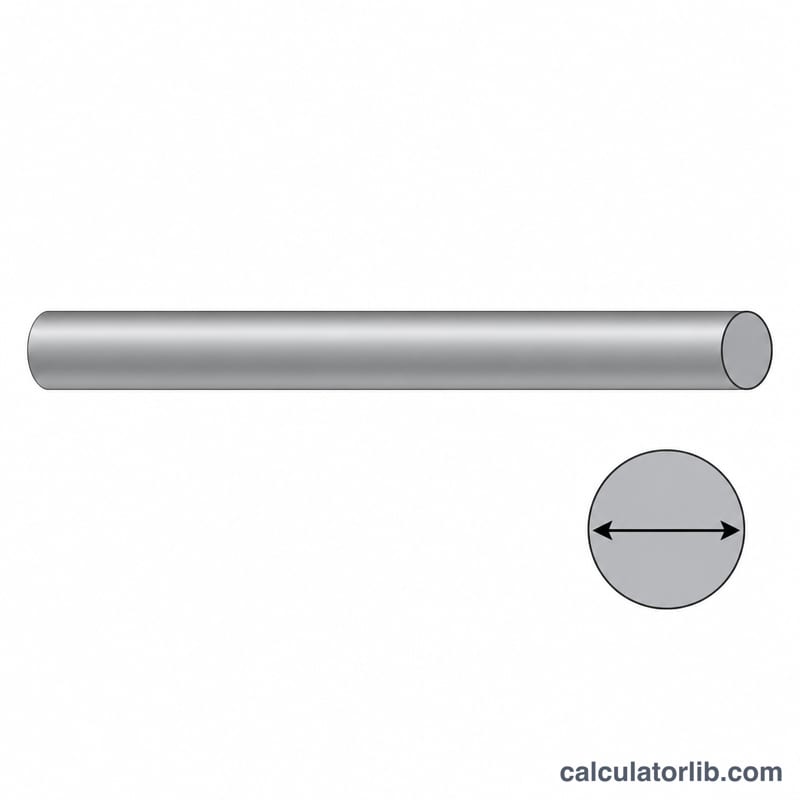
A round wire has a cross-sectional area that depends only on its diameter \(d\):
$$A = \frac{\pi}{4} d^{2}$$Because not every gram of wire ends up in the joint (spatter, stub loss and slag reduce yield), we divide the required deposit volume \(V\) by the deposition efficiency \(\eta\) before dividing by area:
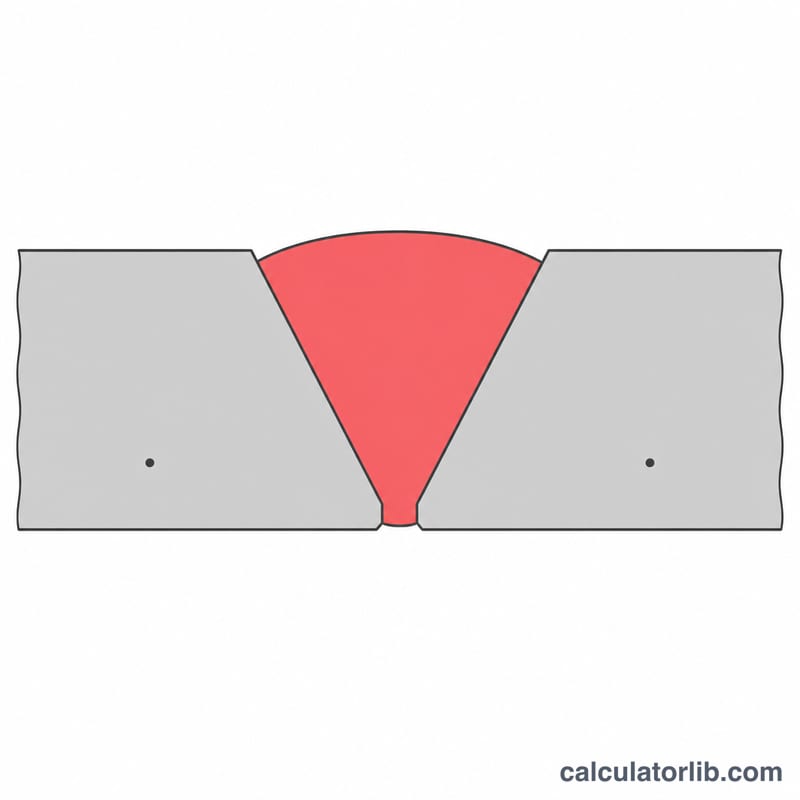
$$L = \frac{V}{\eta \cdot A}$$Here \(V\) = weld deposit volume, \(\eta\) = deposition efficiency as a fraction, \(A\) = wire cross-section, and \(L\) = wire length. The wire weight is \(W = \tfrac{V}{\eta}\times \rho\), where \(\rho\) is the wire density.
How to use it
Enter the weld joint volume in cubic centimeters, the wire diameter in millimeters, the wire density (about \(7.85\) g/cm³ for carbon steel), and the deposition efficiency in percent. The calculator converts units, computes the wire cross-section, and returns length in meters and weight in kilograms.
Worked example
Suppose \(V = 100\) cm³, \(d = 1.2\) mm (\(0.12\) cm), \(\rho = 7.85\) g/cm³ and \(\eta = 0.95\). The wire area is:
$$A = \frac{\pi}{4}(0.12)^{2} = 0.011310\,\text{cm}^{2}$$The wire volume consumed is \(100 / 0.95 = 105.26\) cm³, so:
$$L = \frac{105.26}{0.011310} = 9307\,\text{cm} \approx 93.07\,\text{m}$$The weight is \(105.26 \times 7.85 = 826.3\,\text{g} \approx 0.826\,\text{kg}\).
Wire Length per Kilogram by Diameter and Material
For a solid round wire, one kilogram (1000 g) takes up a volume of \(1000/\rho\) cm³. Divide that volume by the wire's cross-sectional area to get the length:
$$A = \frac{\pi}{4}\left(\frac{d}{10}\right)^2 \ \text{cm}^2, \qquad L = \frac{1000}{\rho \cdot A}\ \text{cm} = \frac{10}{\rho \cdot A}\ \text{m}$$Here \(d\) is the wire diameter in mm and \(\rho\) is the density in g/cm³. For example, 1.2 mm carbon steel wire has \(A = \frac{\pi}{4}(0.12)^2 = 0.011310\) cm². That gives \(L = 10/(7.85 \times 0.011310) = 112.6\) m per kg. The table below uses nominal densities: carbon steel 7.85 g/cm³, aluminum 2.70 g/cm³ and copper alloy 8.9 g/cm³. Real alloys vary a little, so check the density on the manufacturer's data sheet if you need high precision.
| Wire diameter (mm) | Cross-section A (cm²) | Carbon steel, ρ = 7.85 (m/kg) | Aluminum, ρ = 2.70 (m/kg) | Copper alloy, ρ = 8.9 (m/kg) |
|---|---|---|---|---|
| 0.8 | 0.005027 | 253.4 | 736.8 | 223.5 |
| 0.9 | 0.006362 | 200.2 | 582.2 | 176.6 |
| 1.0 | 0.007854 | 162.2 | 471.6 | 143.1 |
| 1.2 | 0.011310 | 112.6 | 327.5 | 99.3 |
| 1.6 | 0.020106 | 63.4 | 184.2 | 55.9 |
| 2.4 | 0.045239 | 28.2 | 81.9 | 24.8 |
Length per kg depends on the square of the diameter. Doubling the diameter (for example from 1.2 to 2.4 mm) cuts the length per kilogram to one quarter. A lighter metal gives proportionally more length: a kilogram of aluminum wire is about 2.9 times longer than a kilogram of steel wire of the same diameter.
Applied to a joint: a weld needing 100 cm³ of deposited steel, using 1.2 mm wire at 100% efficiency, takes \(L = 100/(100 \times 0.011310) =\) 88.4 m of wire. That is \(100 \times 7.85 = 785\) g.
Practical Ordering Tips
The calculated wire length and weight are the theoretical amounts needed to fill the joint. Use these steps to turn them into a realistic purchase:
- Round up to whole spools. Wire is sold in fixed spool or coil sizes. Common sizes are 1, 5, 15 and 18 kg, though what is available depends on the supplier, wire type and region. Round the total weight up to whole spools, and avoid leaving a large job dependent on a partly used spool.
- Add a contingency of about 10–15%. This covers repairs and rework, tack welds, wire cut off when starting or trimming, run-in on test pieces, and setup waste. On short, intermittent or highly repetitive welds the share of waste is higher, so lean toward the upper end.
- Make sure the joint volume is complete. The volume should include the weld reinforcement or cap height, plus the extra metal from the root gap and the full bevel geometry, not just the nominal throat. Leaving out reinforcement and root gap is one of the most common reasons estimates come in too low.
- Use a conservative deposition efficiency. Flux-cored wire loses part of its weight as slag and fume, so use a lower efficiency than you would for solid wire with shielding gas. Also lower the efficiency for out-of-position welding (vertical or overhead), where more spatter and more trimming usually occur. A lower efficiency gives a higher wire estimate, which is safer when ordering.
- Store wire sealed and dry. Keep spools in their original packaging until you use them, and cover or bag partly used spools on the machine. Moisture and contamination can make wire unusable, and that is a common hidden source of loss. This is especially true for flux-cored and aluminum wires.
Treat the result as a planning estimate. Your consumable supplier's data, the welding procedure specification and your own shop's records give the most reliable correction factors for your process.
FAQ
What deposition efficiency should I use? Typical values are about 95% for solid MIG wire, 80-90% for flux-cored, and lower for stick electrodes.
How do I find the joint volume? Multiply the weld cross-sectional area by the weld length. For a triangular fillet, area \(\approx \tfrac{1}{2}\,\text{leg}^{2}\).
Which density do I enter? Use \(7.85\) g/cm³ for steel, \(2.70\) for aluminum, and \(8.9\) for copper alloys.