What is the Cattle Stocking Rate Calculator?
The Cattle Stocking Rate Calculator estimates how many head of cattle a pasture can sustainably support over a grazing period. It balances the forage a pasture produces against the forage your animals consume, so you can avoid overgrazing while making full use of available grass. It is a practical planning tool for ranchers, graziers, and land managers.
The formula explained
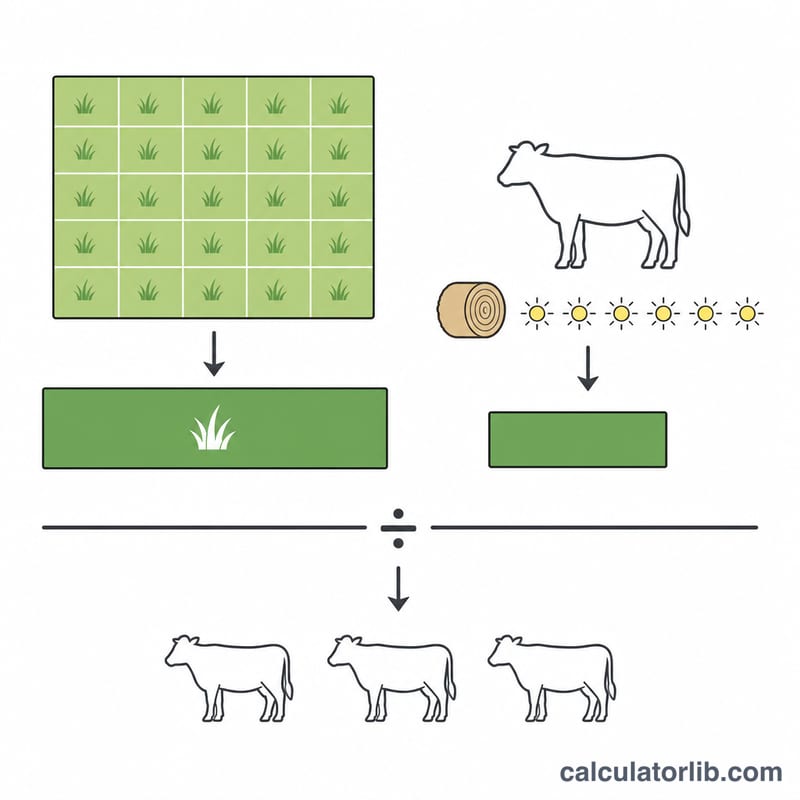
Carrying capacity is total usable forage divided by the forage demand of one animal:
$$\text{Head} = \frac{A \times F \times (U/100)}{W \times (I/100) \times D}$$Where \(A\) = pasture size in acres, \(F\) = forage production in lbs per acre, \(U\) = utilization rate (harvest efficiency) as a percent, \(W\) = animal weight in lbs, \(I\) = daily intake as a percent of body weight, and \(D\) = number of grazing days. The numerator is the usable forage; the denominator is how much one animal eats over the whole period.
How to use it
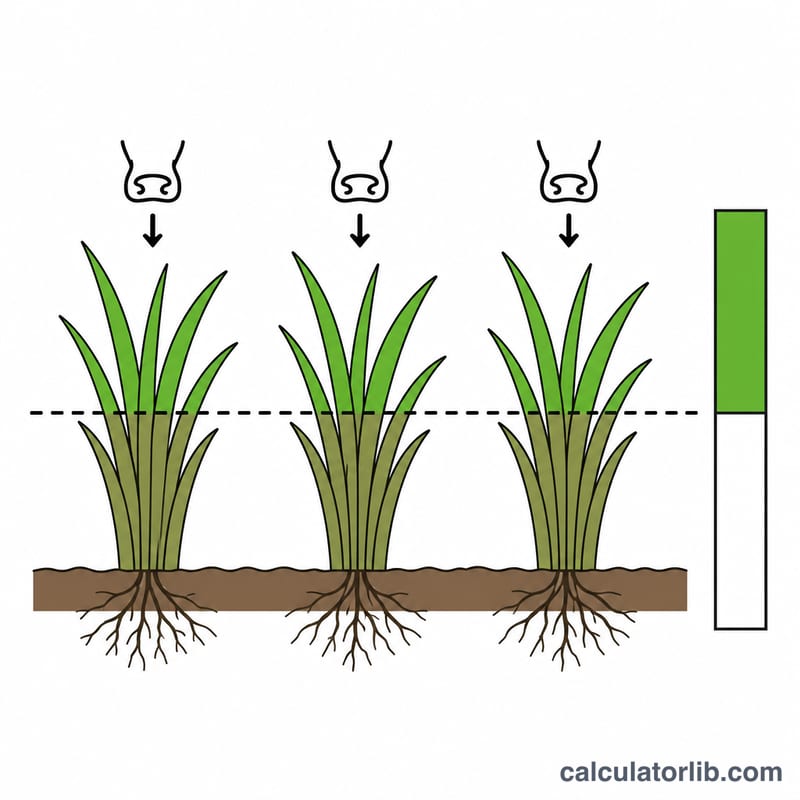
Enter your pasture acreage and an estimate of forage production per acre (from clipping data or local extension figures). Choose a utilization rate — typically 25% to 50% for continuous grazing. Enter the average animal weight, a daily intake rate of about 2.5% to 3% of body weight, and the number of days you plan to graze. The calculator returns the number of head the pasture can carry.
Worked example
For a 100-acre pasture producing 3,000 lbs/acre at 50% utilization, grazing 1,000 lb cattle eating 3% of body weight for 180 days:
$$\text{Usable} = 100 \times 3000 \times 0.50 = 150{,}000\ \text{lbs}$$$$\text{Demand} = 1000 \times 0.03 \times 180 = 5{,}400\ \text{lbs}$$$$\text{Head} = \frac{150{,}000}{5{,}400} \approx 27.8$$So the pasture supports roughly 28 head for that season.
Typical Utilization and Intake Ranges
The two percentage inputs, utilization and intake, have a big effect on the result. The ranges below are general guidelines from extension services, such as the USDA Natural Resources Conservation Service (NRCS) in the United States and university extension programs. Use them as a starting point. Local values depend on climate, forage species, range condition and management, so check them against data for your region.
Forage utilization by grazing system
| Grazing system | Typical utilization of standing forage | Notes |
|---|---|---|
| Continuous / season-long | About 25–35% | Cattle graze favored plants and areas over and over, so planned use is kept low. |
| Rotational (several paddocks) | About 40–50% | Rest periods let plants regrow, which allows higher use. |
| Intensive / mob grazing | Up to about 60–70% | High stock density for short periods. Needs close monitoring and long recovery times. |
| “Take half, leave half” rule | About 50% removed by grazing | A common rule of thumb for managed pasture. Not all of the removed half is eaten, because some is trampled or wasted. |
Daily dry-matter intake as a percent of body weight
| Animal class | Typical daily intake (% of body weight, dry-matter basis) |
|---|---|
| Dry (non-lactating) cows | About 2.0–2.5% |
| Lactating cows | About 2.5–3.0% |
| Growing stockers | About 2.5–3.0% |
| Bulls | About 2.0–2.5% |
Intake percentages are on a dry-matter basis, so the forage production you enter must also be in dry matter. For example, a 1,200 lb lactating cow eating 2.5% of her body weight needs \(1{,}200 \times 0.025 = 30\) lb of dry matter per day. Forage quality affects intake. Animals eat more of leafy, digestible forage and less of mature, stemmy forage.
Animal Unit Equivalents by Class of Livestock
Grazing planners often convert livestock into animal units (AU). Under the US NRCS standard, 1 AU is a 1,000 lb cow, with or without a calf up to about 6 months old, that eats about 26 lb of forage dry matter per day. Other classes are scaled against this reference animal. The equivalents below are approximate. Agencies and states publish slightly different values, and other countries use their own livestock-unit systems.
| Class of livestock | Approximate animal unit equivalent (AU) |
|---|---|
| Cow-calf pair | About 1.0–1.3 |
| Cow, 1,200 lb | About 1.2 |
| Mature bull | About 1.3–1.5 |
| Weaned calf | About 0.5 |
| Yearling | About 0.6–0.75 |
| Horse | About 1.25 |
| Sheep | About 0.2 |
| Goat | About 0.15 |
Animal unit month (AUM)
An AUM is the forage one animal unit eats in one month. At 26 lb of dry matter per day, that is roughly \(26 \times 30 = 780\) lb of dry matter, and some references round it to about 780–790 lb. Rangeland and lease capacity is often quoted in AUMs per acre or acres per AUM.
Converting head count to animal units
To convert, multiply the number of head by the AU equivalent for their class:
$$\text{Total AU} = \text{Head} \times \text{AU equivalent}$$For example, 40 cows of 1,200 lb each equal \(40 \times 1.2 = 48\) AU. Grazing those 48 AU for 5 months uses \(48 \times 5 = 240\) AUM of forage.
FAQ
What utilization rate should I use? A conservative 25% protects plant regrowth; 50% suits well-managed rotational systems.
Why include grazing days? Longer periods raise total demand per animal, lowering the number of head a fixed forage supply can carry.
Is this the same as an animal unit? It is related; using a 1,000 lb animal at about 3% intake approximates one standard animal unit.