What this calculator does
Stocking rate is the number of animals a pasture can support for a given length of time without over-grazing it. This tool works in US customary units — acres and pounds of dry matter (DM) — and converts your paddock acreage and forage productivity into head of livestock, animal units (AU), acres per head, and animal unit months (AUM). One animal unit is defined here as a 1,000 lb animal.
How to use it
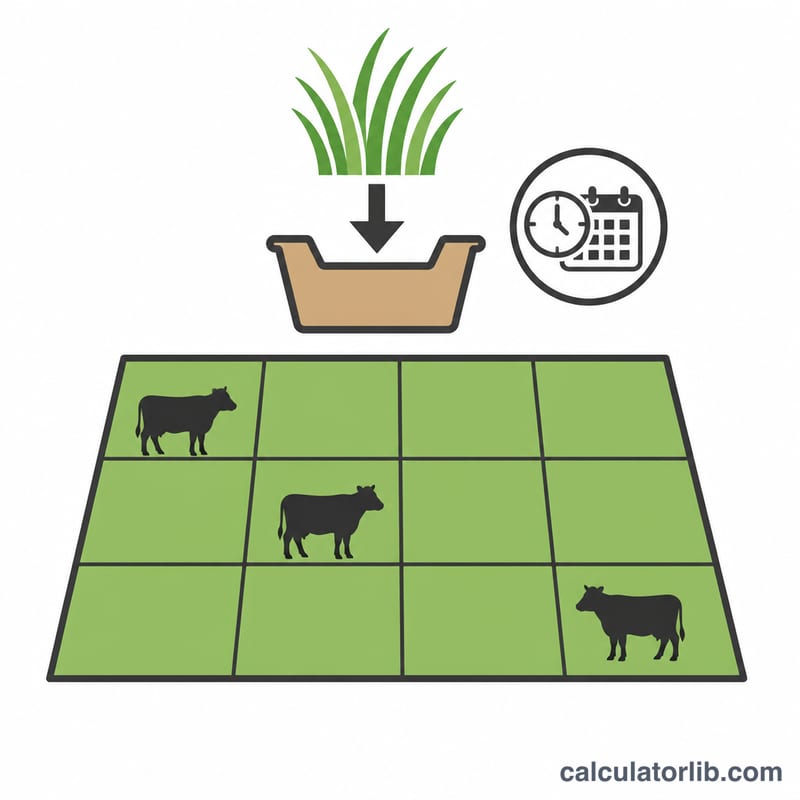
Enter the grazeable acres (exclude timber, ponds, roads), the forage production per acre for the season, and a realistic harvest efficiency. Continuous grazing typically captures only 25–35% of the standing forage; well-managed rotational grazing reaches 50–70%. Then enter the grazing period in days, the average animal weight, and daily dry matter intake as a percentage of body weight — 2.5% is a common figure for dry beef cows, 3.0% or more for lactating cows.
The formula
With \(A\) = acres, \(Y\) = lb DM per acre, \(U\) = utilization percent, \(W\) = animal weight in lb, \(I\) = intake percent, and \(D\) = grazing days:
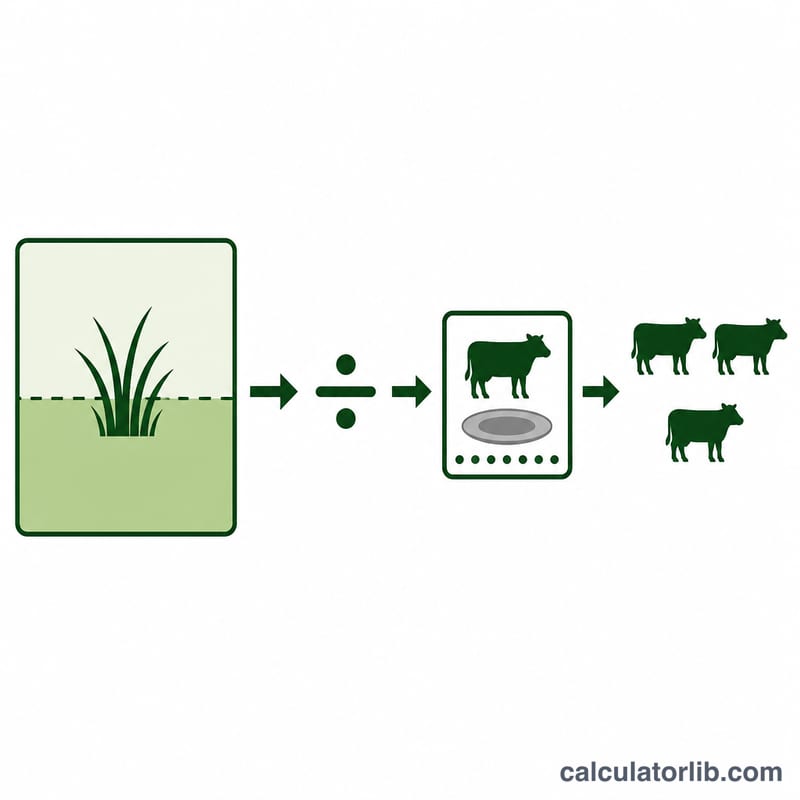
$$\text{Head} = \frac{A \times Y \times (U/100)}{W \times (I/100) \times D}$$The numerator is the forage you can actually harvest; the denominator is what one animal removes over the whole period.
Worked example
A 100-acre pasture yielding 3,000 lb DM per acre at 50% utilization, grazed 180 days by 1,200 lb cows eating 2.5% of body weight:
$$100 \times 3000 \times 0.50 = 150{,}000\ \text{lb DM available}$$$$1200 \times 0.025 \times 180 = 5{,}400\ \text{lb DM per cow}$$$$\text{Head} = \frac{150{,}000}{5{,}400} = 27.8$$That is about 33.3 animal units and 3.6 acres per head.
Typical Forage Yield and Animal Unit Equivalents
The stocking-rate formula needs two numbers you usually have to look up rather than measure: how much dry matter (DM) an acre grows in a year, and how much forage the animals you actually own eat relative to a standard 1,000 lb animal. Both tables below are US-oriented — they use acres, pounds of dry matter and the animal-unit convention used by the USDA Natural Resources Conservation Service (NRCS) and land-grant extension services. Outside the US, forage is normally planned in kg DM/ha and in livestock units (LU/LSU), which are defined differently.
Typical annual dry matter yield (lb DM/acre)
| Forage type / range site | Planning range (lb DM/acre/yr) | Notes |
|---|---|---|
| Native shortgrass range (semi-arid Great Plains, Southwest) | 400 – 1,200 | Rainfall-limited; the low end is normal in drought years |
| Mixed-grass / tallgrass prairie | 1,500 – 3,500 | Wide swing with spring moisture |
| Improved cool-season pasture (tall fescue, orchardgrass, bromegrass) | 3,000 – 6,000 | Assumes adequate fertility; summer slump reduces usable growth |
| Bermudagrass (warm-season sod, Southeast/South) | 4,000 – 8,000 | Strongly nitrogen-responsive |
| Irrigated alfalfa / irrigated mixed pasture | 6,000 – 10,000 | Top end requires full irrigation and multiple harvests |
These are NRCS-style planning ranges, not measurements. Actual yield on a given field varies with rainfall, soil depth, fertility, species composition and grazing history, and a single site can move from the top of its range to the bottom in a dry year. Where a local NRCS ecological site description or extension bulletin exists for your soil and precipitation zone, use its number instead of the range above.
Animal unit equivalents (AUE), referenced to a 1,000 lb animal
| Animal class | AUE | Weight to enter (lb) |
|---|---|---|
| Dry cow, 1,000 lb (the reference animal) | 1.0 | 1,000 |
| Cow with calf (lactating pair) | 1.25 – 1.35 | 1,250 – 1,350 |
| Mature bull | 1.25 – 1.5 | 1,250 – 1,500 |
| Weaned stocker, 500 – 700 lb | 0.5 – 0.7 | 500 – 700 |
| Yearling, 700 – 900 lb | 0.7 – 0.9 | 700 – 900 |
| Horse (mature, light riding) | 1.25 | 1,250 |
| Ewe with lambs | 0.20 | 200 |
| Doe / meat goat with kids | 0.15 – 0.17 | 150 – 170 |
To use this table with the calculator, multiply the AUE by 1,000 lb and enter that as the animal weight:
$$W_{\text{entered}} = \text{AUE} \times 1{,}000\ \text{lb}$$So a cow–calf pair at AUE 1.30 is entered as 1,300 lb, and a band of ewes with lambs at AUE 0.20 is entered as 200 lb. For a mixed herd, convert every class this way, run each class separately, or run the herd as a single average animal unit — the AUE scale exists precisely so that unlike animals can be added together on one forage budget.
What Your Stocking Rate Result Means
The calculator divides the forage you can actually offer by the forage one animal will actually eat, then reports that answer four different ways.
- Head — the number of animals of the weight class you entered that the pasture can carry for the period you entered. It is not a permanent herd size: 15 head for 120 days is not the same statement as 15 head for a year.
- Animal units (AU) — head rescaled to the 1,000 lb standard animal, \(\text{AU} = N_{\text{head}} \times W/1{,}000\). This is the common currency that lets you add cows, bulls, yearlings, horses and sheep onto one forage budget.
- Acres per head — the inverse density figure, \(100 \div N_{\text{head}}\) for a 100-acre unit. Most local rules of thumb ("you need about 12 acres a cow around here") are stated in these terms, which makes it the easiest output to sanity-check against neighbours.
- AUM (animal unit month) — the forage one 1,000 lb animal unit consumes in 30.4 days, roughly 790–915 lb DM depending on the intake percentage assumed. AUMs are the billing unit for US federal grazing permits (BLM and Forest Service) and for many private grazing leases, so this is the output to quote when you are pricing grazing rather than planning it.
A worked example
Forty acres of decent cool-season pasture, 2,500 lb DM/acre, grazed rotationally at 50% utilization for a 120-day season with 1,100 lb dry cows eating 2.5% of body weight:
$$F_{\text{avail}} = 40 \times 2{,}500 \times \frac{50}{100} = 50{,}000\ \text{lb DM}$$$$D_{\text{head}} = 1{,}100 \times \frac{2.5}{100} \times 120 = 27.5 \times 120 = 3{,}300\ \text{lb DM}$$$$N_{\text{head}} = \frac{50{,}000}{3{,}300} = 15.2\ \text{head}$$That is 15.2 head, or 16.7 animal units, about 2.6 acres per head, and roughly 65.8 AUMs of grazing — a number you could compare directly against a lease quoted in dollars per AUM.
How much to trust the number
The result is a theoretical carrying capacity for the yield you typed in, not a guaranteed safe stocking rate. Of the six inputs, forage yield carries by far the most error: intake percentage varies within a narrow band (roughly 2–3% of body weight), grazing days and acreage are known, but yield can be off by a factor of two on the same field between a wet and a dry year. If you are unsure of yield, run the calculation at the bottom of the plausible range and treat the higher figure as an upside case rather than a plan.
Always sanity-check acres per head against local guidance — an NRCS ecological site description, a state extension range site guide, or a neighbour's long-run experience on the same soil and rainfall zone. If the calculator says 3 acres per cow and every local reference says 12, the yield input is wrong, not the local reference. Build in a reserve as well: many US range planners hold back 20–25% of calculated capacity as drought insurance, and on native rangeland conservative stocking generally outperforms chasing the maximum.
Stocking rate is not stocking density
These two terms are constantly confused. Stocking rate is what this calculator returns: animals (or animal units) per unit of land over a period of time — 15 head on 40 acres for 120 days. Stocking density is an instantaneous figure: how many animals are standing on the paddock you have them in right now. A rotational system can run a modest stocking rate of 2.6 acres per head for the season while momentarily concentrating the whole herd at a stocking density of tens of thousands of pounds of liveweight per acre in a small strip. Density drives trampling, manure distribution and grazing uniformity; rate drives whether you run out of feed. Manage density day to day, but plan the season on rate.
This article is general educational information about forage budgeting, not professional agronomic, veterinary or financial advice. Grazing plans, lease terms and permitted stocking on public land should be confirmed with a qualified local adviser or the relevant agency.
FAQ
Why is my answer lower than my neighbor stocking rate? Utilization and yield estimates drive the result. Clipping and weighing forage from a few quadrats gives far better numbers than a guess.
What is an AUM? The forage one 1,000 lb animal unit eats in about a month (30.4 days) — roughly 760 lb DM at 2.5% intake. Public grazing leases are usually priced per AUM.
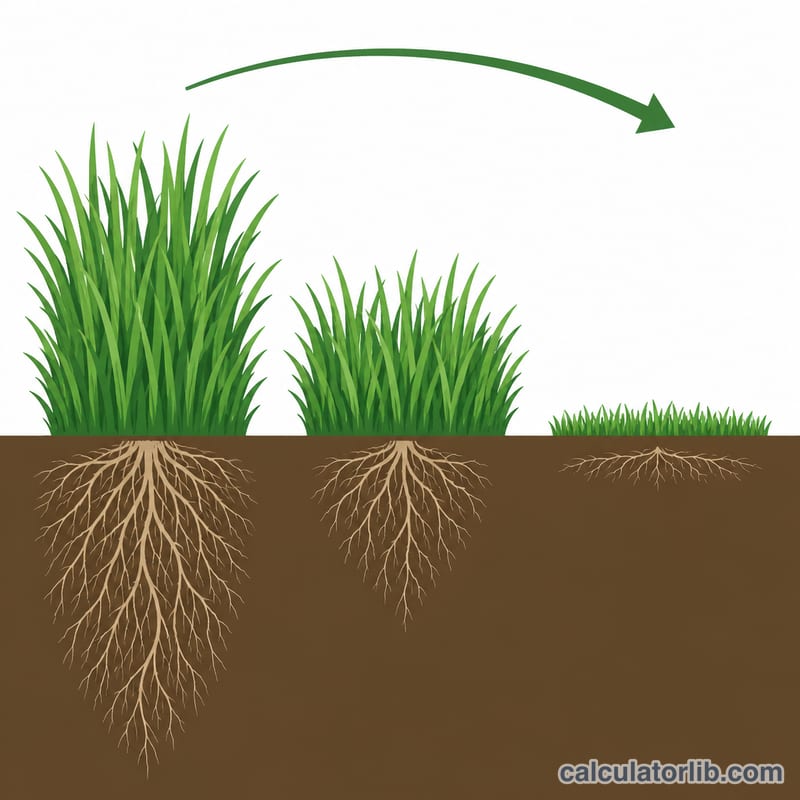
Should I stock at 100% of this figure? No. Keep 20–25% back as a drought and regrowth buffer, and re-measure forage during the season.