What this calculator does
Fermentation turns sugar into alcohol and carbon dioxide, so the liquid gets lighter as it ferments. By taking a hydrometer reading before pitching yeast (original gravity, \(\text{OG}\)) and another when fermentation has finished (final gravity, \(\text{FG}\)), the drop in density tells you how much sugar the yeast consumed and therefore how much alcohol is in the beer. This tool converts those two numbers into alcohol by volume, alcohol by weight, apparent attenuation and an estimated calorie count. It works the same way for wine, cider and mead readings.
How to use it
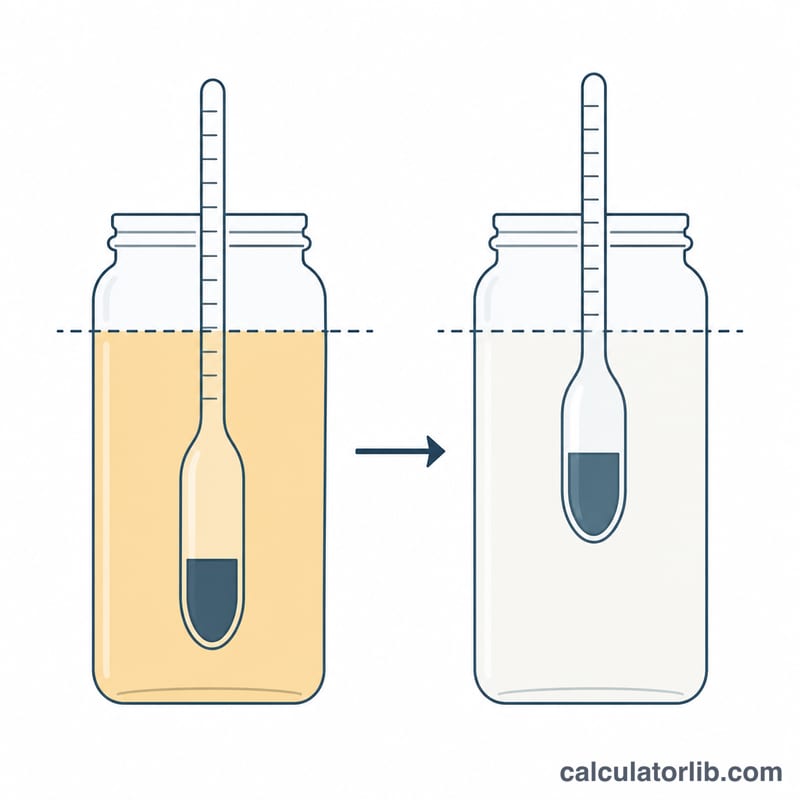
Enter your original gravity (typically between 1.030 and 1.100) and your final gravity (typically 1.005 to 1.020), both temperature corrected to your hydrometer calibration temperature. Choose the standard formula for ordinary strength beers, or the alternate formula if your OG was above about 1.070 - the standard version drifts high on big beers.
The formula explained
The standard estimate is a straight line fit:
$$\text{ABV}\% = (\text{OG} - \text{FG}) \times 131.25$$where \(\text{OG}\) = original specific gravity and \(\text{FG}\) = final specific gravity. Apparent attenuation, the share of available sugar the yeast ate, is
$$\text{AA}\% = \frac{\text{OG} - \text{FG}}{\text{OG} - 1} \times 100$$Because ethanol is lighter than water, alcohol by weight is roughly \(\text{ABW} = \text{ABV} \times 0.79336 / \text{FG}\).
Worked example
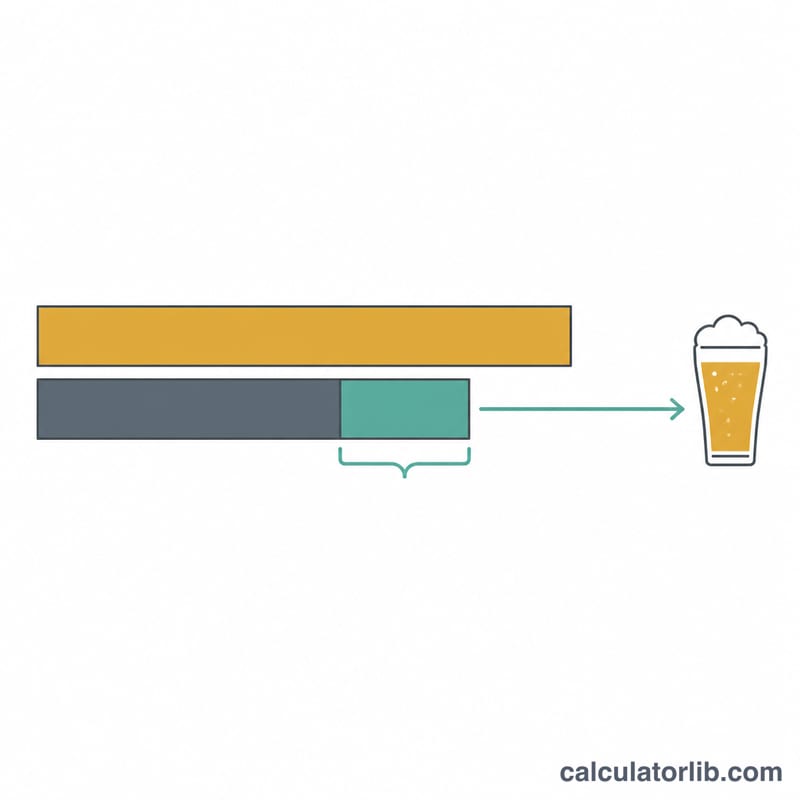
A pale ale starts at 1.050 and finishes at 1.010:
$$\text{ABV}\% = (1.050 - 1.010) \times 131.25 = 5.25\%$$$$\text{AA}\% = \frac{0.040}{0.050} \times 100 = 80\%$$That is a healthy, fully attenuated ale of about 5.25 percent alcohol.
ABV Across Common Homebrew Styles
The table below runs realistic original-gravity (OG) and final-gravity (FG) pairs through the standard homebrew equation \(\text{ABV\%} = (\text{OG} - \text{FG}) \times 131.25\), together with apparent attenuation \(\text{AA\%} = \frac{\text{OG} - \text{FG}}{\text{OG} - 1.000} \times 100\) and an estimated calorie figure.
Assumptions: gravities are specific gravity referenced to water, taken with a hydrometer at its calibration temperature; the calorie column uses the widely used empirical pair \(\text{kcal}_{\text{alcohol}} = 1881.22 \times \text{FG} \times \frac{\text{OG} - \text{FG}}{1.775 - \text{OG}}\) and \(\text{kcal}_{\text{carbs}} = 3550 \times \text{FG} \times (0.1808 \times \text{OG} + 0.8192 \times \text{FG} - 1.0004)\), which are written for a 12 US fluid ounce (355 mL) serving — a US serving size. For a 500 mL bottle multiply by about 1.41; for a UK imperial pint (568 mL) multiply by about 1.60.
| Batch / style | OG | FG | ABV % (×131.25) | Apparent attenuation | Est. kcal per 12 oz (355 mL) |
|---|---|---|---|---|---|
| Session ale | 1.038 | 1.010 | 3.68 % | 73.7 % | ≈ 125 |
| American pale ale | 1.050 | 1.010 | 5.25 % | 80.0 % | ≈ 165 |
| Dry stout | 1.060 | 1.016 | 5.78 % | 73.3 % | ≈ 203 |
| IPA | 1.065 | 1.012 | 6.96 % | 81.5 % | ≈ 218 |
| Imperial stout | 1.090 | 1.022 | 8.93 % standard / 9.72 % alternate | 75.6 % | ≈ 314 |
| Dry cider | 1.050 | 1.000 | 6.56 % | 100 % | ≈ 160 (see note) |
Note on high gravity: the simple ×131.25 multiplier is a linear fit that was calibrated on ordinary-strength beer. Above roughly OG 1.070 it increasingly under-reads, which is why the imperial stout row shows two answers — the alternate high-gravity fit gives about 0.8 percentage points more alcohol for the same readings. Report which formula you used whenever you share a number.
Note on cider: the calorie coefficients are fitted to beer wort, whose residual extract includes unfermentable dextrins. A cider fermented to 1.000 has almost no residual sugar, so the carbohydrate term over-estimates; treat the cider calorie figure as the roughest one in the table.
All figures here are estimates. Real-world ABV also depends on hydrometer accuracy (±0.001 is common), temperature correction, sugar or priming additions after the OG reading, and losses during transfer. Nutrition and alcohol information on this page is general information only and is not professional dietary, medical or legal advice; alcohol labelling rules and any legal ABV limits for home production vary by country.
Constants Used in the Calculation
Every number in this calculator is either an empirical curve fit from brewing literature or a physical property of ethanol and water. None of them are exact by definition.
| Constant | Value | Units | Where it is used |
|---|---|---|---|
| Standard ABV multiplier | 131.25 | dimensionless | \(\text{ABV\%} = (\text{OG} - \text{FG}) \times 131.25\); a linear fit valid for roughly OG 1.030–1.070 |
| Alternate fit coefficients | 76.08, 1.775, 0.794 | dimensionless | High-gravity form (below) |
| Ethanol density at 20 °C | 0.789 | g/cm³ | Converting a volume of alcohol into a mass of alcohol |
| ABV → ABW factor | 0.79336 | dimensionless | \(\text{ABW\%} \approx \text{ABV\%} \times 0.79336\) |
| Energy of ethanol | 6.9 | kcal/g | Alcohol calorie term |
| Energy of carbohydrate | 4.0 | kcal/g | Residual-extract calorie term |
| Per-serving alcohol coefficient | 2550 (equivalently 1881.22 in the gravity form) | kcal per 12 US fl oz | Bundles 6.9 kcal/g with the 355 mL serving |
| Per-serving carbohydrate coefficient | 3550 | kcal per 12 US fl oz | Bundles 4.0 kcal/g with the 355 mL serving |
| Real-extract weighting | 0.1808 / 0.8192 (real ≈ 0.81 × apparent) | dimensionless | Real vs apparent attenuation and extract |
| Hydrometer calibration temperature | 20 °C (68 °F) or 15.6 °C (60 °F) | °C / °F | Reference temperature stamped on the instrument |
The alternate high-gravity equation
$$\text{ABV\%} = 76.08 \times \frac{\text{OG} - \text{FG}}{1.775 - \text{OG}} \times \frac{\text{FG}}{0.794}$$
Worked substitution for the imperial stout above (OG 1.090, FG 1.022):
$$76.08 \times \frac{1.090 - 1.022}{1.775 - 1.090} \times \frac{1.022}{0.794} = 76.08 \times \frac{0.068}{0.685} \times 1.2872 = 76.08 \times 0.09927 \times 1.2872 = 9.72\%$$
The same readings through the linear form give \((1.090 - 1.022) \times 131.25 = 0.068 \times 131.25 = 8.93\%\).
Alcohol by weight and attenuation
Because ethanol is less dense than water (0.789 g/cm³ at 20 °C versus 0.998 g/cm³ for water), a beer always contains fewer percent by weight than percent by volume. For the 5.25 % ABV pale ale:
$$\text{ABW\%} = 5.25 \times 0.79336 = 4.17\%$$
Apparent attenuation is measured with a hydrometer, which is fooled by the alcohol present at the end of fermentation. Real attenuation — the fraction of extract actually consumed — is smaller, roughly:
$$\text{RA\%} \approx \text{AA\%} \times 0.81$$
So the pale ale's 80.0 % apparent attenuation corresponds to about 64.8 % real attenuation.
Calibration temperature caveat
Hydrometers are sold calibrated at either 20 °C (68 °F) or 15.6 °C (60 °F) — check the stem or the paperwork, since 60 °F is not 20 °C and mixing the two adds about one gravity point of error. Both conventions appear in US and European homebrew equipment.
Key Brewing Terms Defined
- Specific gravity (SG)
- The density of a liquid divided by the density of water at a reference temperature; dimensionless. Water reads 1.000. Beer wort typically falls between 1.030 and 1.100 before fermentation and 1.005 to 1.025 after.
- Gravity points
- Shorthand for the decimal part of SG multiplied by 1000. SG 1.048 is "48 points". Convenient for mental arithmetic: a drop from 48 points to 12 points is 36 points, and 36 × 0.13125 ≈ 4.7 % ABV.
- Degrees Plato (°P)
- Grams of sucrose per 100 g of solution — a mass-percent scale. A 12 °P wort is 12 % dissolved extract by weight. Used as standard practice in commercial brewing in Europe and increasingly in the US.
- Degrees Brix (°Bx)
- The same mass-percent-sucrose concept as Plato but calibrated from a slightly different reference dataset; in the brewing range the two differ by less than 0.1 units and are used interchangeably. Brix is the scale printed on most refractometers.
- Original gravity (OG)
- The gravity of the wort or must measured after cooling and before pitching yeast. Typical homebrew range: 1.030 (light session beer) to 1.100+ (barleywine, imperial stout).
- Final gravity (FG)
- The gravity once fermentation has stopped, confirmed by two or three identical readings a few days apart. Typical range 1.006–1.020 for beer; a fully dry cider or mead can reach 0.995–1.000, below water, because ethanol is lighter than water.
- Wort
- The sweet, unfermented liquid extracted from malted grain. Its sugar content is what the OG reading measures.
- Attenuation (apparent)
- The percentage of the original gravity points consumed, calculated from hydrometer readings: \(\frac{\text{OG} - \text{FG}}{\text{OG} - 1.000} \times 100\). Most ale yeasts deliver 70–80 %; highly attenuative strains can exceed 85 %.
- Attenuation (real)
- The true fraction of extract fermented, corrected for the fact that alcohol lowers the hydrometer reading. Roughly 0.81 × the apparent value, so 75 % apparent ≈ 61 % real.
- ABV — alcohol by volume
- Millilitres of pure ethanol per 100 mL of finished drink, expressed as a percent. Homebrew beer commonly lands between 3 % and 10 % ABV.
- ABW — alcohol by weight
- Grams of ethanol per 100 g of drink. Always lower than ABV: \(\text{ABW} \approx 0.79336 \times \text{ABV}\). Historically used on some US labels, so a "3.2 % beer" in certain US states meant 3.2 % by weight — about 4 % ABV.
- Hydrometer
- A weighted glass float that sinks to a depth set by liquid density. Reads SG directly, resolution typically 0.001, needs a 100–250 mL sample, and must be temperature-corrected. It is the instrument the standard ABV formula assumes.
- Refractometer
- An optical instrument reading sugar content in °Brix from two or three drops of liquid. Excellent for pre-fermentation readings, but alcohol bends light differently from sugar, so a post-fermentation reading must be corrected before it can be used as an FG.
- Pitching
- Adding yeast to cooled wort. Typical ale pitching rate is on the order of one million viable cells per millilitre per degree Plato; under-pitching is a common cause of a stuck, high FG.
- Residual / unfermentable sugar
- Dextrins, unfermentable sugars and proteins left after fermentation. They set the floor on FG (usually 1.008–1.020 for beer), contribute body and sweetness, and are the source of the carbohydrate half of the calorie estimate.
Specific Gravity, Plato and Brix Conversion
Hydrometers in the US and UK homebrew market are usually printed in specific gravity, while refractometers and most commercial brewing worldwide use °Plato or °Brix. The table converts between them across the normal homebrew range.
| Specific gravity | Gravity points | °Plato | °Brix | Quick estimate (SG−1)×1000/4 |
|---|---|---|---|---|
| 1.010 | 10 | 2.56 | 2.6 | 2.5 |
| 1.020 | 20 | 5.08 | 5.1 | 5.0 |
| 1.030 | 30 | 7.55 | 7.6 | 7.5 |
| 1.040 | 40 | 9.99 | 10.0 | 10.0 |
| 1.050 | 50 | 12.39 | 12.4 | 12.5 |
| 1.060 | 60 | 14.74 | 14.8 | 15.0 |
| 1.070 | 70 | 17.05 | 17.1 | 17.5 |
| 1.080 | 80 | 19.33 | 19.3 | 20.0 |
| 1.090 | 90 | 21.57 | 21.6 | 22.5 |
| 1.100 | 100 | 23.77 | 23.8 | 25.0 |
The rule of thumb is
$$^\circ P \approx \frac{(\text{SG} - 1) \times 1000}{4}$$
It is accurate to about 0.1 °P up to SG 1.040, but drifts high as gravity climbs — at SG 1.100 it returns 25.0 °P against a true 23.8 °P, an error of roughly 5 %. Use the table (or the calculator) for big beers.
Refractometer readings after fermentation
Ethanol has a much higher refractive index contribution than its density would suggest, so an uncorrected refractometer FG reads far too high. A beer whose true FG is 1.010 will typically show around 6–7 °Bx on a refractometer, which naively converts to roughly SG 1.024 — enough to make you believe fermentation has stalled when it has finished. Always either (a) confirm FG with a hydrometer, or (b) feed both the original and final Brix readings into a dedicated alcohol-correction routine. Separately, many refractometers need a wort correction factor (WCF), commonly 1.02–1.04, applied even to the pre-fermentation reading: divide the displayed Brix by the WCF before converting.
Hydrometer temperature correction
A hydrometer only reads true at its calibration temperature. The corrections below are approximate values to add to a reading taken with an instrument calibrated at 20 °C (68 °F), for wort near SG 1.050. If your hydrometer is instead calibrated at 15.6 °C (60 °F), shift the whole set accordingly — check the instrument before trusting either.
| Sample temperature | Correction to add | Example: reading 1.050 becomes |
|---|---|---|
| 10 °C (50 °F) | −0.0015 | 1.0485 |
| 20 °C (68 °F) | 0.0000 (calibration point) | 1.0500 |
| 30 °C (86 °F) | +0.0026 | 1.0526 |
| 40 °C (104 °F) | +0.0062 | 1.0562 |
The correction grows quickly with temperature because water and wort expand as they warm, so a hot sample is less dense and floats the hydrometer lower. A 6-point error at 40 °C is worth about 0.8 % ABV — more than enough to matter. The simplest fix is to cool the sample to the calibration temperature before reading rather than relying on a correction.
FAQ
Why do my two formulas disagree? They are different empirical fits. Below about 6 percent they agree closely; above that the alternate formula is the more reliable one.
Do I need to correct for temperature? Yes. A hydrometer is calibrated at one temperature (often 20 C or 60 F); a warm sample reads low and will understate your alcohol.
Is apparent attenuation the same as real attenuation? No. Alcohol lowers the density of the sample, so apparent attenuation overstates the true sugar consumed by roughly a fifth. Apparent attenuation is the number brewers and yeast suppliers normally quote.