What is the Brewing ABV Calculator?
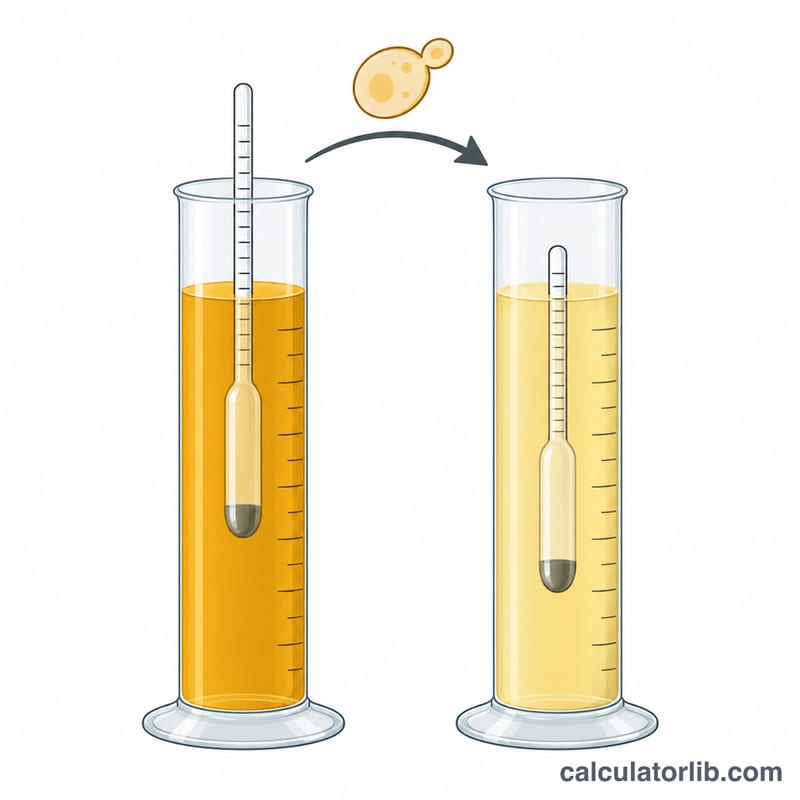
The Brewing ABV calculator estimates the alcohol by volume in your homebrew beer, wine, mead, or cider using two hydrometer readings: the original gravity measured before fermentation and the final gravity measured after it. As yeast converts sugar into alcohol and carbon dioxide, the density of the liquid drops, and that drop is directly related to how much alcohol was produced.
How to use it
Take a hydrometer or refractometer reading of your unfermented wort or must and enter it as the original gravity, for example \(1.050\). After fermentation finishes, take a second reading and enter it as the final gravity, for example \(1.010\). Press calculate to see your estimated ABV and apparent attenuation. For the most accurate result, make sure both readings are temperature corrected to your hydrometer calibration point.
The formula explained
The widely used homebrew estimate multiplies the gravity drop by a constant:
$$\text{ABV} = (\text{OG} - \text{FG}) \times 131.25$$Here \(\text{OG}\) is the original gravity and \(\text{FG}\) is the final gravity. Apparent attenuation, the share of sugar the yeast consumed, is:
$$\text{ADF} = \frac{\text{OG} - \text{FG}}{\text{OG} - 1} \times 100$$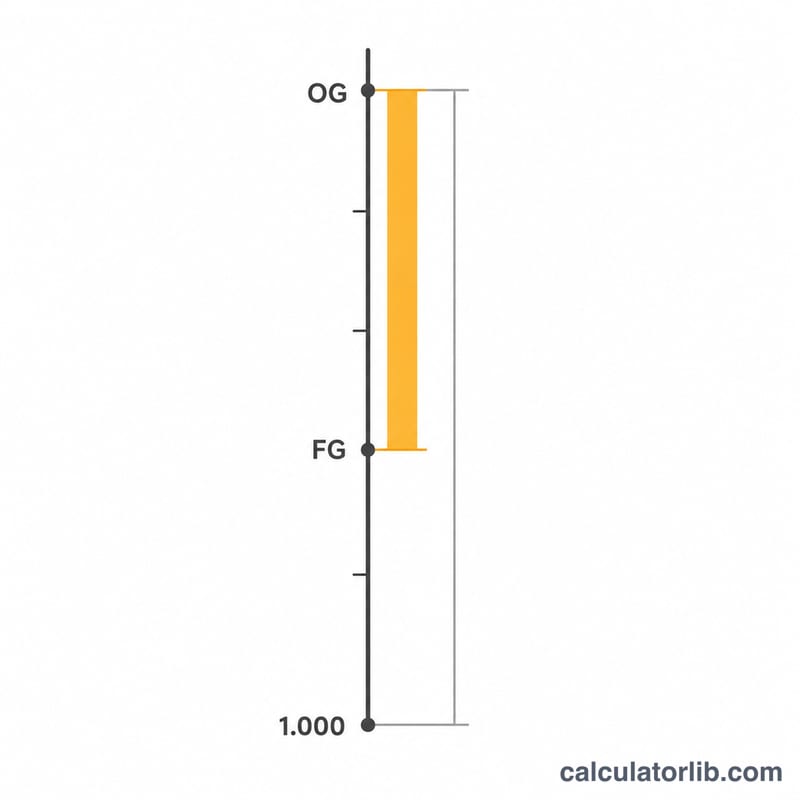
Worked example
Suppose your beer started at \(\text{OG} = 1.050\) and finished at \(\text{FG} = 1.010\). The alcohol by volume is:
$$\text{ABV} = (1.050 - 1.010) \times 131.25 = 5.25\%$$The apparent attenuation is:
$$\text{ADF} = \frac{1.050 - 1.010}{1.050 - 1} \times 100 = 80\%$$Typical Gravity and ABV Ranges by Beverage
The table shows common original gravity (OG) and final gravity (FG) ranges for popular homebrewed drinks. The ABV column is what the calculator's formula, \(\text{ABV} = (\text{OG} - \text{FG}) \times 131.25\), gives at the edges of each range. The low ABV pairs the lowest OG with the highest FG, and the high ABV pairs the highest OG with the lowest FG. The beer ranges are broad summaries that follow the general pattern of the BJCP (Beer Judge Certification Program) style guidelines. BJCP is a US-based judging organisation whose guidelines are widely used internationally. Each BJCP sub-style has its own narrower limits, so check the specific style you are brewing.
| Beverage | Typical OG | Typical FG | Approx. ABV from formula |
|---|---|---|---|
| Light lager / session beer | 1.030–1.040 | 1.004–1.008 | ~2.9–4.7% |
| Pale ale / IPA | 1.045–1.065 | 1.008–1.014 | ~4.1–7.5% |
| Stout / porter (non-imperial) | 1.040–1.075 | 1.008–1.018 | ~2.9–8.8% |
| Strong ale / barleywine | 1.080–1.120 | 1.016–1.030 | ~6.6–13.7% |
| Dry wine | 1.080–1.100 | 0.990–0.998 | ~10.8–14.4% |
| Cider | 1.045–1.060 | 0.995–1.005 | ~5.3–8.5% |
| Mead (dry to sweet) | 1.080–1.130 | 0.990–1.020 | ~7.9–18.4% |
Worked example: a pale ale with OG 1.050 and FG 1.010 gives
$$\text{ABV} = (1.050 - 1.010) \times 131.25 = 0.040 \times 131.25 = 5.25\%$$The result is 5.25% ABV.
A final gravity below 1.000 is normal for dry wine, cider and dry mead. The yeast ferments almost all of the sugar, and ethanol is less dense than water, so the finished liquid can read lighter than plain water on a hydrometer. Beer usually finishes above 1.000 because wort contains dextrins and other sugars that brewing yeast cannot ferment.
Note that the simple 131.25 factor becomes less accurate at high gravities, roughly above an OG of 1.070. At those gravities it tends to underestimate the true ABV. The top of the mead range assumes complete fermentation. Many yeast strains stop before that point because they reach their alcohol tolerance, which leaves a higher FG and a lower ABV.
Interpreting Your Apparent Attenuation
Apparent attenuation is the share of the original gravity points that disappeared during fermentation:
$$\text{Attenuation (\%)} = \frac{\text{OG} - \text{FG}}{\text{OG} - 1} \times 100$$For example, OG 1.050 and FG 1.010 give \(\frac{1.050 - 1.010}{1.050 - 1} \times 100 = \frac{0.040}{0.050} \times 100 = 80\%\). Yeast manufacturers usually publish an attenuation range for each strain. Beer yeasts are commonly grouped like this:
| Attenuation band | Approx. apparent attenuation | Typical character |
|---|---|---|
| Low | ~65–72% | More residual sugar, maltier and fuller-bodied |
| Medium | ~73–77% | Balanced body and sweetness |
| High | ~78–85%+ | Drier, thinner finish |
Results above 100%. Wine, cider and mead yeasts often show more than 100% apparent attenuation. When FG drops below 1.000, the top of the fraction (OG − FG) becomes larger than the bottom (OG − 1). For example, a wine going from 1.090 to 0.995 gives \(\frac{1.090 - 0.995}{1.090 - 1} \times 100 = \frac{0.095}{0.090} \times 100 \approx 105.6\%\). This is expected and does not mean the reading is wrong.
Apparent vs. real attenuation. A hydrometer measures the density of the whole liquid. Alcohol is less dense than water, so it pulls the reading down beyond what sugar consumption alone would cause. As a result, apparent attenuation is always higher than real attenuation, which is the share of extract the yeast actually consumed. For typical beers, real attenuation is roughly 80% of the apparent figure. An apparent 80% therefore corresponds to a real attenuation of about 65%.
Common reasons for unusually low attenuation:
- Stuck or incomplete fermentation: the yeast stopped early, often after a temperature drop or a sudden change in conditions.
- Mash temperature: mashing at the higher end of the usual range (around 68–70 °C / 154–158 °F) produces more unfermentable dextrins and a higher FG.
- Unfermentable sugars: crystal/caramel malts, lactose, maltodextrin or a large share of specialty grains add extract that yeast cannot ferment.
- Yeast health and pitch rate: underpitching, old or poorly stored yeast, or too little oxygen and nutrients at pitching can limit fermentation.
- Strain choice: some strains are naturally low-attenuating or flocculate (drop out of suspension) early.
- Alcohol tolerance: in high-gravity beers, wines and meads, yeast can stop once it reaches its alcohol limit.
- Measurement issues: an uncorrected sample temperature, CO₂ bubbles on the hydrometer, or using a refractometer on fermented wort without alcohol correction can all give a misleading FG.
A stable FG over several days is the usual sign that fermentation has finished, whatever the attenuation figure.
FAQ
Why the number 131.25? It is an empirical constant that converts the specific gravity drop into an alcohol percentage for typical worts. Some brewers prefer 131 or a more complex equation for very strong beers.
Is the result exact? No. It is a reliable estimate, usually within a few tenths of a percent for beers up to about 8% ABV; very strong brews tend to read slightly low with the simple formula.
What if my final gravity is higher than my original gravity? That normally signals a measurement error or unfinished fermentation, and the calculator will return a negative or zero value.