What Is a Soil Amendment Calculator?
A soil amendment calculator tells you how much material—such as compost, lime, peat moss, or manure—you need to spread over a garden bed to reach a target depth. Instead of guessing, you enter the bed area and the layer thickness, and the tool returns the volume in cubic feet, cubic yards, and the number of bags to buy.
How to Use It
Measure your bed and enter the area in square feet (length times width for a rectangle). Enter the depth of amendment you want to add, in inches. Finally, enter the bag size in cubic feet that your supplier sells, and the calculator rounds up to whole bags so you never come up short.
The Formula Explained
The core calculation converts a surface layer into a volume. With \(A\) = area in square feet and \(D\) = depth in inches, the depth is divided by 12 to convert inches to feet:
$$V = A \times \frac{D}{12}$$The result \(V\) is in cubic feet. Landscapers usually order in cubic yards, so divide by 27:
$$V_{yd^3} = \frac{V}{27}$$Bags are rounded up with the ceiling function, where \(B\) = bag size in cubic feet:
$$\text{Bags} = \left\lceil \frac{V}{B} \right\rceil$$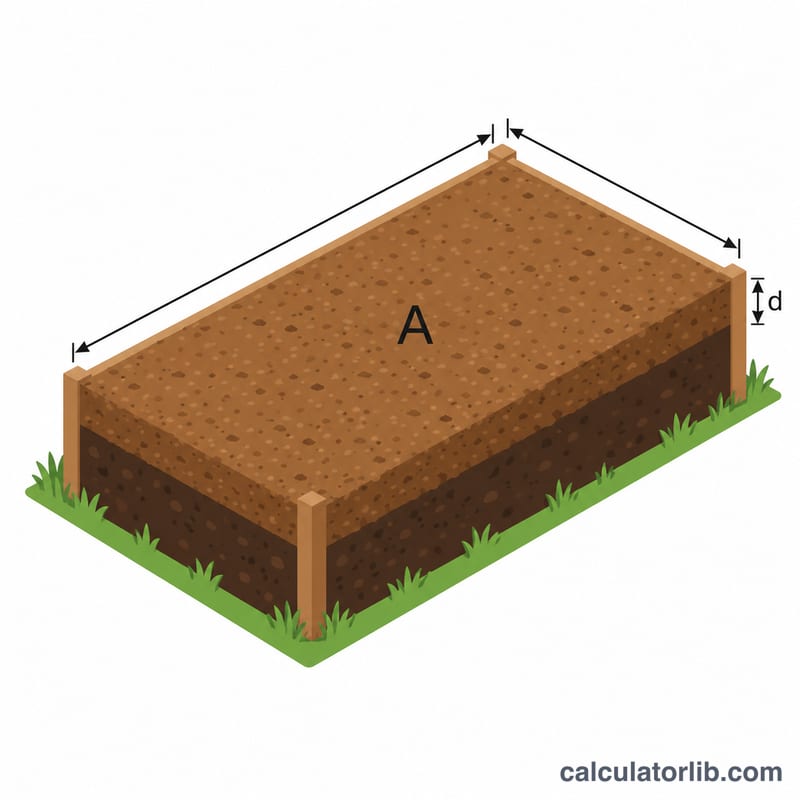
Worked Example
Suppose a raised bed is 100 square feet and you want a 3 inch layer of compost, sold in 1.5 cubic foot bags.
$$V = 100 \times \frac{3}{12} = 25\,\text{ft}^3$$ $$V_{yd^3} = \frac{25}{27} = 0.93\,\text{yd}^3$$ $$\text{Bags} = \left\lceil \frac{25}{1.5} \right\rceil = 17$$So you would buy 17 bags, or order roughly 0.93 cubic yards in bulk.
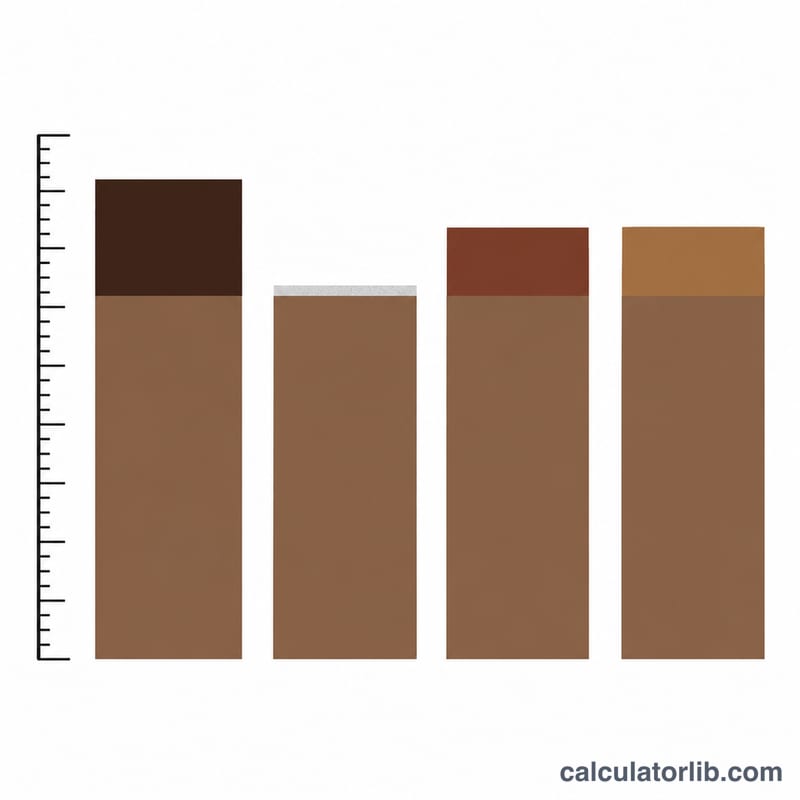
Typical Application Depths by Amendment Type
The depth you enter in the calculator depends on the amendment and how you use it. The ranges below are the ones cooperative extension services commonly publish for home gardens and lawns. Check your local extension office for advice suited to your soil and climate.
| Amendment | Use | Typical depth (inches) | Notes |
|---|---|---|---|
| Compost | Top-dressing an established lawn | 0.25–0.5 | Rake it into the turf so the grass blades aren't smothered. |
| Compost | Top-dressing an established bed | 1–3 | Spread it on the surface around plants. Keep it away from stems and trunks. |
| Compost | Worked into a new bed | 2–4 | Till it into the top 6–12 in of soil. |
| Peat moss | Mixed into soil | 1–3 | Moisten before mixing. Peat is acidic and adds few nutrients. |
| Aged manure | Mixed in or top-dressed | 1–3 | Use only well-aged or composted manure. Fresh manure can burn plants. |
Lime is different: you don't apply it by depth. Lime rates are given by weight per area, for example pounds per 1,000 sq ft. The right rate comes from a soil test that measures your soil's pH and buffer capacity. Use the rate on your soil test report, not a depth value in this calculator.
Source: general guidance published by US land-grant university cooperative extension services. Recommendations vary by region and soil type.
Bags, Cubic Feet and Cubic Yards: Quick Conversions
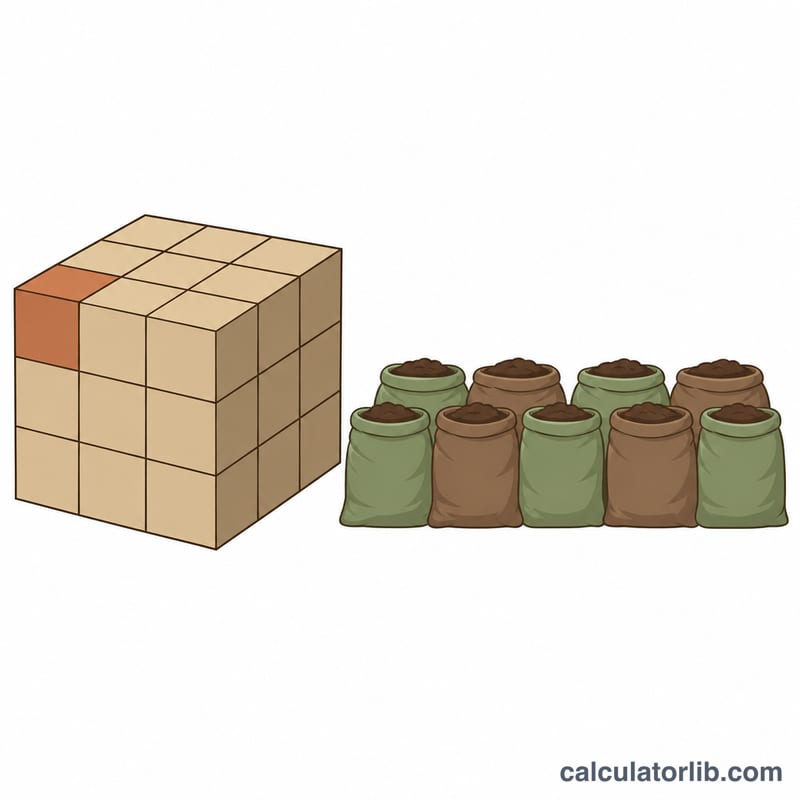
One cubic yard is 27 cubic feet (3 ft × 3 ft × 3 ft). To find how many bags make a cubic yard, divide 27 by the bag size:
$$\text{Bags per yd}^3 = \frac{27}{B}$$| Bag size (cu ft) | Bags per cubic yard (exact) | Bags to buy for 1 cu yd |
|---|---|---|
| 0.75 | 36 | 36 |
| 1 | 27 | 27 |
| 1.5 | 18 | 18 |
| 2 | 13.5 | 14 |
| 2.2 | about 12.27 | 13 |
| 3 | 9 | 9 |
| 3.8 (compressed peat bale) | about 7.11 by labeled volume | 8 by label (roughly 4 after expansion) |
Compressed peat: a compressed peat moss bale expands to roughly twice its labeled volume once you loosen it. A 3.8 cu ft bale gives about 7.6 cu ft of loose peat, so about 27 ÷ 7.6 ≈ 3.6 bales (4 to buy) fill one cubic yard. Check the label, because some brands list the expanded volume instead.
Area covered by 1 cubic yard
Depth in inches is divided by 12 to convert it to feet, so the area one cubic yard covers is:
$$A = \frac{27 \times 12}{d} = \frac{324}{d}$$| Depth (in) | Area covered by 1 cu yd (sq ft) |
|---|---|
| 1 | 324 |
| 2 | 162 |
| 3 | 108 |
| 4 | 81 |
Example: 324 sq ft covered 1 in deep needs \(324 \times \frac{1}{12} = 27\) cu ft, which is exactly 1 cubic yard. In 2 cu ft bags that is \(\lceil 27 / 2 \rceil = \lceil 13.5 \rceil\) = 14 bags.
Practical Ordering Tips
- Order 5–10% extra. Compost and other loose amendments settle once spread. Uneven ground, low spots and spills also use more than the flat-area calculation predicts. For example, a 200 sq ft bed covered 3 in deep needs \(200 \times \frac{3}{12} = 50\) cu ft (about 1.85 cu yd). In 1.5 cu ft bags that is \(\lceil 50 / 1.5 \rceil = \lceil 33.3 \rceil\) = 34 bags. Adding 10% (about 55 cu ft) brings it to roughly 37 bags.
- Compare bulk and bagged prices. Above roughly 1 cubic yard, bulk delivery or pickup by the yard usually costs less than the equivalent number of bags, even with a delivery fee. Bulk also means less plastic waste. Get quotes, since prices and minimum orders vary by supplier.
- Check how peat volume is labeled. Some peat bales list the compressed volume and others the expanded (loose) volume. A compressed bale yields roughly twice its labeled volume, so you need about half as many bales as the raw calculation suggests.
- Apply lime by weight, from a soil test. Don't use a depth for lime. Get a soil test, which is often available through your local cooperative extension service. Then apply the recommended rate in pounds per 1,000 sq ft (or your local unit). To find how much to buy, divide your area by 1,000, multiply by the rate, and divide by the weight of one bag.
- Measure the area accurately. Split irregular beds into rectangles and triangles, work out each area, and add them together before entering the total.
FAQ
How deep should I spread compost? For top-dressing an existing bed, 1 to 3 inches is typical; for building new beds you may want 4 to 6 inches mixed into the soil.
Why does it round bags up? Suppliers sell whole bags, so the calculator uses the ceiling function to make sure you have enough to finish the job.
Can I use this for lime? This tool estimates volume. Lime is often applied by weight per area, so convert using your product density if a weight-based rate is required.