What is the deer meat yield calculator?
This tool estimates how much usable, boneless venison you can expect to recover from a harvested deer. Hunters usually know either the live weight (on the hoof) or the field-dressed weight (after the entrails are removed), and both can be used to project how much meat actually ends up in the freezer.
The formula
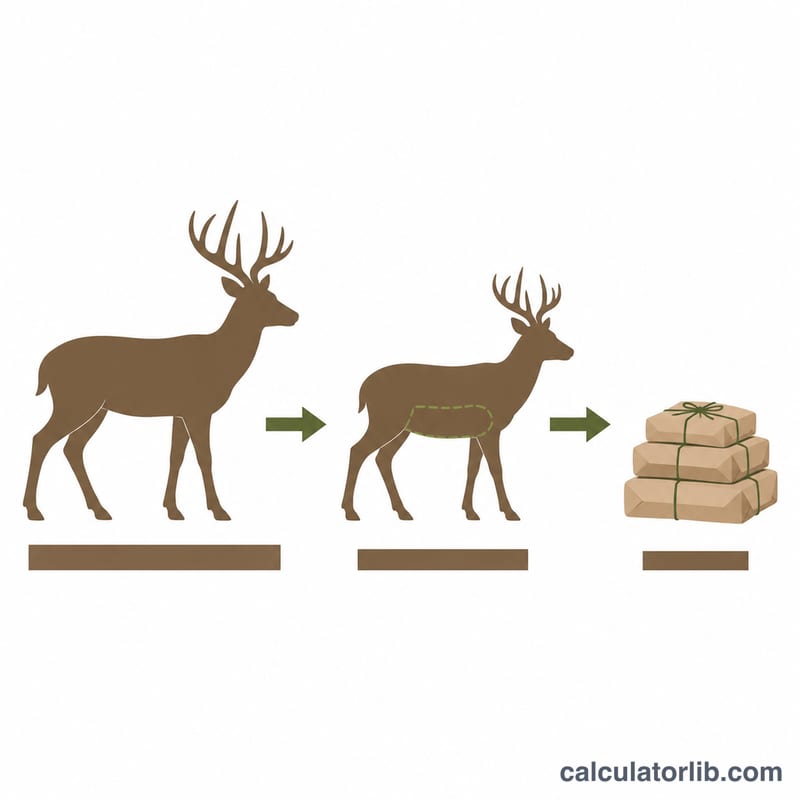
When you start from live weight, the field-dressed weight is about 78% of it, because field dressing removes roughly 20-22% of body mass:
$$W_{fd} = W_{live} \times 0.78$$The amount of boneless meat is then a percentage \(Y\) of the field-dressed weight:
$$\text{Meat} = W_{fd} \times \frac{Y}{100}$$Here \(W_{live}\) is the live weight, \(W_{fd}\) is the field-dressed weight, and \(Y\) is the boneless yield percentage.
How to use it
Choose whether your number is a live or field-dressed weight, enter the weight in pounds, and set the boneless yield percentage. If you are unsure, a yield of 55% of field-dressed weight is a reasonable average for a processed whitetail.
Worked example
Consider a whitetail with a live weight of 140 lb and a 55% yield. First convert to field-dressed weight:
$$W_{fd} = 140 \times 0.78 = 109.2\,\text{lb}$$Then apply the yield:
$$\text{Meat} = 109.2 \times \frac{55}{100} = 60.06\,\text{lb}$$So you would expect roughly 60 lb of boneless venison from that animal.
Venison Yield by Deer Size and Processing Method
The table starts with live weights chosen so the field-dressed (FD) weights come out near 80, 100, 120, 150 and 180 lb. It uses the calculator's rule of thumb: field-dressed weight = live weight × 0.78. Each boneless meat value is that field-dressed weight multiplied by the yield percentage:
$$\text{Usable Meat} = \text{Live Weight} \times 0.78 \times \frac{\text{Yield (\%)}}{100}$$For example, a 150 lb live deer field-dresses to \(150 \times 0.78 = 117\) lb. At 55% yield that gives \(117 \times 0.55 = 64.35\) lb of boneless venison.
| Live weight (lb) | Field-dressed weight (lb) | 50% yield – heavy home trim (lb) | 55% yield – typical (lb) | 60% yield – careful processing (lb) |
|---|---|---|---|---|
| 100 | 78.0 | 39.00 | 42.90 | 46.80 |
| 130 | 101.4 | 50.70 | 55.77 | 60.84 |
| 150 | 117.0 | 58.50 | 64.35 | 70.20 |
| 190 | 148.2 | 74.10 | 81.51 | 88.92 |
| 230 | 179.4 | 89.70 | 98.67 | 107.64 |
On any given deer, the difference between heavy home trim (50%) and careful processing (60%) works out to 10% of the field-dressed weight. That's about 8 lb on a small deer and nearly 18 lb on a large one. The 0.78 factor is an average, so a real carcass can come out above or below it. Treat these figures as planning estimates, not guarantees.
Practical Tips for Planning Your Venison
- Plan your freezer space. One cubic foot of freezer space holds roughly 30–35 lb of packaged meat. A deer that gives about 64 lb of boneless venison needs around 2 cubic feet (\(64 \div 32.5 \approx 2\)). Clear a bit more than that before you pick up the meat.
- Ask how your processor charges. Many processors price by hanging or field-dressed weight, not by how much packaged meat you get back. Others charge a flat fee per deer plus extra for sausage, jerky or other specialty items. Ask before you drop off the deer so the bill isn't a surprise.
- Expect lower yields from damaged deer. Bullet or broadhead damage near the shoulders or hindquarters means bloodshot meat that has to be cut away. Heavy trimming of fat, silverskin and connective tissue also lowers yield. If the deer was shot badly or you trim aggressively, use a yield near 50%. Use 55–60% only for clean shots and careful boning.
- Turn pounds into meals. Plan on roughly 1/4–1/2 lb of meat per serving. At those portion sizes, 64 lb of venison is about 128 to 256 servings (\(64 \div 0.5 = 128\), \(64 \div 0.25 = 256\)).
- Allow some slack. The calculator gives an estimate based on average ratios. Buy a few extra freezer bags, vacuum-seal pouches or butcher paper, and expect the actual weight to differ by several pounds either way.
- Count any added fat. Venison is very lean, so many hunters mix pork or beef fat into burger or sausage. That fat adds to the total weight. For example, mixing 10 lb of pork fat into 40 lb of venison trim makes 50 lb of ground meat. Include it when you plan packaging and freezer space.
FAQ
Why 78%? Field dressing removes the digestive organs, which make up about 20-22% of live weight, leaving close to 78%.
What yield should I use? Boneless venison is usually 50-60% of field-dressed weight; home processing with heavy trim loss sits at the lower end.
Does this include bone-in cuts? No, the default models boneless, trimmed meat. Raise the yield percentage if you keep bone-in roasts.