What is the Soil Fertilizer Calculator?
The Soil Fertilizer Calculator tells you how many kilograms of a fertilizer product to spread across a field so that your crop receives the nutrient it actually needs. It combines three agronomic facts: the size of the field, the target nutrient rate your crop requires, and the nutrient already available in the ground according to your latest soil test. By accounting for soil reserves it helps you avoid both under-feeding and the waste and runoff that come from over-application.
How to use it
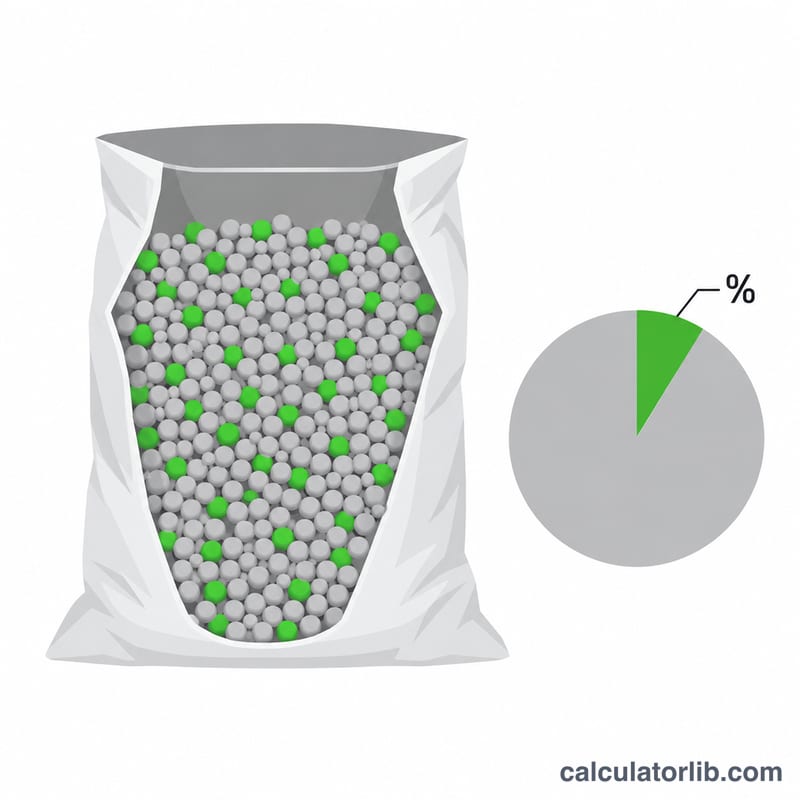
Enter the Area of the field in hectares, the Target Nutrient Rate your agronomist recommends in kilograms per hectare, the Soil Test Credit (the nutrient already supplied by the soil, also in kg/ha), and the Fertilizer Nutrient Content as a percentage. For nitrogen this is the first number of the N-P-K label, for example \(46\%\) for urea. The calculator returns the net rate, the total nutrient required, and the actual product weight to buy and apply.
The formula explained
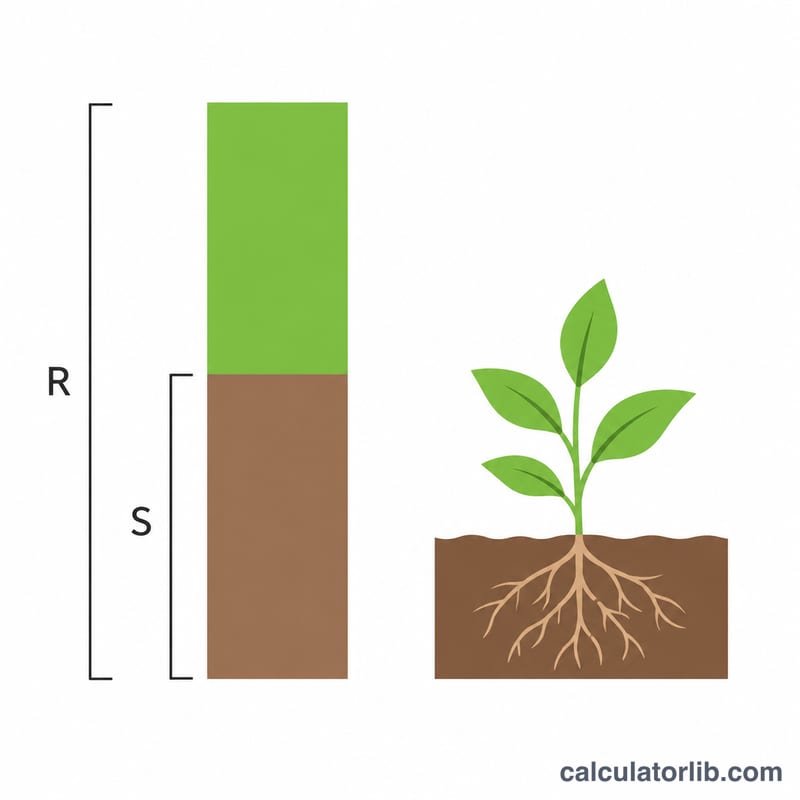
First the soil credit is subtracted from the target to find the net rate still needed, then that is scaled by area and divided by the nutrient fraction in the bag:
$$\text{Product} = \frac{(\text{Target} - \text{Soil})\times \text{Area}}{\text{Nutrient }\% / 100}$$where \(\text{Target}\) and \(\text{Soil}\) are in kg/ha, \(\text{Area}\) is in hectares, and the nutrient content is a percent of the product mass.
Worked example
Suppose you have a \(2\,\text{ha}\) field, a target of \(150\,\text{kg/ha}\) of nitrogen, a soil test credit of \(30\,\text{kg/ha}\), and you are using urea at \(46\%\) N.
$$\text{Net rate} = 150 - 30 = 120\,\text{kg/ha}$$$$\text{Needed} = 120 \times 2 = 240\,\text{kg}$$$$\text{Product} = \frac{240}{0.46} \approx 521.7\,\text{kg}$$So you would apply roughly \(522\) kg of urea across the field.
Unit and Nutrient-Form Conversions
The calculator works in hectares and kg/ha. Use these factors to convert acres, lb/acre, or elemental P and K recommendations before you enter them.
| From | To | Multiply by | Example |
|---|---|---|---|
| acres | hectares (ha) | 0.4047 | 10 acres × 0.4047 = 4.047 ha |
| hectares (ha) | acres | 2.471 | 5 ha × 2.471 = 12.36 acres |
| lb/acre | kg/ha | 1.121 | 150 lb/acre × 1.121 = 168.2 kg/ha |
| kg/ha | lb/acre | 0.892 | 120 kg/ha × 0.892 = 107.0 lb/acre |
| P2O5 | P (elemental) | 0.436 | 100 kg P2O5 × 0.436 = 43.6 kg P |
| P (elemental) | P2O5 | 2.291 | 20 kg P × 2.291 = 45.8 kg P2O5 |
| K2O | K (elemental) | 0.830 | 100 kg K2O × 0.830 = 83.0 kg K |
| K (elemental) | K2O | 1.205 | 50 kg K × 1.205 = 60.3 kg K2O |
| short ton (US) | kg | 907.2 | 2 short tons × 907.2 = 1,814.4 kg |
| tonne (metric) | kg | 1000 | 1.5 t × 1000 = 1,500 kg |
The P and K factors come from atomic masses. P2O5 contains two P atoms (2 × 30.97 = 61.95) in a molecular mass of about 141.94, which gives 0.436. K2O contains two K atoms (2 × 39.10 = 78.20) in a molecular mass of about 94.20, which gives 0.830. The lb/acre factor follows from the unit sizes:
$$1\ \text{lb/acre} = \frac{0.4536\ \text{kg}}{0.4047\ \text{ha}} \approx 1.121\ \text{kg/ha}$$
Practical Tips for Buying and Applying Fertilizer
- Round up to whole bags. The calculator gives an exact weight, but fertilizer is usually sold in fixed bags, often 25 kg or 50 kg. For example, take a target of 120 kg N/ha with a soil test credit of 30 kg/ha on 2 ha, using urea (46% N). The amount needed is \((120 - 30) \times 2 / 0.46\) = 391.3 kg. That rounds up to 8 bags of 50 kg (400 kg) or 16 bags of 25 kg.
- Calibrate the spreader to the product rate. Spreaders are set to a rate of product per hectare, not nutrient per hectare. Divide the net nutrient rate by the nutrient fraction: \(90 / 0.46 \approx 195.7\) kg of urea per ha in the example above. Do a calibration check, such as catch trays or weighing over a measured strip, before treating the whole field.
- Consider splitting nitrogen. Nitrogen can be lost through leaching, volatilization, or denitrification. Splitting the total N into two or more applications timed to crop uptake can make it more efficient. Examples are a portion at planting and the rest as a top-dress or side-dress. Use the calculator once for each split, entering that split's share of the target rate.
- Calculate each nutrient separately with blends. With an NPK blend or a multi-nutrient product such as DAP (18-46-0), first calculate the rate for the nutrient that controls the decision, often P2O5. Then work out how much of the other nutrients that amount supplies (product kg × % ÷ 100). Count those as credits before calculating the remaining N or K from straight fertilizers, or you will over-apply.
- Use recent soil test results. Base soil test credits on a test from the last 2–3 years, taken with consistent sampling depth and timing. Older results may not reflect recent crop removal, manure, or past fertilizer applications.
- Match units and nutrient forms. Make sure the target rate, soil credit, and label percentage all use the same form (N, P2O5, K2O) and the same units (kg/ha) before calculating.
This is general information, not agronomic or professional advice. Recommended nutrient rates depend on crop, yield goal, soil, climate, and local regulations. Some regions set legal limits on nitrogen or phosphorus application. Check with a local agronomist or extension service for rates suited to your field.
FAQ
What if my soil test credit is higher than the target? The net rate is clamped to zero, meaning your soil already supplies enough of that nutrient and no fertilizer is required.
Which nutrient percentage do I enter? Use the percentage for the single nutrient you are targeting, for example the N value for nitrogen or the P value for phosphorus from the N-P-K analysis.
Can I use acres instead of hectares? Keep units consistent: if you work in acres, enter the target rate per acre and the area in acres, and the result will be the product weight for that area.