What this calculator does
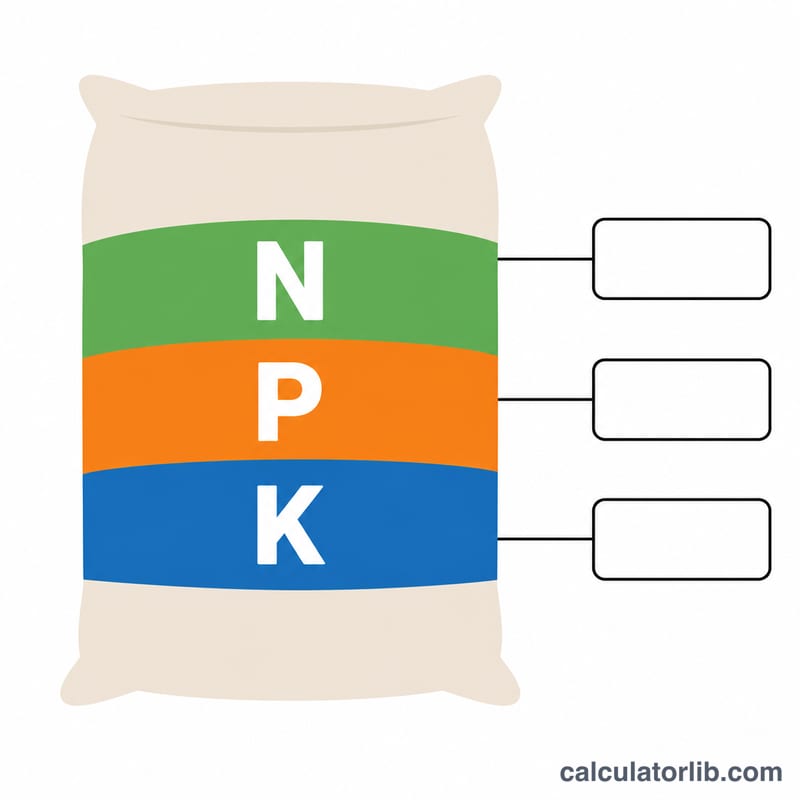
The NPK Fertilizer Calculator tells you how many pounds of a fertilizer product you must spread to hit a target application rate for each of the three primary nutrients: nitrogen (N), phosphorus (P), and potassium (K). Fertilizer bags carry a grade such as 10-10-10, which lists the percentage by weight of each nutrient. Because only part of the bag is any single nutrient, you always need more product than the target weight of pure nutrient.
How to use it
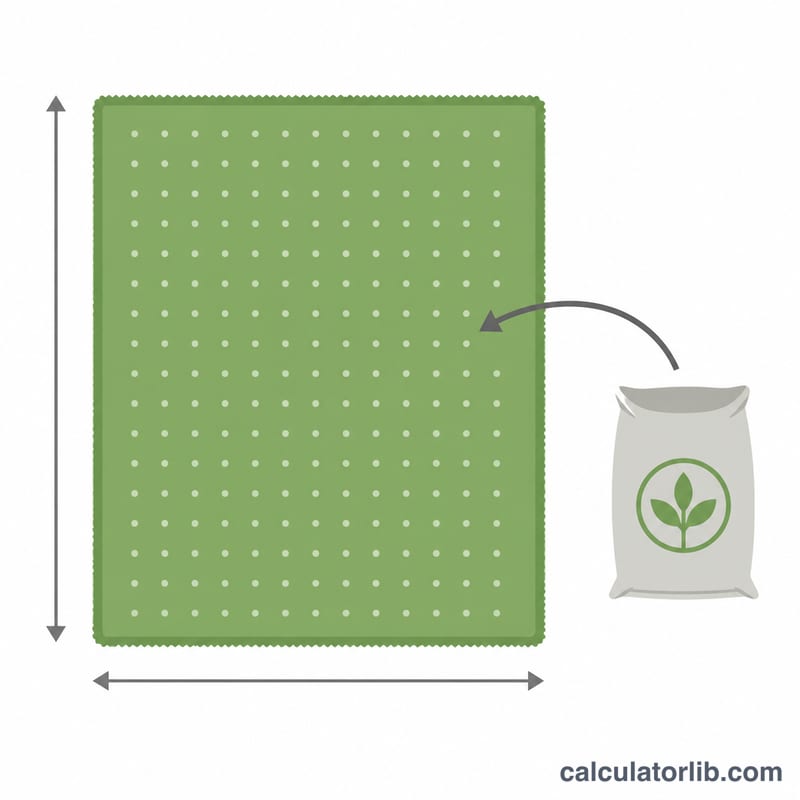
Enter the area you are treating in units of 1,000 square feet, the target rate for each nutrient in pounds per 1,000 square feet, and the three grade percentages printed on the bag. The tool computes the product weight needed for each nutrient independently, so you can see which nutrient is the binding constraint.
The formula explained
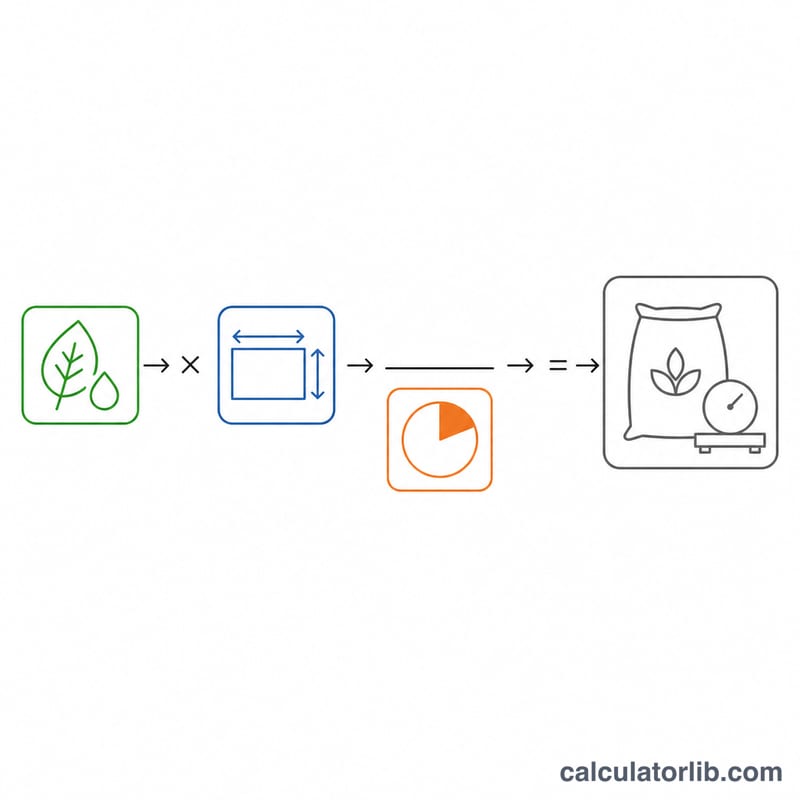
For any nutrient the amount of product is the target rate times the area, divided by the fraction of that nutrient in the product:
$$\text{Fertilizer} = \frac{R \times A}{G / 100}$$Here \(R\) = target rate in lb per 1,000 sq ft, \(A\) = area in units of 1,000 sq ft, and \(G\) = that nutrient's grade percentage. Dividing by \(G/100\) scales the pure-nutrient weight up to the total product weight.
Worked example
Suppose you want \(1\) lb of nitrogen per 1,000 sq ft over an area of \(1\) unit, using a 10-10-10 product so \(G = 10\):
$$\text{Fertilizer} = \frac{1 \times 1}{10 / 100} = \frac{1}{0.1} = 10\ \text{lb}$$So 10 lb of product delivers the target 1 lb of N, plus 1 lb each of P and K at that grade.
FAQ
Why do the three answers differ? Each nutrient has its own target and its own grade, so the product weight needed to satisfy each one can be different. The largest value is usually the amount you actually apply.
Do the grades use P2O5 and K2O? Yes. Bag labels report phosphorus as \(\text{P}_2\text{O}_5\) and potassium as \(\text{K}_2\text{O}\); enter the label numbers directly and keep your target rates in the same terms.
What if a grade is zero? A product with 0% of a nutrient cannot supply it, so the calculator reports 0 for that nutrient rather than dividing by zero.