What this calculator does
The Fertilizer Spread Rate Calculator tells you how much of a fertilizer product to apply so that a lawn, field, or garden bed receives a specific amount of a nutrient such as nitrogen. Because fertilizer bags contain only a percentage of the labeled nutrient, you cannot simply spread the target amount of nutrient directly. This tool converts your target nutrient rate into the actual weight of product to spread.
The formula explained
The product needed per 1000 square feet is the target nutrient rate divided by the nutrient fraction in the bag:
$$R = \frac{N_t}{p/100}$$where \(N_t\) = target nutrient rate in lbs per 1000 sq ft and \(p\) = nutrient percentage on the label. The total product is that rate scaled to your area \(A\):
$$P = R \times \frac{A}{1000}$$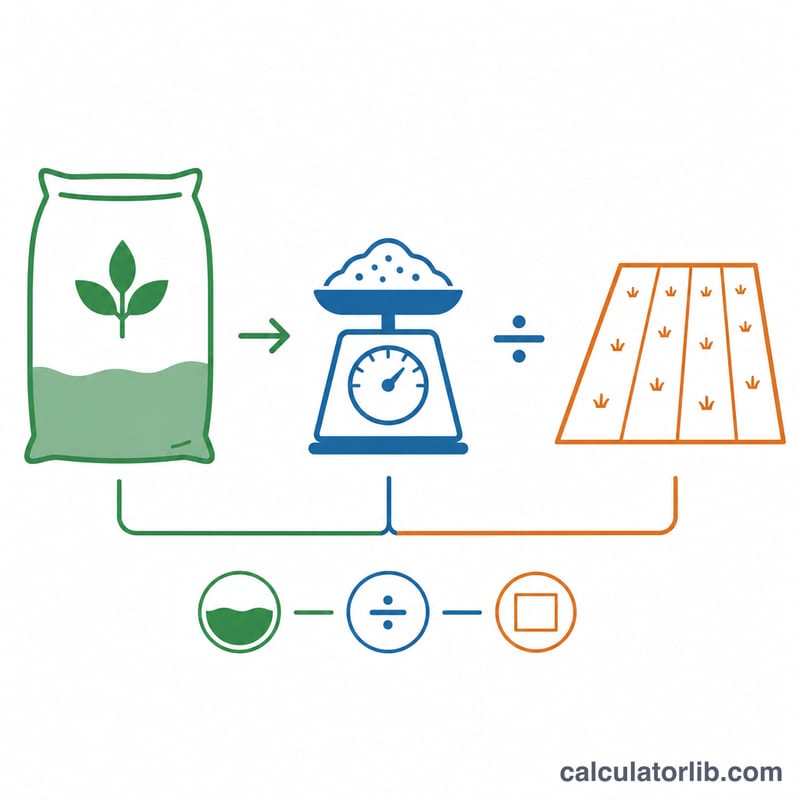
How to use it
Enter your target nutrient rate (for example \(1\) lb of nitrogen per 1000 sq ft), the nutrient percentage from the bag analysis (the first number in an N-P-K label), and the total area to cover in square feet. The calculator returns both the spread rate per 1000 sq ft and the total product to buy.
Worked example
Suppose you want \(1\) lb of nitrogen per 1000 sq ft using a \(25\%\) nitrogen fertilizer over a \(5000\) sq ft lawn. First find the product per 1000 sq ft:
$$R = \frac{1}{25/100} = 4\,\text{lbs}$$Then scale to the full area:
$$P = 4 \times \frac{5000}{1000} = 20\,\text{lbs}$$So you would spread 20 lbs of product total, at 4 lbs per 1000 sq ft.
Typical Nitrogen Rates for Lawns
Most lawn fertilizer advice is given as pounds of actual nitrogen (N) per 1000 square feet. This is the US customary unit used by US university extension services, and it is the unit this calculator uses. For reference, 1 lb per 1000 sq ft is about 4.9 g per square metre. The figures below are commonly cited US extension guidance for turfgrass. They are general starting points, not rules that apply everywhere.
Rate per application
- General range: 0.5–1 lb N per 1000 sq ft per application.
- Quick-release (soluble) nitrogen, such as urea or ammonium sulfate: usually kept at or below about 0.5–0.75 lb N per 1000 sq ft per application. This lowers the risk of burning the grass, causing a sudden growth surge, or losing nitrogen by leaching.
- Slow-release nitrogen, such as polymer- or sulfur-coated urea, methylene urea or natural organic products: can usually go up to about 1 lb N per 1000 sq ft per application.
Typical annual totals by grass type
| Grass group | Examples | Typical annual N (lb per 1000 sq ft per year) |
|---|---|---|
| Cool-season | Kentucky bluegrass, tall fescue, perennial ryegrass | About 2–4 |
| Warm-season, higher input | Bermudagrass | About 2–5 |
| Warm-season, low input | Centipedegrass | Lower, often about 1–2 |
To schedule the year, divide the annual total into separate applications that each stay within the per-application range above. For example, 3 lb N per year could be applied as three applications of 1 lb using a slow-release product, or as more frequent, smaller applications using quick-release nitrogen.
The right amount depends on your region and climate, the exact grass species and cultivar, whether clippings are left on the lawn, irrigation, and how the lawn is used. A soil test is the best guide for phosphorus, potassium and pH. For the best figures, check your local extension service or agronomy advisor.
Product Needed for Common Fertilizer Analyses
The amount of product you need depends on its nitrogen percentage, which is the first number in the N-P-K analysis on the bag. The table below is for a target of 1 lb N per 1000 sq ft. It uses the calculator's formula. For urea (46% N), for example:
$$F_{1000} = \frac{1}{46/100} = \frac{1}{0.46} \approx 2.17 \text{ lb per 1000 sq ft}$$$$F_{total} = 2.17 \times \frac{5000}{1000} \approx 10.9 \text{ lb}$$| Product N content | Example | Product per 1000 sq ft (lb) | Total for a 5000 sq ft lawn (lb) |
|---|---|---|---|
| 46% | Urea (46-0-0) | 2.17 | 10.9 |
| 34% | e.g. 34-0-0 | 2.94 | 14.7 |
| 29% | e.g. 29-0-4 lawn blend | 3.45 | 17.2 |
| 25% | e.g. 25-0-5 lawn blend | 4 | 20 |
| 21% | Ammonium sulfate (21-0-0) | 4.76 | 23.8 |
| 16% | e.g. 16-4-8 | 6.25 | 31.3 |
| 10% | e.g. 10-10-10 | 10 | 50 |
Products with a lower analysis need much more weight to supply the same nitrogen. A 10% product needs more than four times the weight of urea. Keep in mind that a 1 lb target sits at the top of the usual range for quick-release products such as urea and ammonium sulfate. For those, a target of 0.5–0.75 lb is often preferred, which would reduce every figure in the table proportionally.
Practical Spreading Tips
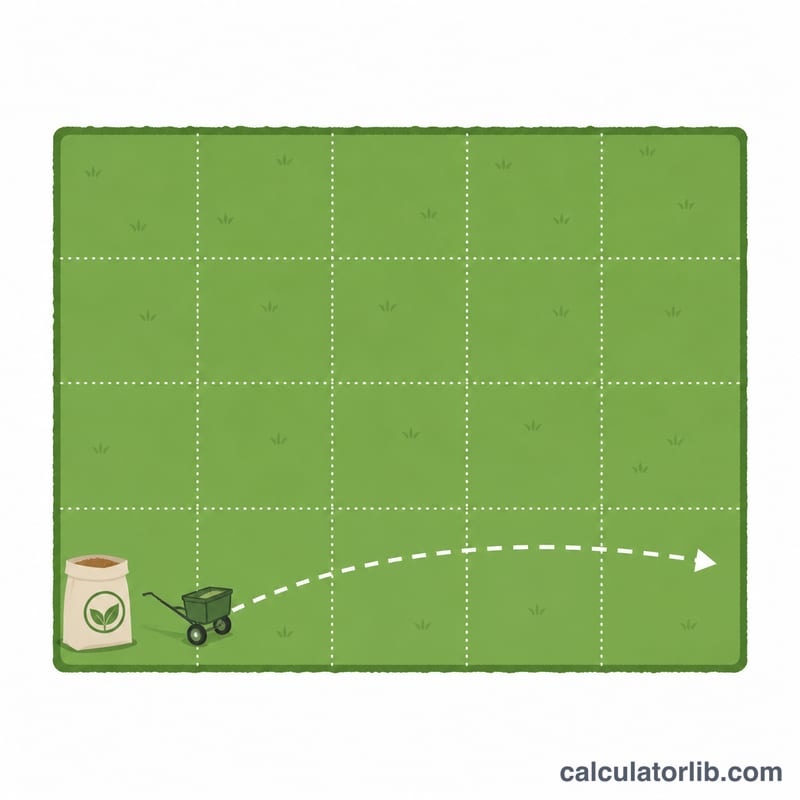
- Measure the area accurately. Measure only the turf you will fertilize. Leave out the house footprint, driveway, patios, paths and planting beds. Overstating the area leads directly to over-application.
- Round up to whole bags and check the weight. Compare the calculated total with the net weight printed on the bag. For example, 23.8 lb of product means one 25 lb bag is enough, but 50 lb may need two bags if they are sold in 40 lb sizes. Store leftover product dry and sealed.
- Set the spreader to the calculated rate. Calibrate your spreader so it delivers the calculated pounds of product per 1000 sq ft. One way is to spread over a measured test area and weigh what was used. Alternatively, start from the spreader setting printed on the bag for your spreader model, then check that it matches your target rate.
- Use two perpendicular passes. Set the spreader to deliver half the rate. Cover the lawn once in one direction, then again at right angles. This evens out striping and missed strips.
- Water in when the label says to. Many quick-release products need to be watered in soon after application. This moves the nitrogen into the soil and reduces leaf burn and volatilization losses.
- Keep granules off hard surfaces. Sweep or blow stray granules from driveways, sidewalks and streets back onto the lawn. Fertilizer left on paving can wash into storm drains and waterways.
- Follow local rules. Some jurisdictions, including a number of US states and municipalities, restrict when fertilizer may be applied (for example, blackout periods or no application on frozen ground). Some also limit or ban phosphorus on established lawns unless a soil test shows it is needed. Check the regulations where you live before you buy or spread.
FAQ
Which label number do I use? Use the percentage of the nutrient you are targeting. For nitrogen it is the first number in the N-P-K analysis.
Can I use metric units? The tool assumes pounds and square feet, but the ratio math works with any consistent set of units.
Why is the product weight higher than the nutrient rate? Because the bag is only partly nutrient. A 25% product means only a quarter of its weight is the nutrient, so you spread four times the nutrient rate.