What this calculator does
The Fertilizer Ratio Calculator tells you how much of a bagged NPK product you need to apply so that your lawn, garden, or field receives a target nitrogen rate. It also reports how much phosphorus and potassium tag along, so you can judge whether the ratio fits your soil test.
The formula explained
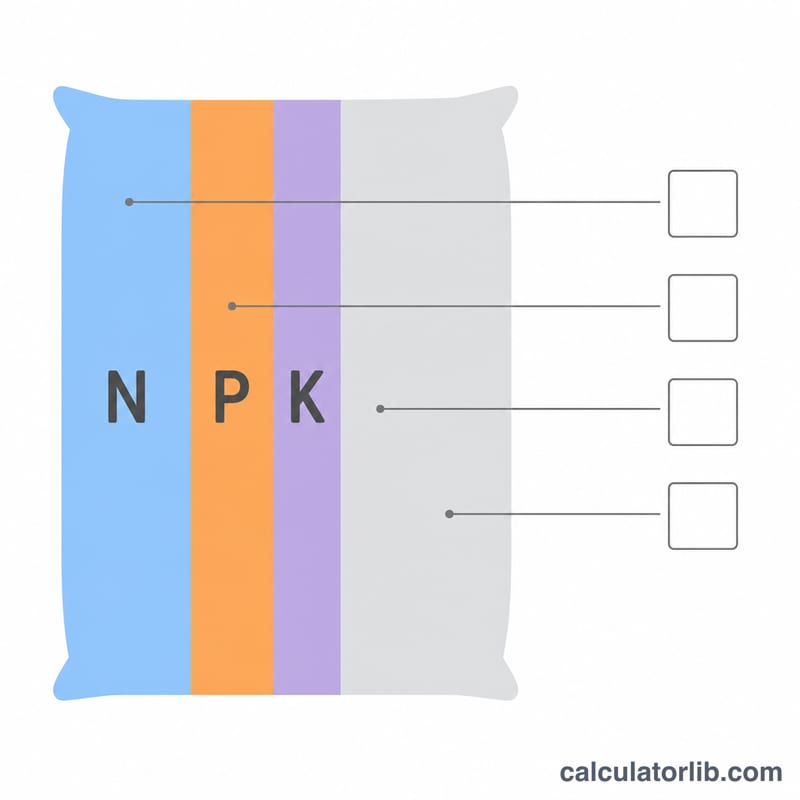
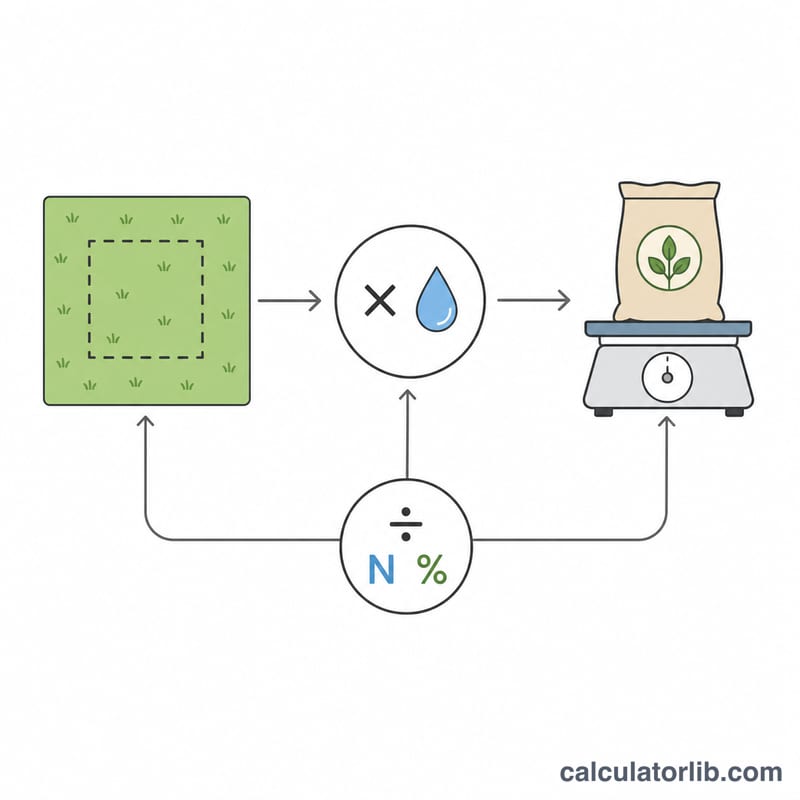
Nitrogen rates are normally quoted in pounds per 1000 square feet. The total nitrogen you actually need is the rate times the area in thousands of square feet. Dividing that by the nitrogen fraction of the product gives the pounds of product to spread:
$$F = \frac{R \times (A / 1000)}{p_N / 100}$$Here \(F\) = pounds of fertilizer product, \(R\) = target nitrogen rate in lb per 1000 sq ft, \(A\) = area in square feet, and \(p_N\) = the first number on the bag (percent nitrogen). Each secondary nutrient delivered is \(N_{del} = F \times \tfrac{p}{100}\), where \(p\) is the P2O5 or K2O percentage.
How to use it
Enter the area to be treated, the nitrogen rate you want (often 0.5 to 1 lb per 1000 sq ft per feeding), and the three analysis numbers printed on the bag. The calculator returns the product weight to apply and the phosphorus and potassium that come with it.
Worked example
Suppose you treat 5000 sq ft at 1 lb of nitrogen per 1000 sq ft with a 20-5-10 fertilizer. Total nitrogen needed is \(1 \times 5 = 5\) lb, so:
$$F = \frac{5}{20 / 100} = 25\ \text{lb}$$That 25 lb also supplies \(25 \times 0.05 = 1.25\) lb of P2O5 and \(25 \times 0.10 = 2.5\) lb of K2O.
Oxide-to-Element and Rate Unit Conversions
In the United States, Canada and many other countries, the three numbers on a fertilizer label (the N-P-K grade) give nitrogen as elemental N. Phosphorus is given as phosphate (P2O5) and potassium as potash (K2O). Some countries print elemental P and K instead, so check which form your label uses. The P and K amounts this calculator reports are in the same form as the percentages you enter. If you enter the label grade, the results are lb of P2O5 and K2O. Use the factors below to convert between the oxide and elemental forms.
| Conversion | Multiply by |
|---|---|
| P2O5 → P | 0.436 |
| P → P2O5 | 2.29 |
| K2O → K | 0.830 |
| K → K2O | 1.20 |
| Rate or area unit | Equivalent |
|---|---|
| 1 lb/1000 sq ft | 43.56 lb/acre |
| 1 lb/1000 sq ft | ≈ 48.8 kg/ha |
| 1 lb/1000 sq ft | ≈ 4.88 g/m² |
| 1 acre | 43,560 sq ft |
| 1 m² | 10.764 sq ft |
Worked line (20-5-10): to apply 1 lb N/1000 sq ft over 5,000 sq ft, the calculator gives
$$\text{Fertilizer} = \frac{1 \times \dfrac{5000}{1000}}{\dfrac{20}{100}} = \frac{5}{0.20} = 25\ \text{lb}$$That is 25 lb of product. It supplies \(25 \times 0.05 = 1.25\) lb of P2O5, which is \(1.25 \times 0.436 \approx 0.55\) lb of elemental P. It also supplies \(25 \times 0.10 = 2.5\) lb of K2O, which is \(2.5 \times 0.830 \approx 2.08\) lb of K.
Typical Nitrogen Rates by Use
The ranges below are commonly cited by US university extension services and are given in US units (lb N per 1,000 sq ft). They are general starting points, not universal standards. The right rate depends on your region and climate, the grass species or crop, how long the growing season is, whether clippings are returned, and your soil test results. Check your local extension service or agricultural advisory body for recommendations that fit your conditions.
| Use | Typical N rate (lb N/1000 sq ft) | Notes |
|---|---|---|
| Lawn, single application | 0.5–1.0 | Apply no more than about 0.5 lb of soluble (quick-release) N at one time to limit burn and leaching |
| Cool-season lawn, low input (annual total) | ≈ 1–2 | Lower-maintenance turf |
| Cool-season lawn, maintained (annual total) | ≈ 2–4 | For example, Kentucky bluegrass or tall fescue under regular care |
| Warm-season lawn (annual total) | ≈ 2–5 | For example, bermudagrass; the higher rates suit long growing seasons |
| Vegetable garden (per season) | ≈ 2–3 | Often split between a pre-plant application and side-dressings |
To use a metric rate, convert with 1 lb/1000 sq ft ≈ 48.8 kg/ha ≈ 4.88 g/m². For example, 0.5 lb N/1000 sq ft ≈ 2.4 g N/m². Enter the single-application rate in the N Rate field, not the annual total. The calculator then shows how much product is needed for each feeding.
Practical Application Tips
- Convert the result into bags. Divide the total product weight by the bag weight and round up to a whole bag. For example, 25 lb of product from 15 lb bags is \(25 \div 15 \approx 1.67\), so buy 2 bags and store what is left somewhere dry.
- Split large annual totals. Do not apply a whole season's nitrogen at once. Divide it into several feedings at the per-application rate and time them to when the grass or crop is actively growing.
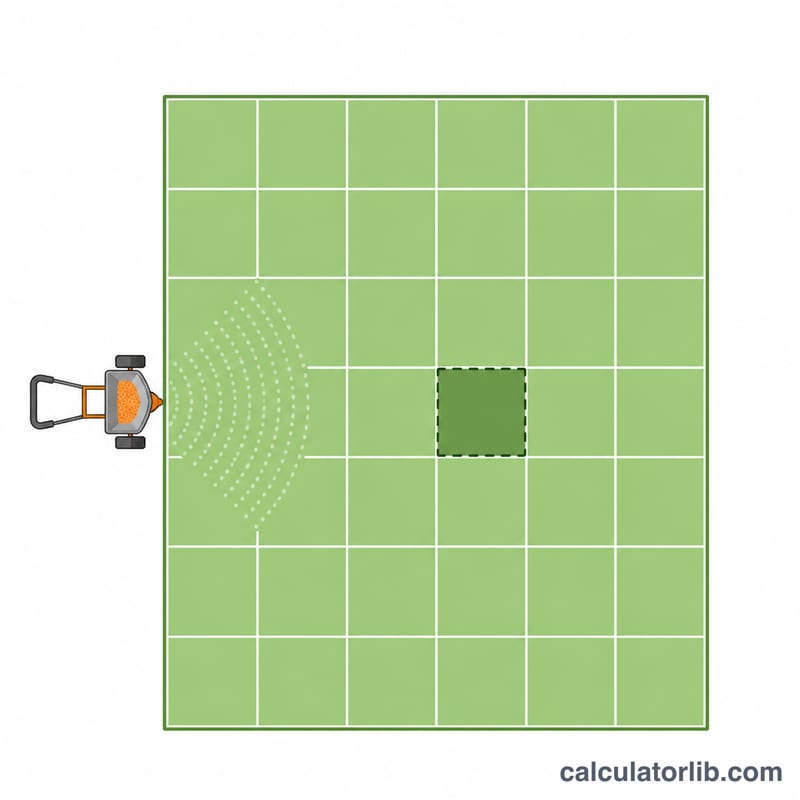
- Get even coverage. Calibrate your spreader to the product you are using, because label settings are only approximate. Another option is to set the spreader to deliver half the amount and make two passes at right angles to each other. This reduces stripes and missed spots.
- Measure the area accurately. Measure the area you will actually fertilize, and subtract driveways, patios, walkways, buildings and beds you will not treat. If you overestimate the area, you will overapply.
- Water in and keep it contained. Lightly water in soluble products, as the label directs, so they move into the soil and are less likely to burn. Sweep or blow any granules off pavement back onto the turf. Leave an unfertilized buffer next to streams, ponds and storm drains.
- Match P and K to the soil test. If the calculator shows more phosphorus or potassium than your soil test calls for, choose a fertilizer with a different ratio. Where lawn phosphorus is restricted, use a 0-P formulation (for example 20-0-10). Several US states and some other jurisdictions have such restrictions unless a soil test or new seeding justifies phosphorus.
This is general information for home and garden use, not professional agronomic advice. Always follow the product label and any local rules on fertilizer use.
FAQ
What do the three numbers mean? They are the percent by weight of nitrogen (N), phosphate (P2O5), and potash (K2O) in the bag, in that order.
Can I base it on phosphorus instead? This tool sizes the application to your nitrogen target because nitrogen usually drives feeding schedules; the P and K delivered are shown so you can check them against a soil test.
What units are used? Area in square feet, rate in pounds per 1000 square feet, and all outputs in pounds of material.