What It Is
The Paver Patio Cost Calculator estimates how much it will cost to build a paver patio based on its size, the price of your pavers, a waste allowance for cuts and breakage, and your labor rate. It splits the estimate into material and labor so you can see where the money goes before you buy anything.
How To Use It
Enter the patio length and width in feet, the paver cost per square foot, a waste factor as a percentage, and the labor cost per square foot. The calculator returns the base area, the waste-adjusted area, the material cost, the labor cost, and the total.
The Formula Explained
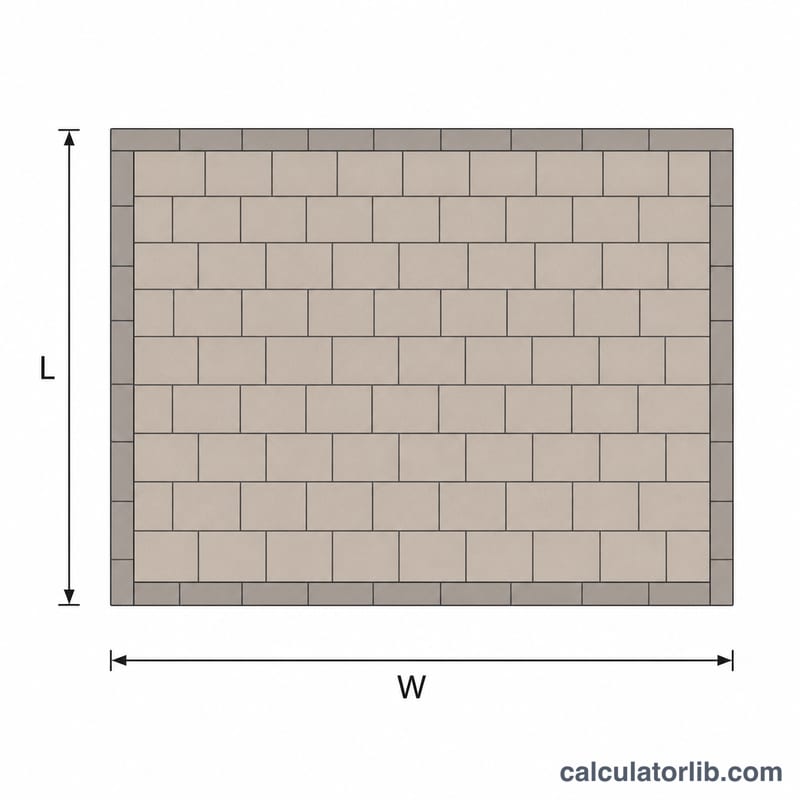
First find the area, where \(L\) = length in feet and \(W\) = width in feet:
$$A = L \times W$$Materials are priced on the area plus a waste factor \(w\) (as a decimal) at paver price \(p\), while labor uses the base area at rate \(l\):
$$\text{Total} = A(1+w)\,p + A\,l$$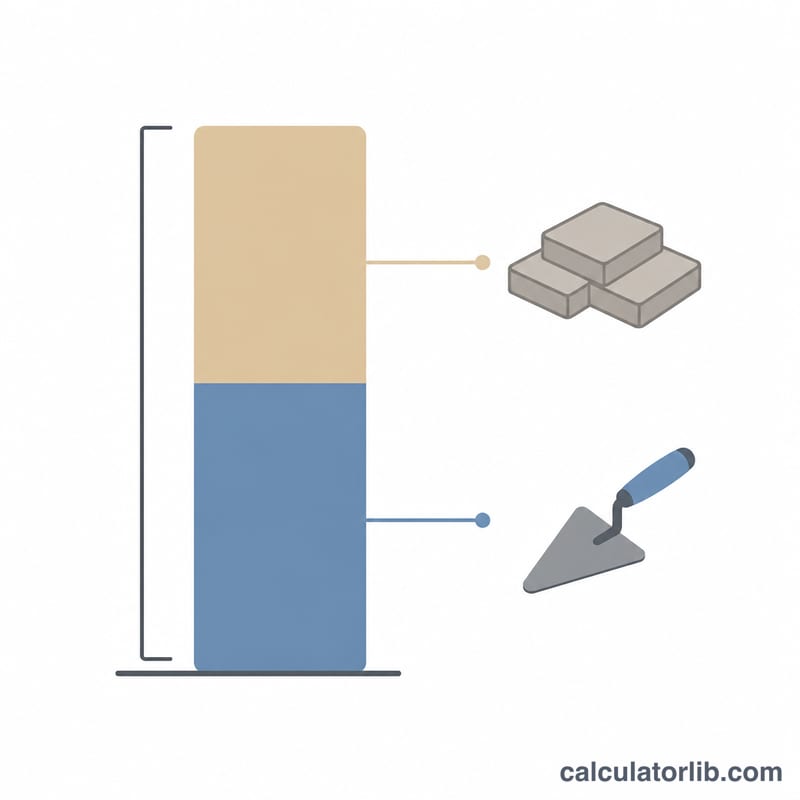
Worked Example
For a 20 ft by 10 ft patio with pavers at $5 per sq ft, a 10% waste factor, and labor at $8 per sq ft:
$$A = 20 \times 10 = 200\,\text{sq ft}$$$$\text{Material} = 200(1.10)\times 5 = \$1{,}100$$$$\text{Labor} = 200 \times 8 = \$1{,}600$$$$\text{Total} = 1100 + 1600 = \$2{,}700$$Cost Comparison: Patio Sizes and Paver Types
The table compares four common patio sizes built with two types of paver. Concrete pavers are priced at $4 per sq ft and natural stone at $15 per sq ft. Both use a 10% waste factor and labor at $8 per sq ft. All prices are illustrative US-dollar figures. Real prices depend on your region, supplier, paver style and site conditions, so replace them with local quotes. Every row uses the calculator's formula:
$$\text{Total} = A\left(1+\frac{\text{Waste}}{100}\right)\times \text{Paver Cost} + A \times \text{Labor Cost},\quad A = L \times W$$For example, a 16 × 20 ft patio has \(A = 320\) sq ft. The waste-adjusted area is \(320 \times 1.10 = 352\) sq ft. With natural stone, material costs \(352 \times \$15 = \$5{,}280\) and labor costs \(320 \times \$8 = \$2{,}560\), so the total is \(\$5{,}280 + \$2{,}560 = \$7{,}840\).
| Size (ft) | Area (sq ft) | Waste-adjusted area (sq ft) | Labor ($8/sq ft) | Concrete material ($4/sq ft) | Concrete total | Natural stone material ($15/sq ft) | Natural stone total |
|---|---|---|---|---|---|---|---|
| 10 × 10 | 100 | 110 | $800 | $440 | $1,240 | $1,650 | $2,450 |
| 12 × 12 | 144 | 158.4 | $1,152 | $633.60 | $1,785.60 | $2,376 | $3,528 |
| 16 × 20 | 320 | 352 | $2,560 | $1,408 | $3,968 | $5,280 | $7,840 |
| 20 × 20 | 400 | 440 | $3,200 | $1,760 | $4,960 | $6,600 | $9,800 |
Waste is added only to the material, because you buy extra pavers to cover cuts and breakage. Labor is charged on the actual patio area. In this table the paver type changes only the material cost. In practice, natural stone often costs more to install because it is heavier and harder to cut, so ask installers for a separate labor rate for each material. These totals also leave out base materials, edging, excavation and haul-away, which are covered in the next section.
Practical Tips for Ordering and Budgeting
This is general information, not professional construction or financial advice. Local building codes, soil conditions and supplier practices vary, so confirm the details with local suppliers or contractors.
- Match the waste factor to the layout. About 5% is usually enough for a simple rectangle laid in a running-bond or stack pattern. Use 10–15% for curved edges, circles or herringbone and other diagonal patterns, because these need many more cut pieces.
- Round up to full pallets or bundles. Pavers are often sold by the pallet, bundle or fixed square-foot unit. After applying waste, round your total up to the next full unit. Keep a few spare pavers from the same production batch, since colors can vary between batches and the spares make later repairs easier.
- Budget separately for base materials. The calculator covers only pavers and labor. A typical installation also needs:
- a compacted gravel base about 4–6 in deep (deeper on poor soils, in freezing climates or under vehicle traffic). For example, a 4 in base under a 320 sq ft patio is \(320 \times \tfrac{4}{12} \approx 106.7\) cu ft, which is about 4 cu yd before compaction;
- about 1 in of bedding sand, which is roughly \(320 \times \tfrac{1}{12} \approx 26.7\) cu ft (about 1 cu yd) for the same patio;
- edge restraints around the perimeter to stop the pavers from spreading;
- polymeric sand to fill the joints;
- optionally, a geotextile fabric under the base.
- Allow for excavation and disposal. Removing sod, soil or an old slab can mean dumpster fees, haul-away charges or equipment rental. If you hire out, these costs can add noticeably to the total.
- Add a contingency of about 10%. Unexpected roots, drainage fixes, grading changes or price increases are common, so add about 10% to the estimate as a buffer.
- Get several itemized quotes. Ask at least three contractors to break out pavers, base depth, labor, excavation, edging and cleanup separately. This makes the quotes comparable and shows whether a low bid skimps on base preparation, which is a common cause of settling and uneven pavers.
FAQ
Why add a waste factor? Cutting pavers to fit edges and curves creates scrap, so ordering 5-15% extra prevents a second trip to the supplier.
Does this include base gravel and sand? No. This estimate covers pavers and labor; add base materials separately if needed.
Is labor really per square foot? Contractors often quote per square foot, but always confirm whether their quote is labor-only or turnkey.