What Is the BTU Output Calculator?
A BTU (British Thermal Unit) output calculator estimates how much heating or cooling power a unit must deliver to keep a room comfortable. One BTU is the energy needed to raise one pound of water by one degree Fahrenheit, and HVAC equipment is rated in BTU per hour. Sizing a unit correctly avoids the wasted energy of an oversized system and the non-stop running of an undersized one.
The Formula Explained
This tool uses the sensible air heat-load equation driven by air changes:
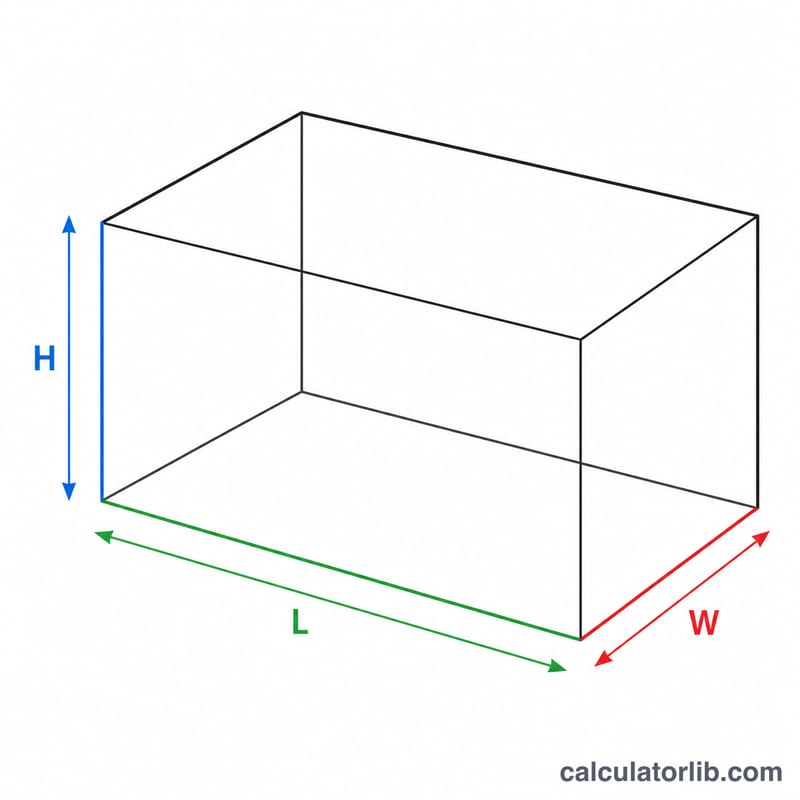
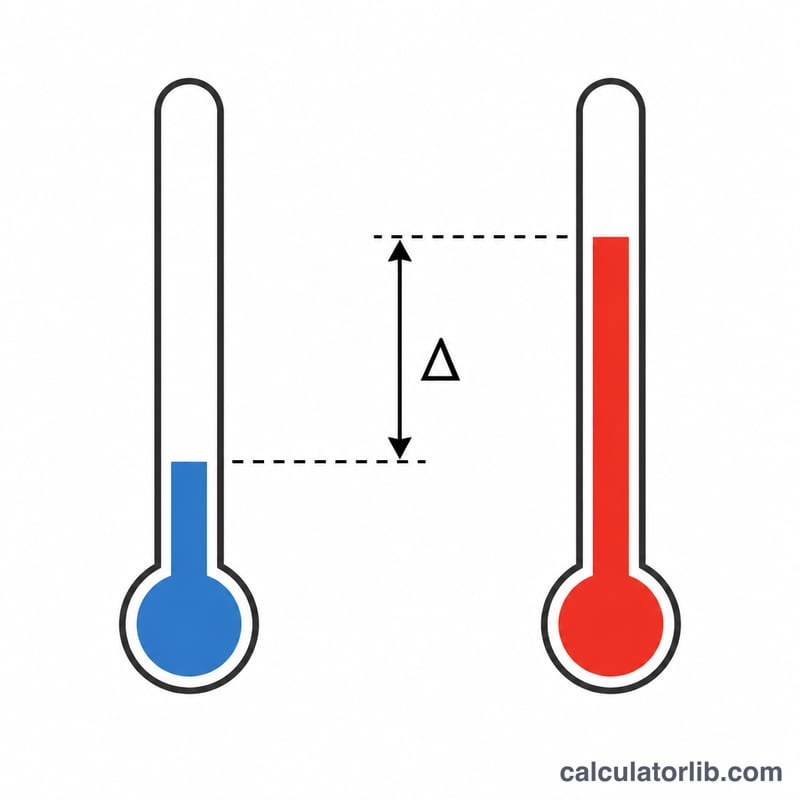
$$\text{BTU/hr} = 0.018 \times V \times \Delta T \times \text{ACH}$$where \(V\) = room volume in cubic feet, \(\Delta T\) = temperature difference between inside and outside in °F, \(\text{ACH}\) = air changes per hour, and \(0.018\) is the volumetric heat capacity of air in \(\text{BTU}/(\text{ft}^3\cdot{}^\circ\text{F})\). Room volume is \(V = L \times W \times H\).
How to Use It
Enter the room length, width, and ceiling height in feet, the target temperature difference, and an air-changes value that reflects insulation quality. Use about 1 for tight modern rooms and up to 2 for older, drafty spaces. The calculator returns the required BTU per hour for the space.
Worked Example
For a 20 ft by 15 ft room with an 8 ft ceiling, a 40°F difference, and 1 air change per hour:
$$V = 20 \times 15 \times 8 = 2400\,\text{ft}^3$$$$\text{BTU/hr} = 0.018 \times 2400 \times 40 \times 1 = 1728$$So the space needs roughly 1,728 BTU/hr of sensible capacity to offset air infiltration.
Typical Air Changes per Hour and Design Temperature Differences
This calculator uses US customary units: feet, °F and BTU/hr. The two inputs people find hardest to choose are the air change rate (ACH) and the temperature difference (ΔT). The tables below give rough starting values consistent with common ASHRAE and ACCA Manual J practice in the United States. They are rough guides, not measured values. A blower-door test gives the actual air leakage of a specific building.
Table 1: Typical air changes per hour by construction quality
| Construction quality | Typical natural ACH |
|---|---|
| New tight construction or Passive House level | ~0.35–0.5 |
| Modern, well-sealed home | ~0.5–1.0 |
| Average home built in the 1970s–1990s | ~1.0–1.5 |
| Older or drafty home | ~1.5–2.0 or more |
A room with a fireplace, many exterior doors, or windows that leak noticeably will sit at the higher end of its range. If the room has mechanical ventilation, add the extra air it brings in.
Table 2: Example design temperature differences
For heating, take the indoor setpoint (usually about 70°F) and subtract the local 99% heating design temperature. That design temperature is the outdoor temperature that is reached or exceeded 99% of the hours in a typical year:
$$\Delta T_{\text{heating}} = T_{\text{indoor}} - T_{\text{99\% design}}$$| Climate / season | Example outdoor design temperature | Typical ΔT |
|---|---|---|
| Mild winter | ~40–50°F | ~20–30°F |
| Moderate winter | ~20–30°F | ~40–50°F |
| Cold winter | ~0–10°F | ~60–70°F |
| Very cold winter | ~−10°F or below | ~80°F or more |
| Summer cooling (most climates) | ~90–100°F outdoors vs. ~75°F indoors | ~15–25°F |
These are illustrations only. Look up the ASHRAE heating and cooling design temperatures for your nearest weather station. Local building departments and Manual J software usually list them. Climates vary too much for a single national figure to be reliable.
BTU/hr Conversions: Watts, Kilowatts and Tons
Heating and cooling equipment is rated in BTU per hour (BTU/hr) in the United States and some other markets. Much of the world uses watts or kilowatts instead. Ratings in "tons" of refrigeration are common for North American air conditioners. The conversion factors are:
- 1 BTU/hr = 0.29307 W
- 1 kW = 3,412 BTU/hr (3,412.14 to be more precise)
- 1 ton of refrigeration = 12,000 BTU/hr
For example, a 12 × 10 × 8 ft room with a ΔT of 50°F and 2 ACH gives \(0.018 \times 960 \times 50 \times 2 =\) 1,728 BTU/hr. That equals \(1{,}728 \times 0.29307 \approx 506.4\) W.
| BTU/hr | Watts (W) | Kilowatts (kW) | Tons |
|---|---|---|---|
| 1,000 | 293.1 | 0.293 | 0.083 |
| 1,728 (worked example) | 506.4 | 0.506 | 0.144 |
| 5,000 | 1,465.4 | 1.465 | 0.417 |
| 6,000 | 1,758.4 | 1.758 | 0.5 |
| 9,000 | 2,637.6 | 2.638 | 0.75 |
| 12,000 | 3,516.8 | 3.517 | 1.0 |
| 18,000 | 5,275.3 | 5.275 | 1.5 |
| 24,000 | 7,033.7 | 7.034 | 2.0 |
| 36,000 | 10,550.5 | 10.551 | 3.0 |
A unit's thermal output in BTU/hr is not the same as the electrical power it draws. A heat pump or air conditioner delivering 12,000 BTU/hr (about 3.5 kW of heat) typically uses far less electricity than 3.5 kW, because of its coefficient of performance (COP) or efficiency rating.
From Result to Unit Size: Practical Tips
The formula \(0.018 \times V \times \Delta T \times \text{ACH}\) gives only the sensible load from infiltration and ventilation. That is the heat needed to warm or cool the outside air leaking into the room. The factor 0.018 BTU/ft³·°F is the approximate heat capacity of air in US customary units. Use the result as one part of the sizing, not the whole answer.
- Add the other loads. Heat also moves by conduction through walls, windows, doors, floors and the roof. Each is roughly area × U-value × ΔT. In cooling season, add solar gain through glass and internal gains from people, lighting and appliances. A full ACCA Manual J calculation (the US residential standard) or an equivalent national method covers all of these.
- Round up to a standard size. Room units commonly come in sizes such as 5,000, 6,000, 8,000, 10,000, 12,000, 18,000 and 24,000 BTU/hr. Choose the next size at or above your total load.
- Avoid heavy oversizing. An oversized unit short-cycles, switching on and off frequently. This wastes energy, wears components, causes uneven temperatures and, for air conditioners, removes moisture poorly, which leaves the room cool but clammy.
- Add a modest margin for extremes. In very cold or very hot climates, or for rooms with large glass areas or high ceilings, a small allowance above the calculated load is reasonable. A margin of 10–20% is a common rule of thumb, not a standard.
- Remember the latent load for cooling. Air conditioners must also remove humidity. In humid climates this latent load can be significant, so check that the unit's sensible and latent capacity both meet the need.
- Get professional sizing for whole-house systems. For furnaces, central air conditioning, heat pumps or ductwork, have a qualified HVAC professional do a room-by-room load calculation. They should follow your local code and standards.
This is general information to help with estimates. It is not a substitute for a professional load calculation or engineering advice.
FAQ
Does this include wall conduction? No, it models the sensible load from air changes only; add conduction and solar gains for a full Manual J load.
What ACH value should I use? Use roughly 0.5 to 1 for well-sealed rooms and 1.5 to 2 for older, leaky ones.
Can I use it for cooling? Yes, just enter the summer indoor-to-outdoor temperature difference.