What this calculator does
This tool performs the weight and balance check for a Cessna 150 two-seat trainer. Enter the basic empty weight and arm from your aircraft weighing record, then the pilot, passenger, fuel and baggage loads. It returns total weight, total moment, the center of gravity (CG) and whether the result sits inside the weight limit and CG envelope. Figures for the envelope are typical values for a 150M style airplane and are for planning only: always follow the Pilot Operating Handbook and the weight and balance data for your specific aircraft.
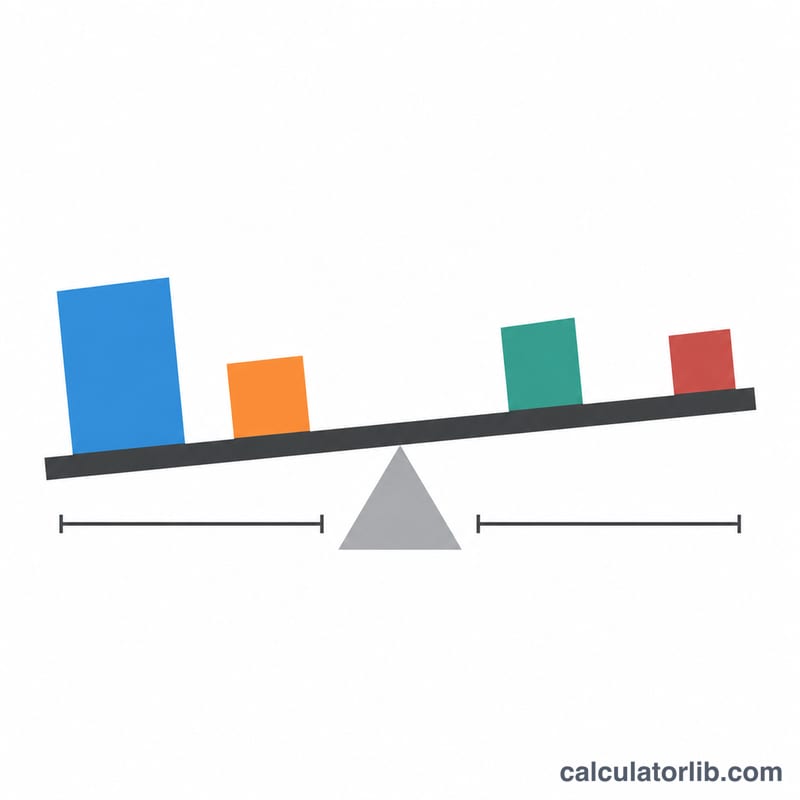
How to use it
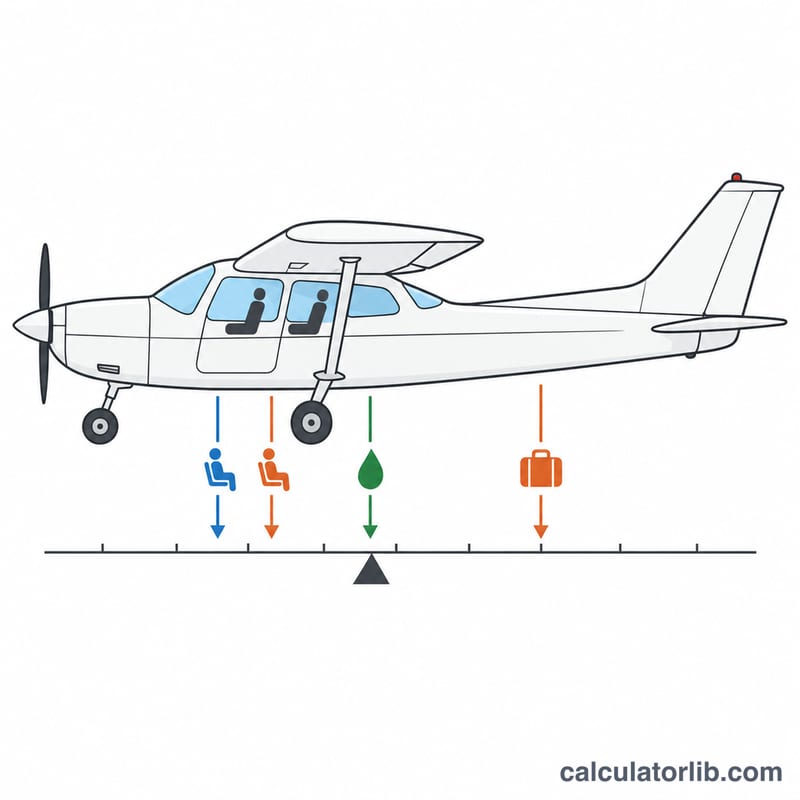
Fill in empty weight and empty arm, the weight of each occupant, fuel in US gallons (converted at 6 lb per gallon) and baggage in pounds. The calculator uses arms of 39 in for the seats, 42 in for fuel and 64 in for the baggage area. It assumes oil is included in the empty weight.
The formula
Every item creates a moment equal to its weight times its arm. The CG is the sum of all moments divided by the sum of all weights:
$$\text{CG} = \frac{ M_{total} }{ W_{total} } = \frac{\sum W_i a_i}{\sum W_i}$$Here \(W_i\) is the weight of an item in pounds and \(a_i\) is its arm in inches from the datum.
Worked example
Take an empty weight of 1,100 lb at 31.0 in, a 170 lb pilot, no passenger, 20 gal of fuel (120 lb) and no baggage.
$$W_{total} = 1100 + 170 + 120 = 1390\,\text{lb}$$$$M_{total} = 34100 + 6630 + 5040 = 45770\,\text{lb-in}$$$$\text{CG} = \frac{45770}{1390} = 32.93\,\text{in}$$At 1,390 lb the forward limit is about 31.96 in and the aft limit is 36.5 in, so this loading is inside the envelope.
Arms, Limits and Fixed Values Used
The calculator uses the fixed values below for every calculation. Only the empty weight, empty arm, loads and maximum gross weight are entered by you. The limits are typical for a Cessna 150M, and they vary by model year and individual aircraft. Always confirm every figure against the POH and current weight-and-balance record for the specific aircraft. Arms are measured in inches aft of the datum.
| Item | Value used | Notes |
|---|---|---|
| Pilot / passenger seat arm | 39 in | Both front seats use the same arm |
| Fuel arm | 42 in | Applied to fuel weight |
| Baggage arm | 64 in | Baggage area |
| Fuel weight | 6 lb per US gal | Aviation gasoline (avgas) |
| Oil | Included in empty weight | Not added separately |
| Maximum takeoff weight | 1,600 lb (typical 150M) | Editable in the tool as maximum gross |
| Aft CG limit | 36.5 in | Applies at all weights |
| Forward CG limit | about 31.0 in up to 1,500 lb | Slopes to about 32 in at maximum weight |
| Baggage limit | 120 lb (typical for 150M) | To be verified against the POH |
| Fuel capacity | 26 gal total / 22.5 gal usable | Use usable fuel for planning |
The calculation is: total weight \(W\) is the sum of all weights, total moment \(M\) is the sum of each weight multiplied by its arm, and \(\text{CG} = M / W\) in inches aft of the datum.
Loading Scenarios Compared
These examples use an empty weight of 1,100 lb at an arm of 31.0 in (moment 34,100 lb·in), the arms 39 / 42 / 64 in, and 6 lb per gallon. Fuel moment is 252 lb·in per gallon (6 × 42). Limits are the typical 150M values from the previous section: 1,600 lb maximum, forward limit 31.0 in up to 1,500 lb sloping to about 32 in at 1,600 lb, aft limit 36.5 in. The weights are illustrative only.
| Scenario | Pilot (lb) | Passenger (lb) | Fuel (gal) | Baggage (lb) | Total weight (lb) | Total moment (lb·in) | CG (in) | Status |
|---|---|---|---|---|---|---|---|---|
| A. Solo, full usable fuel, no baggage | 170 | 0 | 22.5 | 0 | 1,405 | 46,400 | 33.02 | Within envelope |
| B. Two occupants, full usable fuel, 40 lb baggage | 170 | 170 | 22.5 | 40 | 1,615 | 55,590 | 34.42 | Overweight by 15 lb (CG itself is between the limits) |
| C. Light solo pilot, max baggage, 15 gal | 140 | 0 | 15 | 120 | 1,450 | 51,020 | 35.19 | Within envelope, but near the aft end |
| D. Solo, half fuel (11 gal), no baggage | 170 | 0 | 11 | 0 | 1,336 | 43,502 | 32.56 | Within envelope |
Worked check for scenario A: \(W = 1100 + 170 + 6(22.5) = 1405\) lb. \(M = 34100 + 39(170) + 42 \cdot 6(22.5) = 34100 + 6630 + 5670 = 46400\) lb·in. \(\text{CG} = 46400 / 1405 \approx 33.02\) in.
Worked check for scenario C: \(W = 1100 + 140 + 90 + 120 = 1450\) lb. \(M = 34100 + 5460 + 3780 + 7680 = 51020\) lb·in. \(\text{CG} = 51020 / 1450 \approx 35.19\) in.
Scenario B shows that two adults with full fuel and baggage can exceed maximum weight even when the CG is acceptable. The usual remedy is to reduce fuel, baggage or both.
Interpreting Your CG Result
A loading is acceptable only if both the total weight and the CG are within limits. The CG must fall inside the envelope at that weight, so a CG that looks fine on its own can still be unacceptable if the aircraft is overweight. Compare your result with the weight and CG envelope in the POH. If the aircraft has been reweighed or modified, use the empty weight and arm from its current weighing record rather than a generic figure.
Result inside the envelope
The CG lies between the forward and aft limits for the calculated weight, and the weight does not exceed maximum gross. The aircraft is then loaded within its certified limits. Handling still varies across the envelope, so a CG near either edge gives noticeably different characteristics from one near the middle.
Result forward of the envelope
A CG ahead of the forward limit makes the aircraft nose-heavy. Typical effects are:
- higher stall speed, because the tail must produce more downforce;
- heavier elevator control forces;
- reduced elevator authority in the landing flare, which can make it hard to hold the nose up at low speed;
- higher drag and slightly reduced cruise performance.
Result aft of the envelope
A CG behind the aft limit makes the aircraft less stable in pitch. Typical effects are:
- reduced longitudinal stability and lighter elevator forces, so it is easier to over-control;
- a greater tendency to stall at a given pitch input, with a stall that may be harder to recover from;
- a spin that can become flat and difficult or impossible to recover from.
In the 150, a heavy baggage load or an aft-seated load with low fuel moves the CG toward the aft limit. Burning fuel also shifts the CG slightly, so the landing condition is worth checking as well as takeoff.
This tool provides a calculation aid based on typical 150M values. It does not replace the aircraft's approved POH, current weight-and-balance data, or the pilot-in-command's responsibility for determining that the aircraft is within limits.
FAQ
What happens if I am over gross weight?
The calculator flags the overweight condition. Cut fuel, baggage or passenger weight until you are at or below the maximum takeoff weight.
Why is the Cessna 150 easy to overload on baggage?
The baggage area is far aft at 64 in, so even a small load moves the CG rearward noticeably, especially with a light pilot and no passenger.
Can I use this for every Cessna 150 model?
Limits differ between model years, so edit the weights and compare with your own POH envelope before flying.