What is a parenteral nutrition calculator?
Total parenteral nutrition (TPN) delivers protein, carbohydrate, fat, fluid and micronutrients directly into the bloodstream when the gut cannot be used. This calculator converts per-kilogram targets into daily grams, calories, the volume of each stock solution and the final pump rate. It is an educational tool and does not replace a clinical pharmacist, dietitian or institutional protocol.
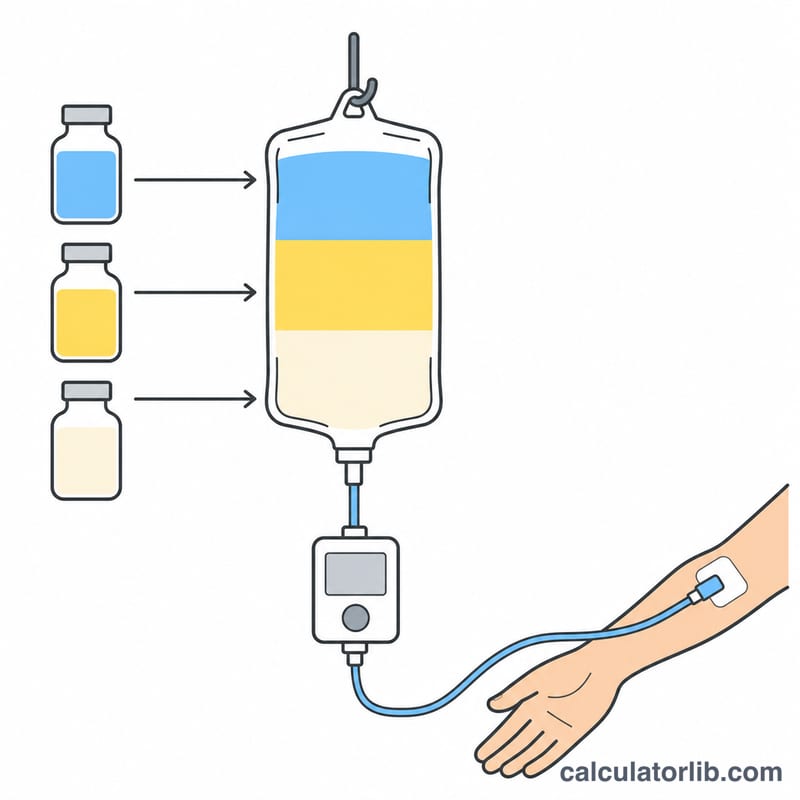
How to use it
Enter the patient weight, the energy goal (kcal/kg/day), protein goal (g/kg/day), the share of calories from lipids, the total fluid goal and the infusion time. Then enter the concentrations of your stock solutions: dextrose (commonly 70%), amino acids (commonly 10%) and lipid emulsion (commonly 20%). The result lists every component and the remaining volume for sterile water, electrolytes and additives.
The formulas explained
Protein provides 4 kcal/g, lipid emulsion about 10 kcal/g (including glycerol and phospholipids) and dextrose monohydrate 3.4 kcal/g. Dextrose supplies whatever energy remains after protein and lipid:
$$\text{Dextrose (g)} = \frac{E_{total} - 4P - 10L}{3.4}$$Here \(E_{total}\) is total kcal, \(P\) is protein in grams and \(L\) is lipid in grams. The infusion rate is total volume divided by hours, and the glucose infusion rate (GIR) is dextrose in mg per kg per minute.
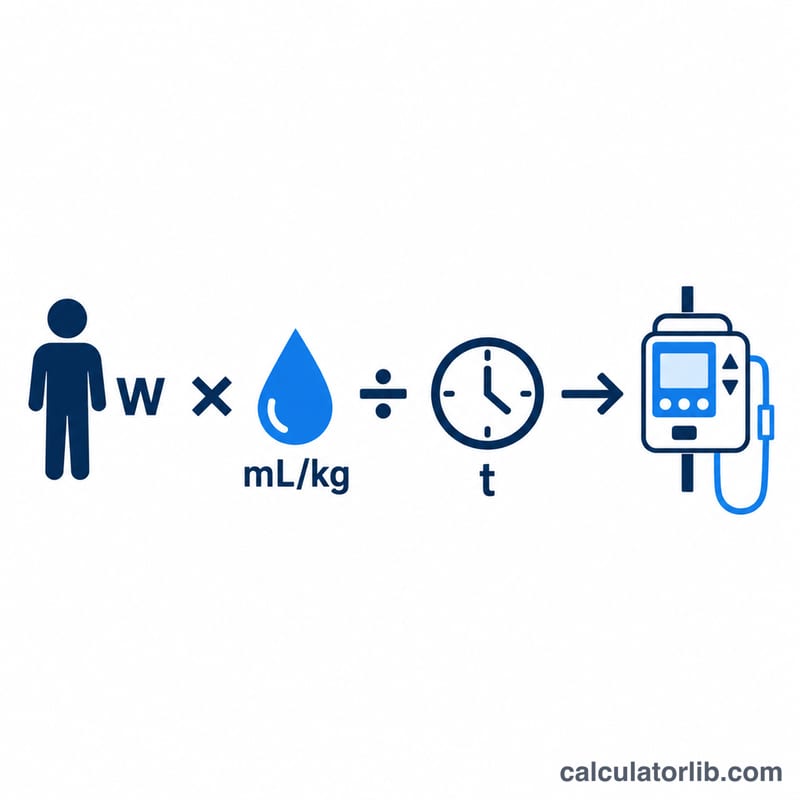
Worked example
A 70 kg adult needs 25 kcal/kg, 1.5 g/kg protein, 30% lipid calories, 30 mL/kg fluid over 24 hours.
$$E_{total} = 70 \times 25 = 1750\,\text{kcal}$$$$P = 70 \times 1.5 = 105\,\text{g} \;(420\,\text{kcal}),\quad L = \frac{0.30 \times 1750}{10} = 52.5\,\text{g}$$$$\text{Dextrose} = \frac{1750 - 420 - 525}{3.4} = 236.8\,\text{g}$$$$\text{Rate} = \frac{70 \times 30}{24} = 87.5\,\text{mL/h},\quad \text{GIR} = \frac{236.8 \times 1000}{70 \times 24 \times 60} = 2.35\,\text{mg/kg/min}$$With 10% amino acids, 70% dextrose and 20% lipid, the stock volumes are 1050 mL, 338.2 mL and 262.5 mL, leaving about 449 mL for water and additives.
Typical Macronutrient and Glucose Infusion Rate Ranges
The ranges below are general figures from published adult and paediatric guidance (ASPEN, ESPEN, ESPGHAN/ESPEN/ESPR). Guidelines differ by clinical setting, so they are reference points, not targets. Individual orders come from the clinical team and local protocol.
| Parameter | Population | Typical range | Source |
|---|---|---|---|
| Energy | Adults | 20-30 kcal/kg/day | ASPEN / ESPEN adult guidance |
| Protein | Adults | 1.2-2.0 g/kg/day | ASPEN/SCCM critical care guidance; ESPEN |
| Lipid | Adults | Up to about 1 g/kg/day; generally not above 2.5 g/kg/day | ASPEN; ESPEN |
| Fluid | Adults | About 30-40 mL/kg/day | Common clinical guidance (ESPEN / ASPEN) |
| Glucose infusion rate (GIR) | Adults | Up to 4-5 mg/kg/min | ASPEN / ESPEN |
| Maximum glucose oxidation | Adults | About 5-7 mg/kg/min | ESPEN / ASPEN physiology reviews |
| GIR | Neonates | About 4-12 mg/kg/min (commonly started at the lower end and titrated) | ESPGHAN/ESPEN/ESPR/CSPEN paediatric PN guidelines; neonatal practice |
| GIR | Infants and children | Generally lower than neonates and falling with age, roughly 5-10 mg/kg/min in infants and lower in older children | ESPGHAN/ESPEN/ESPR paediatric PN guidelines (approximate) |
Glucose infusion rate: \(\text{GIR (mg/kg/min)} = \frac{\text{dextrose (g/day)} \times 1000}{\text{weight (kg)} \times 1440}\).
This is general information, not professional advice. Paediatric and neonatal needs vary widely with age, gestation and clinical condition.
Energy Densities and Standard Stock Concentrations
| Substrate | Energy density | Notes |
|---|---|---|
| Amino acids / protein | 4 kcal/g | Used for protein energy; 10% solution gives about 0.4 kcal/mL |
| Dextrose monohydrate | 3.4 kcal/g | Hydrated dextrose gives less energy than anhydrous glucose (about 4 kcal/g) |
| Lipid emulsion | 10 kcal/g of fat (the calculator's factor) | Commercial emulsions also contain glycerol and phospholipid, so the energy per mL is higher than the fat content alone suggests |
| Stock product | Concentration | Approximate energy per mL |
|---|---|---|
| Dextrose 50% | 0.5 g/mL | 1.7 kcal/mL |
| Dextrose 70% | 0.7 g/mL | 2.38 kcal/mL |
| Amino acids 10% | 0.1 g/mL | 0.4 kcal/mL |
| Lipid emulsion 10% | 0.1 g/mL | About 1.1 kcal/mL |
| Lipid emulsion 20% | 0.2 g/mL | About 2 kcal/mL |
| Lipid emulsion 30% | 0.3 g/mL | About 3 kcal/mL |
Available concentrations and brands vary by country and manufacturer; check the product labels in use.
GIR unit conversion: 1 g = 1000 mg and 1 day = 24 × 60 = 1440 min. So \(1\ \text{g/kg/day} = \frac{1000}{1440} \approx 0.694\ \text{mg/kg/min}\), and \(1\ \text{mg/kg/min} = 1.44\ \text{g/kg/day}\).
Interpreting the Calculator Output
- Grams of protein, dextrose and lipid: the daily macronutrient amounts that supply the entered energy, protein and lipid share. Lipid grams are \(L = \frac{E \times \text{lipid\%}}{100 \times 10}\). Dextrose supplies the remaining non-protein energy, divided by 3.4 kcal/g.
- Percentage of calories: protein kcal ÷ total kcal, dextrose kcal ÷ total kcal and lipid kcal ÷ total kcal. They show how the energy is split among the three substrates.
- Non-protein calorie-to-nitrogen ratio (NPC:N): nitrogen (g) = protein (g) ÷ 6.25, and NPC = total kcal − protein kcal. A lower ratio means more protein relative to energy.
- Stock volumes: each volume is grams ÷ (concentration ÷ 100), for example \(V_{AA} = \frac{P}{\text{aminoConc}/100}\). They show how much of each stock solution the order needs.
- Rate (mL/hr): total volume ÷ infusion hours. A shorter infusion time raises the hourly rate and the hourly glucose load.
- GIR versus oxidation limits: GIR is dextrose delivered per kg per minute. A GIR near or above the adult oxidation limit of about 5-7 mg/kg/min suggests glucose may be supplied faster than it can be used. Cycled or shortened infusions raise GIR for the same daily dose, because the same grams are delivered in fewer minutes.
- Remaining water volume: \(V_{\text{water}} = V - V_{AA} - V_L - V_D\). A small value means the stock solutions use up nearly all the fluid, which implies a very concentrated formulation. A negative value means the chosen fluid volume cannot hold the stock volumes. In that case the fluid target, stock concentrations or macronutrient targets need to be revisited. Electrolytes, vitamins and trace elements also take up volume, and this calculator does not include them.
Example
For a 70 kg adult at 25 kcal/kg, 1.5 g/kg protein and 30% lipid calories: \(E = 70 \times 25 = 1750\) kcal and \(P = 70 \times 1.5 = 105\) g. Then \(L = \frac{1750 \times 30}{1000} = 52.5\) g and \(D = \frac{1750 \times 0.7 - 4 \times 105}{3.4} = \frac{805}{3.4} \approx 236.8\) g. The calorie split is protein 420 kcal (24%), lipid 525 kcal (30%) and dextrose 805 kcal (46%). GIR over 24 h is \(\frac{236.8 \times 1000}{70 \times 1440} \approx 2.35\) mg/kg/min. Nitrogen is \(105 / 6.25 = 16.8\) g and NPC is \(1750 - 420 = 1330\) kcal, so NPC:N ≈ 79:1.
This is general information, not professional advice. The calculator is an arithmetic aid. Parenteral nutrition orders should be set and checked by the clinical nutrition team under local protocols.
FAQ
What is a safe glucose infusion rate?
Adults usually tolerate up to about 4 to 5 mg/kg/min, and the oxidation limit is around 5 to 7 mg/kg/min in adults. Neonates are often dosed higher. The calculator warns above 12 mg/kg/min.
Why is the water volume negative?
The stock solutions alone exceed the fluid goal. Use more concentrated solutions, raise the fluid goal if clinically appropriate, or reduce nutrient targets.
Does this include electrolytes, vitamins and trace elements?
No. Those additives are ordered separately and take up part of the remaining volume.