What It Is
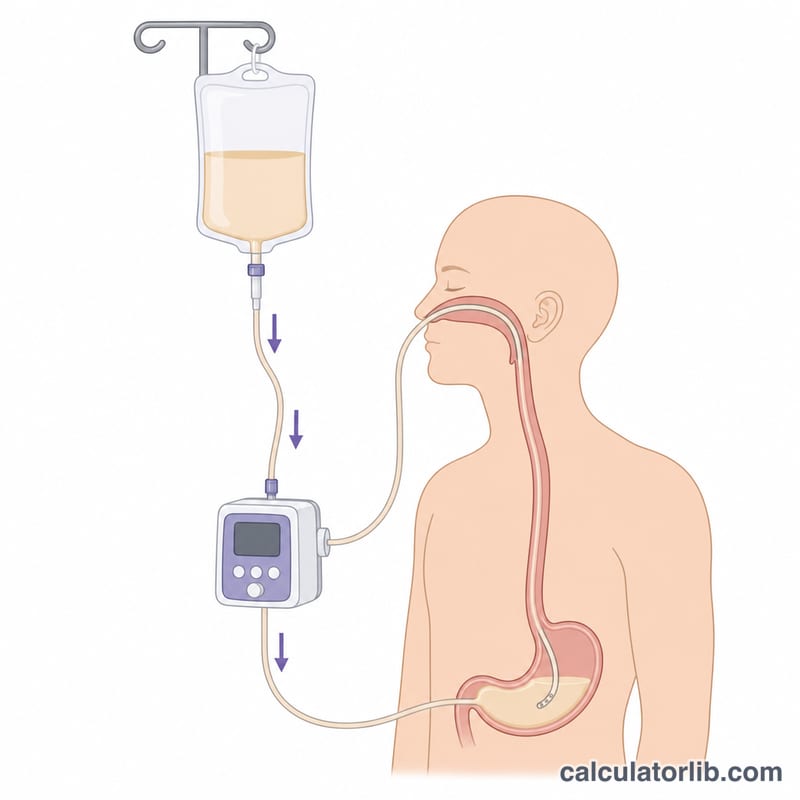
The Enteral Nutrition Calculator helps clinicians plan tube feeding by converting a patient body weight and target requirements into a practical pump infusion rate, daily calorie goal, formula volume, and free water flush. It is a planning aid for enteral (tube-fed) nutrition support and does not replace clinical judgment.
The Formula Explained
The daily calorie target is weight times the caloric need per kilogram. Dividing by the formula caloric density gives the volume of formula, and dividing that by feeding hours gives the pump rate:
$$\text{Rate} = \dfrac{W \times k}{D \times H}$$Here \(W\) = weight in kg, \(k\) = kcal/kg/day, \(D\) = formula density in kcal/mL, and \(H\) = feeding hours per day. Fluid planning subtracts the water in the formula (roughly 85% of volume) from the total fluid need \(W \times f\):
$$\text{FreeWater} = (W \times f) - 0.85 \times V$$
How To Use It
Enter the patient weight, the target calories per kilogram, the caloric density printed on the formula label, the planned number of feeding hours, and the total fluid goal per kilogram. The calculator returns the hourly rate to program the pump plus the supporting daily totals.
Worked Example
For a 70 kg patient at 25 kcal/kg/day using a 1.0 kcal/mL formula over 24 hours: the calorie target is \(70 \times 25 = 1750\) kcal/day, giving a volume of \(1750 / 1.0 = 1750\) mL/day, so the rate is
$$\text{Rate} = \dfrac{1750}{24} = 72.9\ \text{mL/hr}$$With a 30 mL/kg/day fluid goal, total fluid is \(70 \times 30 = 2100\) mL, formula water is \(0.85 \times 1750 = 1487.5\) mL, so free water flush is \(2100 - 1487.5 = 612.5\) mL/day.
Formula Caloric Density and Water Content
Not all of the volume in an enteral formula is free water. The rest is protein, carbohydrate, fat, fibre and minerals. The more calories a formula packs into each millilitre, the less water it contains. You need to know how much water the formula provides before you can work out how much extra water to give as flushes.
| Caloric density (kcal/mL) | Typical use | kcal per 1000 mL | Typical water content | Free water per 1000 mL of formula |
|---|---|---|---|---|
| 1.0 | Standard isotonic formula | 1000 | about 84% | about 840 mL |
| 1.2 | Standard or higher-protein formula | 1200 | about 81% | about 810 mL |
| 1.5 | Energy-dense formula | 1500 | about 76% | about 760 mL |
| 2.0 | Concentrated or fluid-restricted formula | 2000 | about 70% | about 700 mL |
Free water from formula is the formula volume multiplied by its water fraction:
$$\text{Formula water (mL)} = V \times \text{water fraction}$$The calculator uses a single fixed factor of 0.85, \(W = F - 0.85\,V\). That figure is close to the water content of a 1.0 kcal/mL formula. With a 1.5 or 2.0 kcal/mL formula it overstates the water the formula supplies, so the free water flush it gives will be too low. For denser formulas, recalculate the flush using the water fraction from the table above or, better, from the product label.
These percentages are typical, not exact. Water content varies by manufacturer and product, and fibre-containing or disease-specific formulas can differ. Always check the label or the manufacturer's product information for the exact figure, usually listed as "free water" or "water content" in mL per litre.
Typical Calorie and Fluid Ranges
This is general information, not professional advice. A dietitian or physician sets enteral nutrition targets for each person based on their clinical condition, labs, fluid balance and how well they tolerate feeds.
| Parameter | Typical starting range (adults) | Source / note |
|---|---|---|
| Energy, most hospitalised adults | 25–30 kcal/kg/day | Simple weight-based estimate used in ASPEN and ESPEN guidance when indirect calorimetry is not available |
| Energy, early critical illness | Lower, hypocaloric intake in the first days (e.g. not more than about 70% of estimated expenditure), then increased toward 80–100% | ESPEN ICU guideline (2019). Measured energy expenditure (indirect calorimetry) is preferred where available. |
| Energy, critically ill adults with obesity | 11–14 kcal/kg actual body weight (BMI 30–50); 22–25 kcal/kg ideal body weight (BMI > 50) | ASPEN/SCCM critical care guideline (2016): high-protein hypocaloric feeding |
| Fluid, weight method | 30–35 mL/kg/day | Common adult maintenance estimate. Needs are often lower in older adults and in people with heart, kidney or liver failure. |
| Fluid, energy method | 1 mL per kcal delivered | Alternative estimate. For example, 1800 kcal/day gives about 1800 mL/day of total fluid. |
| Continuous feeding | 24 hours/day | Often used in the ICU, when feeding into the small bowel, or when large boluses are not tolerated |
| Cyclic feeding | Typically 10–16 hours/day (often overnight) | Frees the patient from the pump during the day. It needs a higher hourly rate to deliver the same volume. |
In this calculator, enter the chosen value in kcal/kg/day for energy, in mL/kg/day for fluid, and the planned pump time in Feeding Hours. If you use the 1 mL/kcal method, set the mL/kg value equal to the kcal/kg value.
Treat these ranges as starting points. Targets are adjusted based on weight trend, fluid balance, electrolytes, gastric tolerance, refeeding risk, and losses such as fever, wounds, diarrhoea or drains. Local protocols may differ from the ASPEN and ESPEN figures shown here.
How Formula Density and Feeding Hours Change the Rate
Example: a 70 kg adult with a target of 25 kcal/kg/day and 30 mL/kg/day of fluid.
$$E = 70 \times 25 = 1750\ \text{kcal/day} \qquad F = 70 \times 30 = 2100\ \text{mL/day}$$The formula volume is \(V = E / \text{density}\) and the pump rate is \(R = V / \text{hours}\). The free water flush in the table uses the water fraction for each density (84%, 76% and 70%):
$$\text{Flush} = F - V \times \text{water fraction}$$| Formula (kcal/mL) | Feeding hours | Volume (mL/day) | Rate (mL/hr) | Formula water (mL/day) | Free water flush (mL/day) |
|---|---|---|---|---|---|
| 1.0 | 24 | 1750 | 72.9 | 1470 (1750 × 0.84) | 630 |
| 1.0 | 12 | 1750 | 145.8 | 1470 | 630 |
| 1.5 | 24 | 1166.7 | 48.6 | 887 (1166.7 × 0.76) | 1213 |
| 1.5 | 12 | 1166.7 | 97.2 | 887 | 1213 |
| 2.0 | 24 | 875 | 36.5 | 613 (875 × 0.70) | 1488 |
| 2.0 | 12 | 875 | 72.9 | 613 | 1488 |
What the comparison shows:
- Higher density means less volume and a slower pump rate. Switching from 1.0 to 2.0 kcal/mL halves the daily volume, from 1750 to 875 mL.
- Fewer feeding hours means a faster rate, but the volume stays the same. Going from 24 h to 12 h doubles the rate, for example from 72.9 to 145.8 mL/hr with the 1.0 kcal/mL formula. Daily calories, formula water and flush volume do not change.
- Denser formulas need more free water. The flush rises from about 630 mL/day with the 1.0 kcal/mL formula to about 1488 mL/day with the 2.0 kcal/mL formula. This is because the denser formula supplies both less volume and a lower percentage of water.
- The calculator's fixed 0.85 factor. For the 2.0 kcal/mL case, the calculator's formula gives \(2100 - 0.85 \times 875 = 1356.25\) mL. That is about 130 mL/day less than the density-specific estimate of 1488 mL. Use the product's labelled water content when precision matters.
In practice, the total flush is split into several doses through the day (for example every 4–6 hours), alongside any water given with medications. The care team adjusts it based on sodium levels, urine output and fluid balance. This is general information, not professional advice.
FAQ
What caloric target should I use? Common estimates range from 25 to 30 kcal/kg/day, but individual needs vary with condition and activity.
Why estimate 85% water? Standard 1.0 kcal/mL formulas are about 80-85% water; concentrated formulas contain less, increasing free water needs.
Can I use fewer feeding hours? Yes, cyclic feeding over fewer hours raises the hourly rate proportionally, which the calculator reflects.