What this calculator does
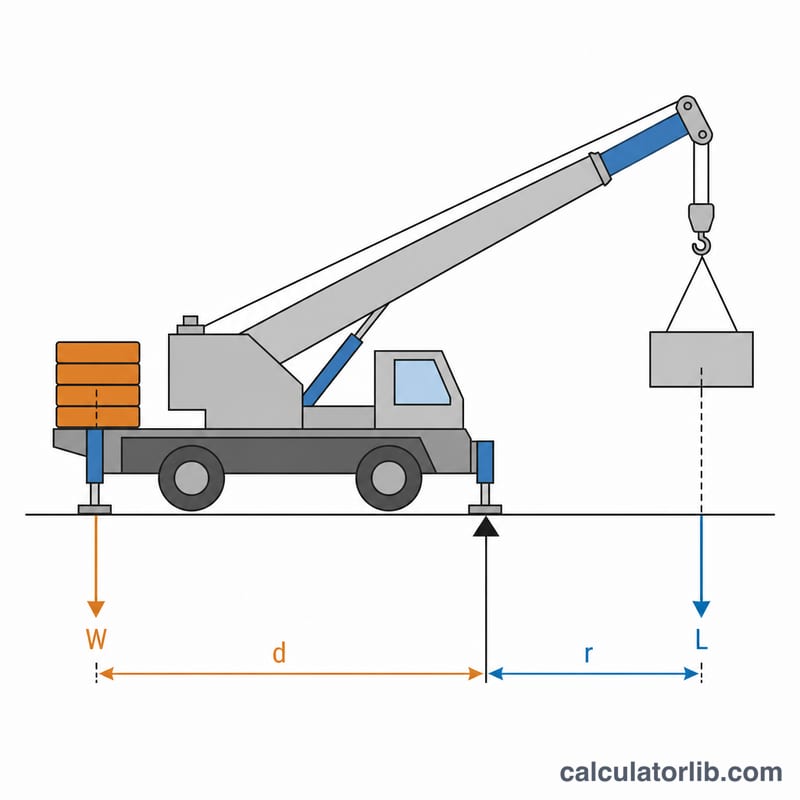
The Crane Lifting Capacity Calculator estimates the rated load a crane can lift at a planned working radius. It uses a simplified moment-balance (stability) model where the counterweight moment about the tipping point resists the moment created by the suspended load. It is useful for quick lift planning, comparing configurations, and sanity-checking a manufacturer load chart.
The formula explained
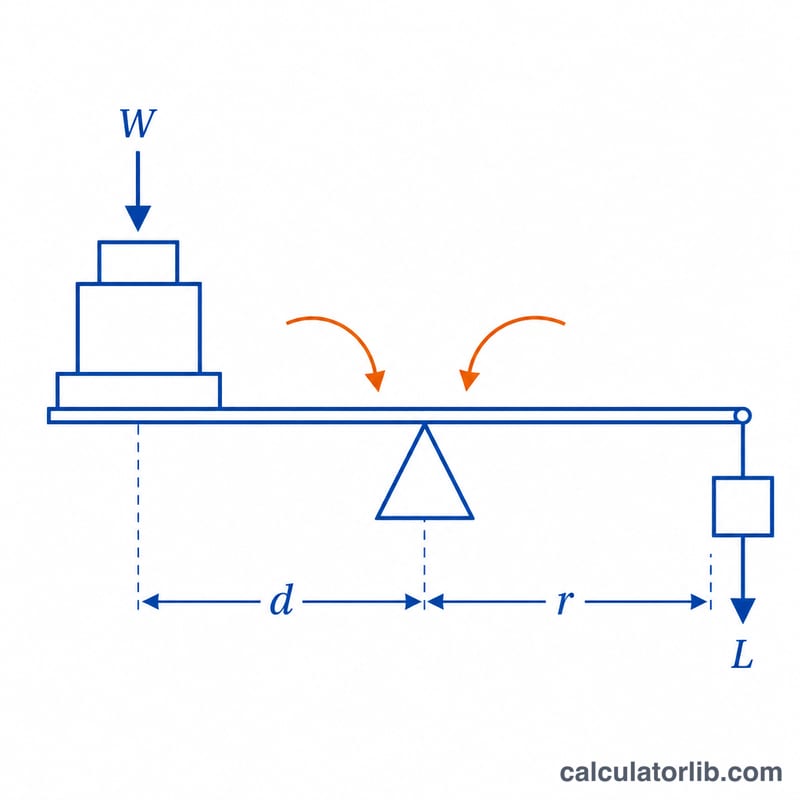
Tipping occurs when the load moment equals the stabilising counterweight moment. The tipping load is the counterweight moment divided by the load radius:
$$W_{tip} = \frac{W_c \times d_c}{R}$$where \(W_c\) = counterweight mass in kg, \(d_c\) = distance from the counterweight to the tipping fulcrum in m, and \(R\) = the load radius in m. The rated capacity applies a stability factor \(S\) so the crane never lifts to the tipping point:
$$\text{Capacity} = W_{tip} \times S$$Crawler cranes are typically rated at 75% of tipping load (\(S = 0.75\)), while mobile cranes on fully extended outriggers are rated at 85% (\(S = 0.85\)); see the table below and always use the crane's load chart.
How to use it
Enter the counterweight mass, the counterweight distance to the fulcrum, the load radius, and the stability factor as a percent. The calculator returns the load moment, the tipping load, and the rated lifting capacity in kilograms.
Worked example
With \(W_c = 20{,}000\ \text{kg}\), \(d_c = 5\ \text{m}\), \(R = 10\ \text{m}\) and \(S = 75\%\):
$$W_{tip} = \frac{20000 \times 5}{10} = 10{,}000\ \text{kg}$$$$\text{Capacity} = 10000 \times 0.75 = 7{,}500\ \text{kg}$$Under these simplified assumptions the rated capacity is about 7,500 kg at a 10 m radius. This is an estimate, not a safe working load: the manufacturer's load chart governs.
Typical Stability Factors by Crane Type
The stability factor is the share of the tipping load that a crane is allowed to lift. In the United States, ASME B30.5 (Mobile and Locomotive Cranes) sets the maximum rated load as a percentage of the tipping load for each type of crane and setup. The table shows the most common values. These are US ASME figures. Other countries use different rules. For example, EN 13000 in Europe and ISO 4305 assess mobile-crane stability with their own criteria, so you can't swap a single percentage from one standard into another.
| Crane type and setup (ASME B30.5) | Rated load as % of tipping load | Stability factor to enter |
|---|---|---|
| Crawler crane, on crawlers | 75% | 75 |
| Mobile (truck or wheel-mounted) crane, on fully extended outriggers | 85% | 85 |
| Rubber-tired crane, lifting on tires (stationary, no outriggers) | 75% | 75 |
The value for a mobile crane depends on how it is set up. On outriggers, a mobile crane is rated at 85% of tipping. When it lifts on its tires, the figure drops to 75%. Crawler cranes are rated at 75%. Don't use 75% as the default for every mobile crane. Pick the row that matches how the crane is actually set up.
Many charts also have structural limits that apply before the stability limit. This is common at short radii. In that zone the chart value can be lower than any figure based on tipping. Some setups, such as pick-and-carry, partly extended outriggers or lifting over the front, have their own chart ratings.
Note: The manufacturer's load chart for the exact crane, setup and boom length always takes priority over this table and over this calculator. So do your local regulations. This calculator gives a simplified estimate for learning and early planning only.
Practical Lift-Planning Checks
Use these checks to turn the calculator's estimate into a realistic plan:
- Subtract rigging and lifting gear. The rated capacity covers everything hanging below the boom tip. Before you compare it with the load, subtract the hook block, slings, shackles, spreader or lifting beams, and any jib or extra hoist rope. Your load chart may say whether stowed jibs also count. Net capacity = rated capacity − total weight of lifting gear.
- Measure the radius correctly. Load radius is the horizontal distance from the slew (rotation) centre to the load's centre of gravity. It is not the distance to the edge of the load or to the crane body. The boom bends and the radius grows once the load is lifted. Use the largest radius the load will reach during the lift, including where it is set down.
- Watch out for lifts near the limit. Many companies and jurisdictions treat lifts above about 75–90% of chart capacity as critical lifts. The exact threshold depends on company policy and local rules. Critical lifts need a formal written lift plan, an engineering review and a sign-off from a competent person. Lifts with more than one crane, or lifts over occupied areas, usually count as critical too.
- Check the ground and the outriggers. Make sure the outriggers are set up exactly as the chart assumes, usually fully extended. The crane must be level within the manufacturer's tolerance. Use mats or pads sized so the ground bearing pressure stays below what the ground can safely carry. Watch for soft ground, backfilled trenches and buried services.
- Reduce capacity for wind and dynamic effects. Wind on large or light loads, fast slewing, and sudden starts or stops all add load. Follow the manufacturer's wind speed limits and wind reductions. Stop the lift when the limits are exceeded.
- Always check against the manufacturer's load chart. This calculator's formula is a simplified estimate. The final authority is the chart for the exact crane, counterweight, boom length, radius and setup, together with the crane's rated capacity indicator. Your local lifting regulations also apply.
FAQ
Is this a substitute for the load chart? No. Always use the manufacturer certified load chart for real lifts; this tool is an estimate for planning.
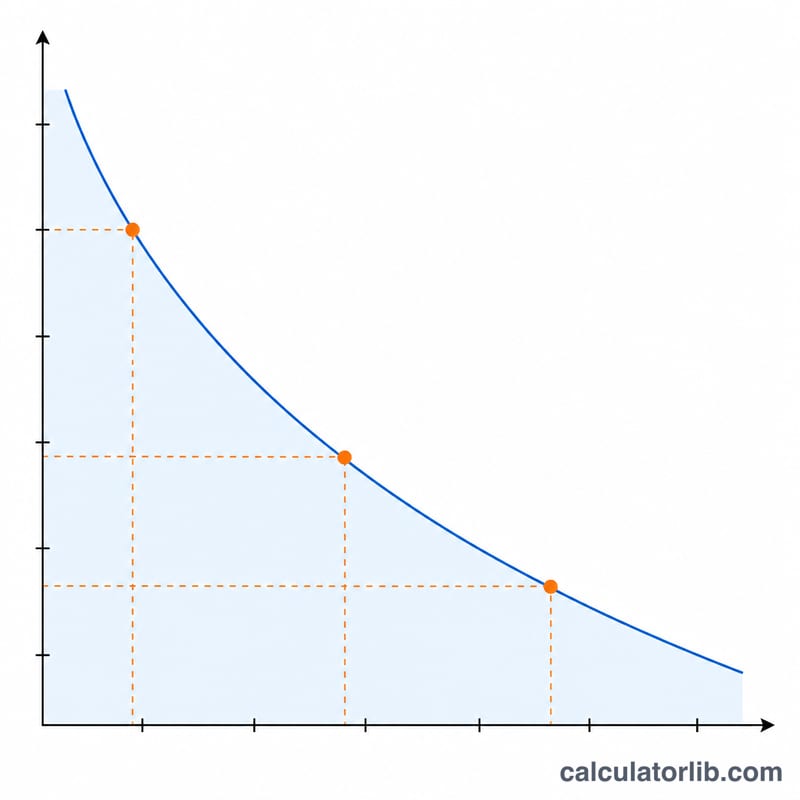
Why does capacity fall as radius grows? A larger radius increases the load moment for the same weight, so capacity drops as \(R\) rises.
What stability factor should I use? It depends on the setup: 75% for crawler cranes and 85% for mobile cranes on fully extended outriggers (see the table above), and your load chart governs; follow your equipment standard and local regulations.