What Is the Top of Descent?
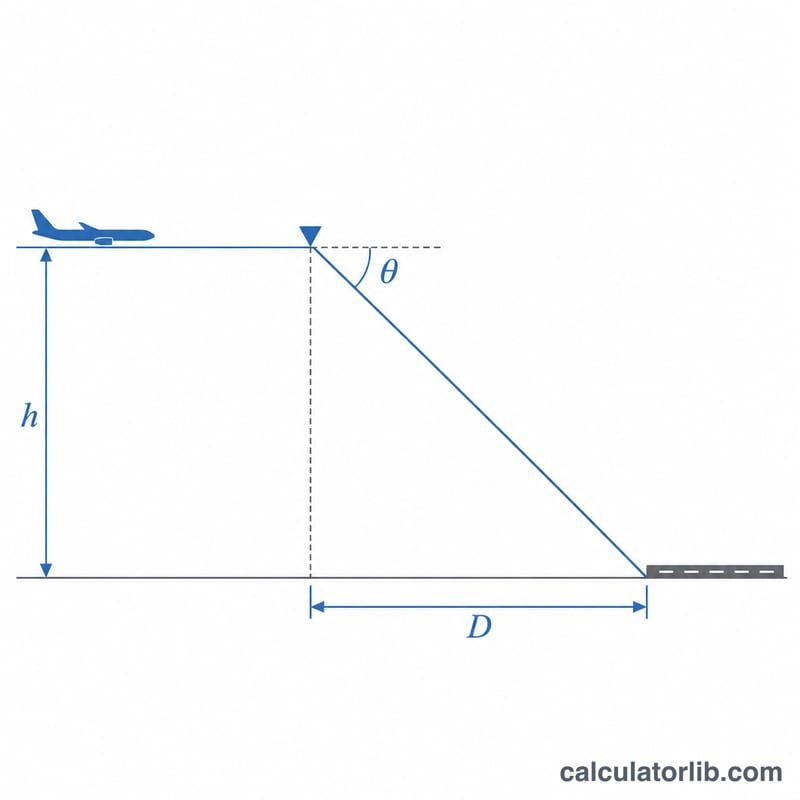
The top of descent (TOD) is the point along your route where you start a smooth, idle-power descent so the aircraft reaches a target altitude exactly at a chosen waypoint. Starting too early wastes fuel and time; starting too late forces a steep, uncomfortable descent. This calculator turns three numbers — altitude to lose, descent rate, and groundspeed — into the distance and time you need.
How to Use It
Enter the altitude to lose in feet (cruise altitude minus target altitude), your planned descent rate in feet per minute, and your current groundspeed in knots. The tool returns the distance before the target where you should begin descending, how long the descent will take, and the resulting descent angle.
The Formula
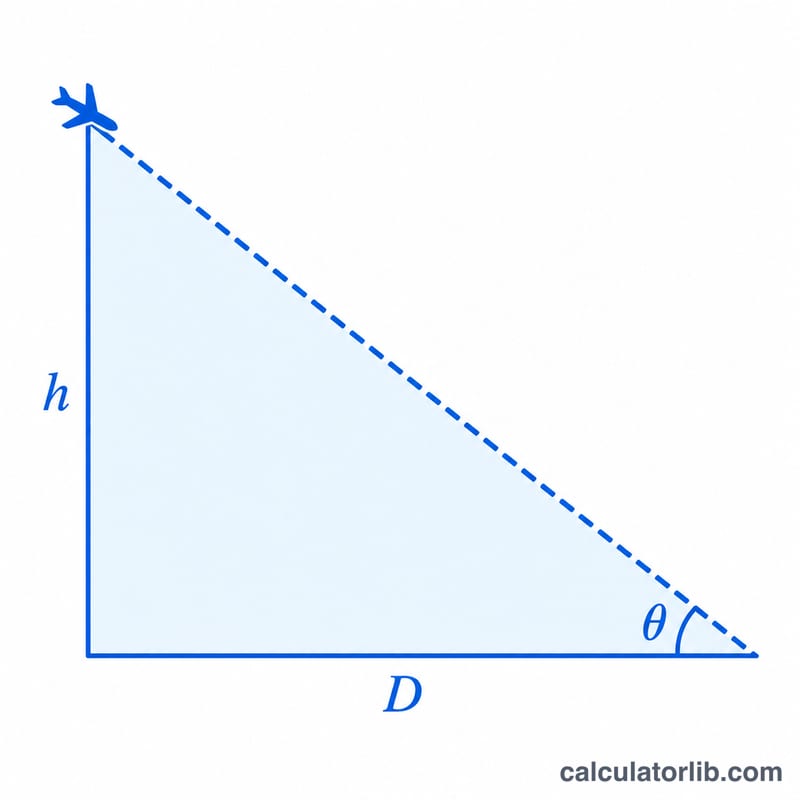
First find the descent time, then convert it to distance using groundspeed. With \(t\) in minutes, \(d\) in nautical miles, and groundspeed in knots:
$$t = \frac{\text{Altitude to lose}}{\text{Descent rate}}, \qquad d = \text{GS} \times \frac{t}{60}$$The descent angle follows from \(\theta = \arctan\!\left(\frac{\text{Rate}}{\text{GS} \times 101.27}\right)\), since one knot equals about \(101.27\) feet per minute.
Worked Example
Descending from 35,000 ft at 1,500 ft/min with a 450-knot groundspeed:
$$t = \frac{35000}{1500} = 23.33\,\text{min}$$$$d = 450 \times \frac{23.33}{60} = 175\,\text{NM}$$So begin the descent about 175 nautical miles before the target waypoint.
TOD Distance Across Common Descent Scenarios
The table below runs five typical descents through the calculator's formulas: time \(t = h / V_s\), distance \(D = GS \cdot t / 60\), and descent angle \(\theta = \arctan\left(V_s / (101.27 \cdot GS)\right)\). The constant 101.27 converts knots to feet per minute (1 kt ≈ 101.27 ft/min). The last column shows the 3-to-1 rule estimate: 3 NM for every 1,000 ft to lose. That rule assumes a path of about 3°.
| Scenario | Altitude to lose (ft) | Rate (fpm) | GS (kt) | Time (min) | Distance (NM) | Angle (°) | 3-to-1 estimate (NM) |
|---|---|---|---|---|---|---|---|
| Light piston | 8,000 | 500 | 140 | 16.0 | 37.33 | 2.02 | 24 |
| Turboprop | 20,000 | 1,500 | 250 | 13.33 | 55.56 | 3.39 | 60 |
| Jet, no wind | 35,000 | 2,000 | 450 | 17.5 | 131.25 | 2.51 | 105 |
| Jet, 50 kt headwind | 35,000 | 2,000 | 400 | 17.5 | 116.67 | 2.83 | 105 |
| Jet, 50 kt tailwind | 35,000 | 2,000 | 500 | 17.5 | 145.83 | 2.26 | 105 |
Here is the jet row worked through in full:
$$t = \frac{35000}{2000} = 17.5\ \text{min} \qquad D = \frac{450 \times 17.5}{60} = 131.25\ \text{NM} \qquad \theta = \arctan\left(\frac{2000}{101.27 \times 450}\right) = \arctan(0.04389) \approx 2.51^\circ$$What the comparison shows:
- Wind changes distance, not time. At a fixed descent rate the descent always takes 17.5 minutes. The ground covered in that time is what changes. A 50 kt headwind moves the TOD about 14.6 NM closer to the destination than in still air, and a 50 kt tailwind moves it about 14.6 NM farther out. The two wind cases are 29.2 NM apart.
- The 3-to-1 rule ignores rate and wind. It matches the calculator only when the descent rate gives a path of about 3°. The piston at 500 fpm descends at a shallow 2.02°, so it needs 37 NM rather than 24 NM. The turboprop at 1,500 fpm descends a little steeper than 3°, so it needs slightly less than 60 NM.
- Add a buffer for slowing down. None of these figures includes extra distance to lose speed or to level off before a crossing restriction. Pilots often add a few miles for these.
Typical Descent Rates and Angles
The figures below are typical planning values for estimating a top of descent. They are not operational limits. ATC instructions, published procedures, and the aircraft's flight manual or operator procedures always take precedence.
| Aircraft class | Typical planning descent rate | Notes |
|---|---|---|
| Light piston (unpressurized) | ~500 fpm | Chosen mainly for passenger ear comfort and to limit shock cooling of the engine |
| Turboprop | ~1,000–1,500 fpm | Varies with pressurization, speed limits, and the operator's procedures |
| Jet airliner | ~1,500–2,500 fpm | Often flown as an idle-thrust descent. The actual rate depends on weight, speed, and wind. |
The 3° reference path
A glidepath of about 3° is the standard reference for ILS approaches. Many idle descent profiles also come close to it. A 3° path loses about 318 ft per nautical mile (\(6076 \times \tan 3^\circ \approx 318\)). This is where the 3-to-1 rule comes from: about 3 NM for every 1,000 ft.
Rule of thumb: rate ≈ 5 × groundspeed
To hold a path of about 3°, set the descent rate to roughly five times the groundspeed in knots:
$$V_s \approx 5 \times GS \qquad \text{e.g. } 5 \times 140\ \text{kt} = 700\ \text{fpm}$$The exact factor is about 5.3. Groundspeed in NM per minute is \(GS/60\), and multiplying by 318 ft/NM gives \(318/60 \approx 5.3\). So a rate of 5 × GS gives an angle just under 3°. Because the rule uses groundspeed rather than airspeed, it adjusts for wind automatically. In a headwind you need a lower rate; in a tailwind, a higher one.
Cabin descent rate
In pressurized aircraft, the cabin altitude usually descends much more slowly than the aircraft. Cabin rates of about 300–500 fpm are commonly used for passenger comfort. In unpressurized aircraft, the cabin descends at the same rate as the aircraft. This is one reason pilots of light aircraft often plan around 500 fpm.
FAQ
What is a good descent rate? Airliners commonly use 1,500 to 2,000 ft/min; a comfortable rule of thumb keeps the descent angle near 3 degrees.
Does wind matter? Yes — always use groundspeed, not airspeed, because a tailwind stretches the descent and a headwind shortens it.
What is the 3-to-1 rule? A quick mental check: multiply the altitude to lose in thousands of feet by 3 to estimate the TOD distance in nautical miles.