What Is Turning Material Removal Rate?
The material removal rate (MRR) in a lathe turning operation is the volume of metal a single-point cutting tool shaves off a rotating workpiece every minute. It is one of the most important productivity indicators in machining, directly linking cutting parameters to how quickly a part is roughed or finished. A higher MRR means faster production, but it also increases cutting forces, heat, tool wear, and power demand, so engineers balance it against tool life and surface quality.
How to Use This Calculator
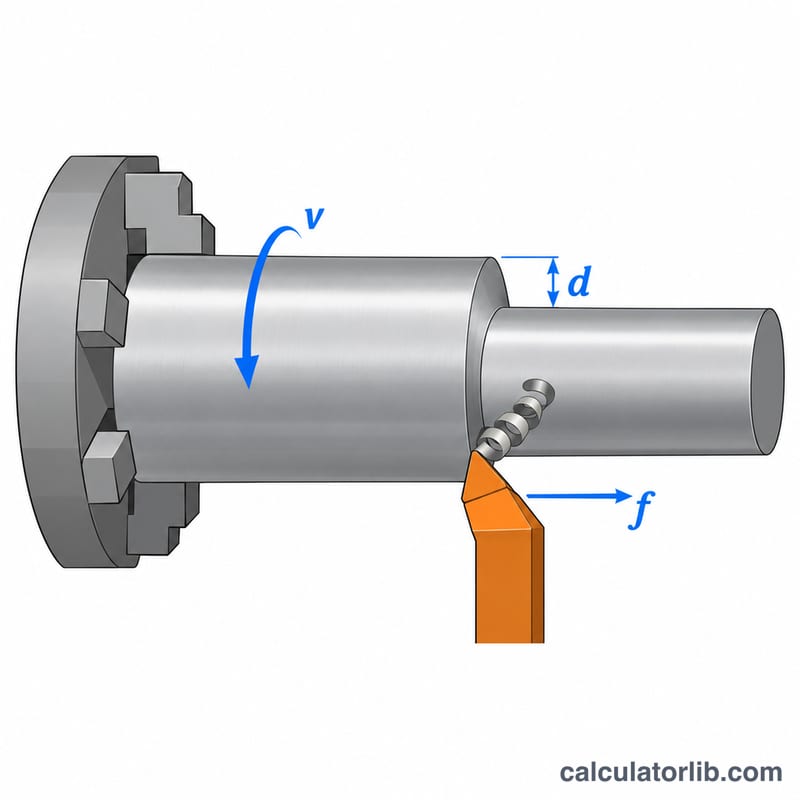
Enter three values: the cutting speed \(v\) in metres per minute, the feed \(f\) in millimetres per revolution, and the depth of cut \(d\) in millimetres. The calculator returns the MRR in both cubic millimetres per minute and cubic centimetres per minute. These parameters usually come from the tool manufacturer recommendations for the workpiece material and insert grade.
The Formula Explained
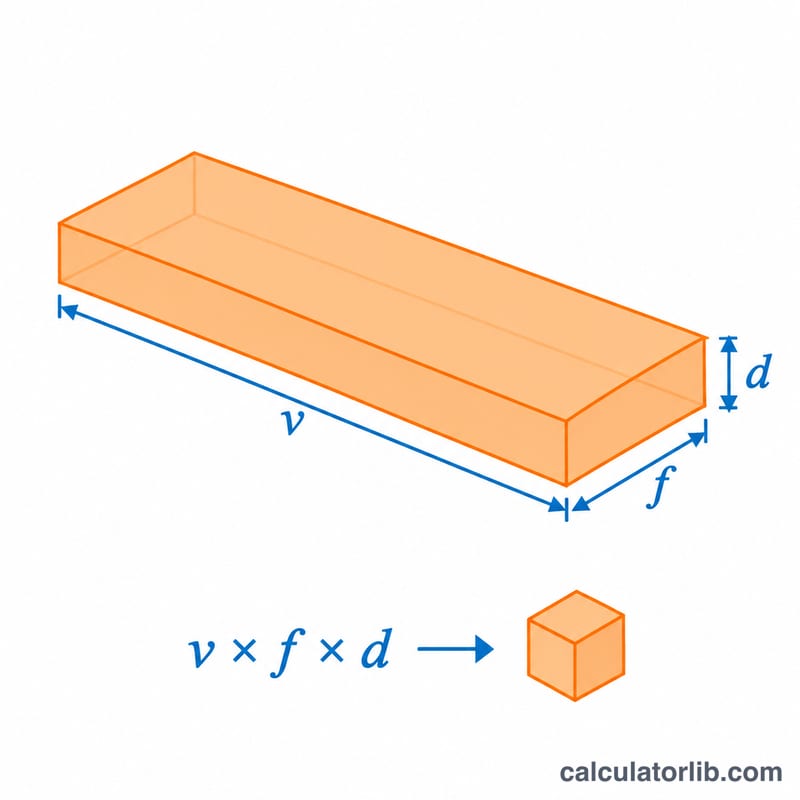
For turning, the chip cross-section equals feed times depth of cut, and the cutting edge sweeps along the surface at the cutting speed. The MRR is therefore:
$$\text{MRR} = 1000 \times v \times f \times d$$
where \(v\) = cutting speed (m/min), \(f\) = feed (mm/rev), and \(d\) = depth of cut (mm). The factor of 1000 converts the cutting speed from metres per minute to millimetres per minute so the answer comes out in \(\text{mm}^3/\text{min}\).
Worked Example
Suppose you turn steel at a cutting speed of 100 m/min, a feed of 0.2 mm/rev, and a depth of cut of 2 mm:
$$\text{MRR} = 1000 \times 100 \times 0.2 \times 2 = 40000\,\text{mm}^3/\text{min}$$
That is equal to \(40\,\text{cm}^3/\text{min}\) of material removed.
Typical Cutting Parameters by Workpiece Material
The table lists general starting ranges for external longitudinal turning with coated carbide inserts. The material groups follow the ISO 513 workpiece classification used by insert makers: P = steel, M = stainless steel, K = cast iron, N = non-ferrous, S = heat-resistant alloys and titanium. The ranges are approximate and in line with handbook data such as Machinery's Handbook and manufacturer catalogues. They assume a rigid setup, flood coolant and a suitable insert grade and chipbreaker.
| Material (ISO group) | Operation | Cutting speed \(v\) (m/min) | Feed \(f\) (mm/rev) | Depth of cut \(d\) (mm) |
|---|---|---|---|---|
| Low-carbon steel (P) | Roughing | 180–300 | 0.25–0.5 | 2–6 |
| Finishing | 250–400 | 0.05–0.15 | 0.25–1 | |
| Alloy steel, annealed (P) | Roughing | 120–220 | 0.2–0.4 | 2–5 |
| Finishing | 180–300 | 0.05–0.15 | 0.25–1 | |
| Austenitic stainless steel (M) | Roughing | 120–200 | 0.2–0.4 | 1.5–4 |
| Finishing | 150–250 | 0.05–0.15 | 0.25–1 | |
| Grey cast iron (K) | Roughing | 150–250 | 0.25–0.5 | 2–6 |
| Finishing | 200–350 | 0.1–0.2 | 0.25–1 | |
| Aluminium alloys (N) | Roughing | 300–1000 | 0.2–0.5 | 2–6 |
| Finishing | 400–1500 | 0.05–0.15 | 0.25–1 | |
| Titanium alloys, e.g. Ti-6Al-4V (S) | Roughing | 40–70 | 0.15–0.3 | 1–3 |
| Finishing | 50–90 | 0.05–0.15 | 0.25–1 |
Use these numbers only as starting points. The right values depend on the insert grade, coating, nose radius and chipbreaker, as well as the material's hardness, machine power and rigidity, workpiece overhang and coolant. Always check the insert manufacturer's recommended cutting data, which is usually printed on the insert box or in the catalogue. Start in the lower half of a range, then adjust based on tool wear, chip formation and surface finish. Machine spindle power also limits how much material you can remove, so make sure the machine can deliver the power needed for the MRR you plan.
MRR Comparison: Roughing vs Finishing Across Materials
Each scenario below uses typical carbide parameters from the ranges above. The material removal rate is calculated with
$$\text{MRR} = 1000 \cdot v \cdot f \cdot d$$Here \(v\) is in m/min and \(f\) is in mm/rev, so the factor 1000 turns metres into millimetres. \(d\) is in mm. To get cm³/min, divide the result in mm³/min by 1000.
| Scenario | \(v\) (m/min) | \(f\) (mm/rev) | \(d\) (mm) | Calculation | MRR (mm³/min) | MRR (cm³/min) |
|---|---|---|---|---|---|---|
| Aluminium alloy roughing | 500 | 0.3 | 3 | \(1000 \times 500 \times 0.3 \times 3\) | 450,000 | 450 |
| Steel roughing | 200 | 0.3 | 3 | \(1000 \times 200 \times 0.3 \times 3\) | 180,000 | 180 |
| Steel finishing | 250 | 0.1 | 0.5 | \(1000 \times 250 \times 0.1 \times 0.5\) | 12,500 | 12.5 |
| Stainless steel roughing | 150 | 0.25 | 2.5 | \(1000 \times 150 \times 0.25 \times 2.5\) | 93,750 | 93.75 |
| Titanium alloy roughing | 50 | 0.2 | 2 | \(1000 \times 50 \times 0.2 \times 2\) | 20,000 | 20 |
Roughing removes far more material per minute than finishing. In steel, the roughing pass above removes 180 cm³/min and the finishing pass only 12.5 cm³/min, about 14 times less. That is because finishing uses a much smaller feed and depth of cut to get good surface finish and dimensional accuracy. Material matters just as much: aluminium can be cut at high speed, while titanium needs low cutting speeds to control heat and tool wear, so its MRR is much lower. A common strategy is to remove most of the stock with high-MRR roughing passes and leave a small, even allowance for a single finishing pass.
Frequently Asked Questions
Why multiply by 1000? Cutting speed is given in m/min while feed and depth are in mm. Converting the speed to mm/min keeps every length in the same unit, yielding a volume in \(\text{mm}^3/\text{min}\).
Does a higher MRR always help? Not always. Pushing MRR too far raises temperature and cutting force, shortening tool life and risking poor finish, so it must stay within the machine power and tool limits.
Can I use it for roughing and finishing? Yes. Roughing passes use large depth and feed for a high MRR, while finishing passes use small values for accuracy and surface quality.