What this calculator does
The Solar Power Bank Charging Calculator estimates two things at once: how many hours of direct sunlight a solar panel needs to fully charge a power bank, and how many times that charged bank can then top up a phone or other device. It turns raw specifications — panel wattage, battery capacity in mAh, voltage and real-world losses — into practical numbers you can plan a trip or off-grid setup around.
How to use it
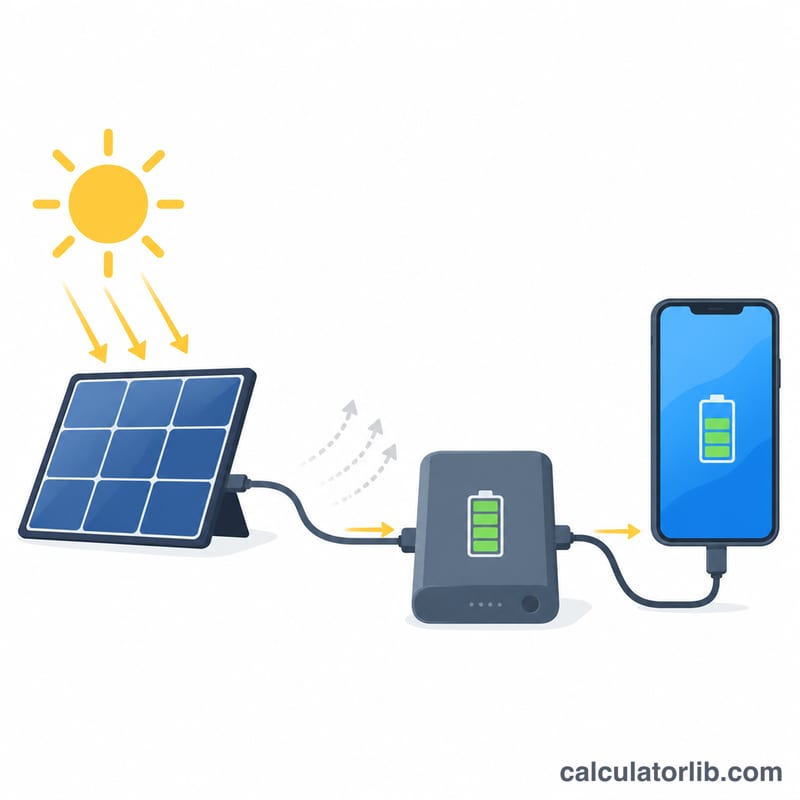
Enter the rated power of your solar panel in watts, the capacity of your power bank in mAh, and the nominal cell voltage (usually \(3.7\,\text{V}\) for lithium cells). Add an overall efficiency to cover the charge controller, heat, cable and conversion losses — \(60\text{–}75\%\) is typical for portable solar. Finally, enter the battery size of the device you want to recharge.
The formula explained
First the stored energy of the bank is found from its capacity and voltage, \(E = \frac{\text{mAh}}{1000}\times V\) watt-hours. Charge time divides that energy by the panel power actually delivered after losses:
$$t = \frac{(\text{mAh}/1000)\times V}{P_{\text{panel}}\times \eta}$$where \(\eta\) is the efficiency as a fraction. Because voltage cancels, the number of device charges simplifies to:
$$n = \frac{\text{mAh}\times \eta}{\text{mAh}_{\text{device}}}$$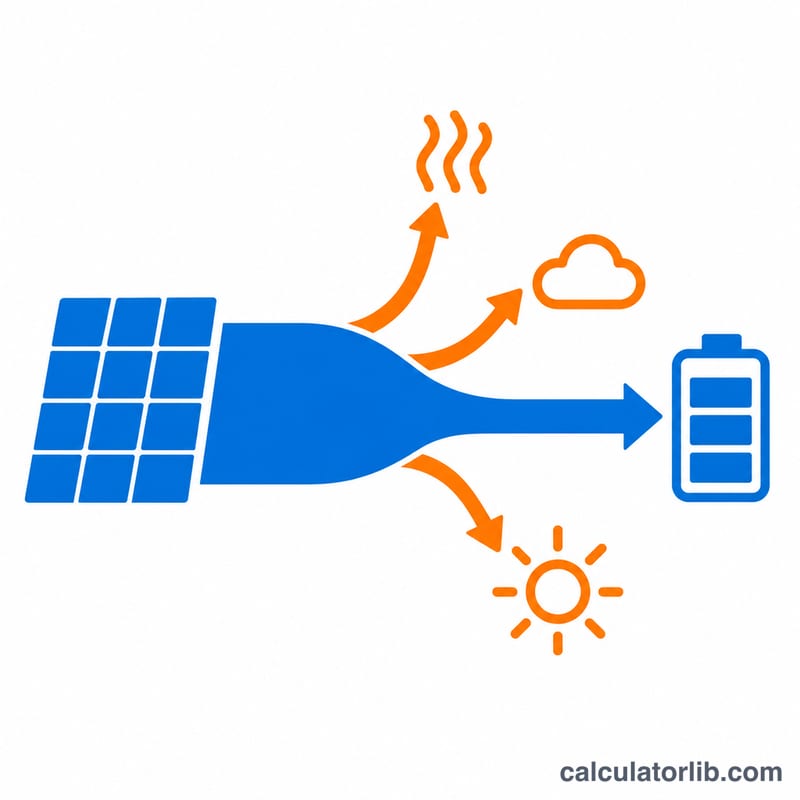
Worked example
Take a \(10\,\text{W}\) panel, a \(20{,}000\,\text{mAh}\) bank at \(3.7\,\text{V}\), \(70\%\) efficiency and a \(3000\,\text{mAh}\) phone:
$$t = \frac{(20000/1000)\times 3.7}{10 \times 0.70} = \frac{74}{7} \approx 10.57\,\text{h}$$$$n = \frac{20000 \times 0.70}{3000} \approx 4.67\ \text{charges}$$So about ten and a half hours of strong sun fills the bank, which then delivers roughly four and a half phone charges.
Charge Time and Phone Charges by Panel and Power Bank Size
The table below is built only from this tool's formulas, with every scenario evaluated at a battery voltage of 3.7 V, a combined panel-and-conversion efficiency of 70%, and a phone battery of 3,000 mAh. The stored energy is \( E_{\text{bank}} = \dfrac{\text{Capacity}}{1000} \times 3.7 \), the effective input power is \( P_{\text{eff}} = \text{Panel} \times 0.70 \), the charge time is \( t_{\text{charge}} = \dfrac{E_{\text{bank}}}{P_{\text{eff}}} \), and the phone charges are \( \dfrac{E_{\text{bank}}}{3 \times 3.7} = \dfrac{E_{\text{bank}}}{11.1} \).
| Panel | Power bank | Stored energy (Wh) | Charge time (h) | Phone charges (3,000 mAh) |
|---|---|---|---|---|
| 5 W | 5,000 mAh | 18.5 | 5.29 | 1.67 |
| 10 W | 10,000 mAh | 37.0 | 5.29 | 3.33 |
| 20 W | 20,000 mAh | 74.0 | 5.29 | 6.67 |
| 28 W | 26,800 mAh | 99.16 | 5.06 | 8.93 |
Note: These charge times assume full rated sun on the panel for the entire period — bright, direct sunlight with the panel squarely facing the sun. Real sunlight is weaker and intermittent, so expect the actual time to be longer (see the planning section below). Because the first three rows pair each panel with a bank of exactly 1,000 mAh per watt, their charge times come out identical at about 5.29 h; the 28 W row charges slightly faster because its 26,800 mAh bank is a little under that ratio.
Planning Your Solar Charging in Practice
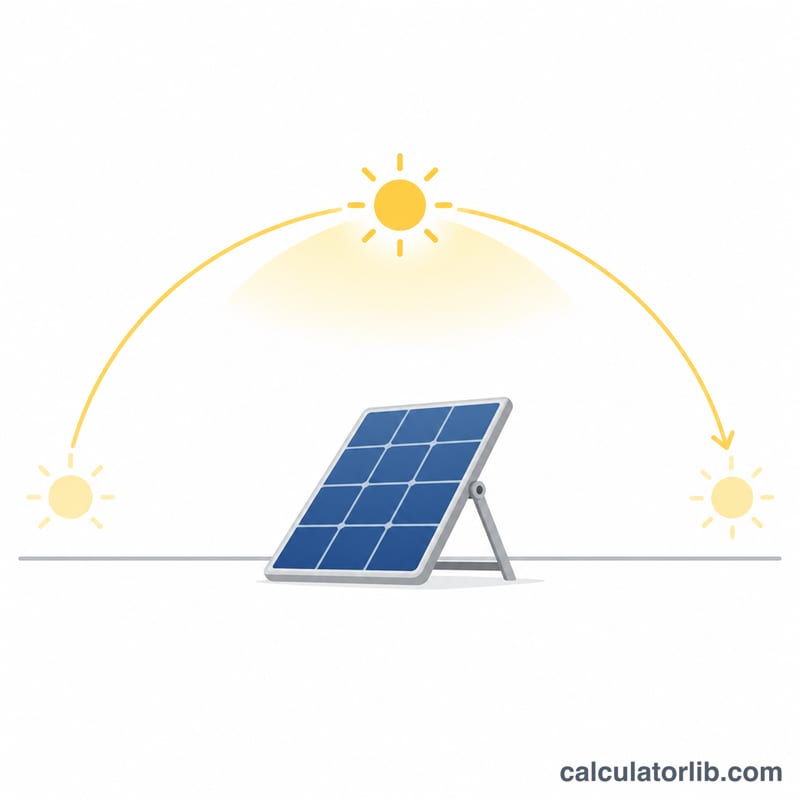
The charge time from this calculator is the number of hours of full rated sun the panel needs. The sun is not at full strength all day, so convert those hours into real days using your local peak sun hours — the number of hours per day equivalent to full-strength sun. This figure depends on your location and the season, but it is typically about 3–6 per day in many places:
$$\text{days} = \frac{t_{\text{charge}}}{\text{peak sun hours per day}}$$
For example, a 10 W panel charging a 10,000 mAh bank needs about 5.29 h of full sun; at 4 peak sun hours per day that is \( 5.29 / 4 \approx 1.3 \) days of charging.
- Oversize the panel or add days. Clouds, haze, dust and a panel that is not aimed straight at the sun all cut real output. To stay on schedule, choose a panel with about 1.5–2× the wattage the formula suggests (for a computed 10 W, pick roughly 15–20 W), or simply plan for extra days to absorb the shortfall.
- Round phone charges down. A result of 8.93 charges does not mean nine full top-ups — treat it as 8 complete phone charges, because conversion losses and the last partial charge rarely land as a usable full charge.
- Keep the bank cool, point the panel at the sun. Heat shortens battery life and can throttle charging, so keep the power bank in the shade (in a bag or under the panel) while only the panel sits in direct sunlight, angled to face the sun.
- Check the bank's maximum input wattage. A power bank accepts charge only up to its rated input (for example 10 W or 18 W). If the panel can deliver more than the bank accepts, the bank's input limit — not the panel — sets the real charging speed, so the actual time can be longer than the formula shows.
This section is general planning guidance; sunlight, equipment and conditions vary, so verify the ratings printed on your own panel and power bank.
FAQ
Why is my real charge time longer? Panels rarely hit their rated wattage; clouds, angle and temperature reduce output, so treat the result as a best case under full, direct sun.
What efficiency should I pick? Use \(70\%\) as a sensible default, and lower it toward \(60\%\) for cheap panels or hot conditions.
Does voltage matter for the charge count? For the device-charge number it cancels out, but it still sets the stored energy in watt-hours shown in the results.