What is the Solar Battery Loan Calculator?
A home solar battery lets you store energy and trim your electricity bill, but the upfront cost is usually financed with a loan. This calculator estimates the monthly payment and total interest on that loan and compares it against the energy savings the battery is expected to deliver, so you can see whether the system pays for itself.
How to use it
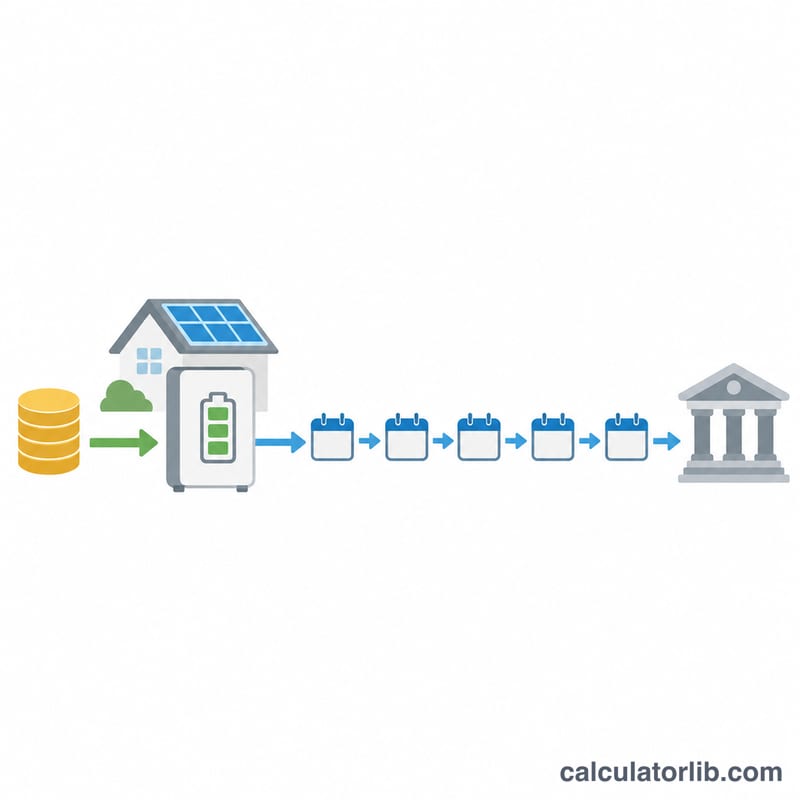
Enter the amount you are borrowing, the annual percentage rate (APR), the loan term in years, and the monthly energy savings you expect. The calculator returns your monthly payment, the total interest over the life of the loan, the total amount repaid, and the net monthly figure (savings minus payment).
The formula explained
Financing uses the standard amortized loan payment formula:
$$M = P \times \frac{r(1+r)^{n}}{(1+r)^{n}-1}$$Here \(P\) is the loan amount, \(r\) is the monthly interest rate (the APR divided by 12 and by 100), and \(n\) is the number of monthly payments (years times 12). Total interest is \(I = M \times n - P\), and the net monthly position is \(\text{savings} - M\).
Worked example
Suppose you finance $10,000 at a 6% APR over 10 years. Then \(r = 0.06/12 = 0.005\) and \(n = 120\):
$$M = 10000 \times \frac{0.005(1.005)^{120}}{(1.005)^{120}-1} = \$111.02$$Over the full term you repay \(\$111.02 \times 120 = \$13{,}322.46\), so the total interest is
$$I = \$13{,}322.46 - \$10{,}000 = \$3{,}322.46$$If the battery saves $120 a month, the net monthly position is \(\$120 - \$111.02 = \$8.98\), so the savings slightly exceed the payment.
Scenario Comparison
Each row below uses the standard amortization formula \(M = P \cdot \frac{r(1+r)^{n}}{(1+r)^{n}-1}\), where \(r = \text{APR}/1200\) and \(n = 12 \times \text{years}\). Total repaid is \(M \times n\). Total interest is total repaid minus the loan amount. Net monthly is \(S - M\). Amounts are shown in US dollars, but the math works the same in any currency. The monthly savings figures are only example assumptions. Real savings depend on your local electricity tariff, time-of-use pricing, export rules and how you use the battery.
| Loan amount | APR | Term | Monthly payment | Total interest | Total repaid | Assumed monthly savings | Net monthly (savings − payment) |
|---|---|---|---|---|---|---|---|
| $10,000 | 4% | 5 yr | $184.17 | $1,049.91 | $11,049.91 | $100 | −$84.17 |
| $10,000 | 4% | 15 yr | $73.97 | $3,314.38 | $13,314.38 | $100 | +$26.03 |
| $10,000 | 6% | 10 yr | $111.02 | $3,322.46 | $13,322.46 | $120 | +$8.98 |
| $15,000 | 6% | 10 yr | $166.53 | $4,983.69 | $19,983.69 | $150 | −$16.53 |
| $15,000 | 9% | 10 yr | $190.01 | $7,801.64 | $22,801.64 | $150 | −$40.01 |
| $20,000 | 6% | 15 yr | $168.77 | $10,378.85 | $30,378.85 | $150 | −$18.77 |
For example, the $15,000 loan at 9% over 10 years has \(r = 9/1200 = 0.0075\) and \(n = 120\). Plugging these in gives:
$$M = 15000 \cdot \frac{0.0075 \times 1.0075^{120}}{1.0075^{120} - 1} \approx 15000 \times 0.0126676 \approx \$190.01$$Over the full term you repay \(190.0137 \times 120 \approx \$22{,}801.64\), which includes $7,801.64 of interest.
Compare the first two rows: the loan amount and APR are the same, but stretching the term from 5 to 15 years cuts the monthly payment by more than half. It also roughly triples the total interest.
Interpreting Your Result
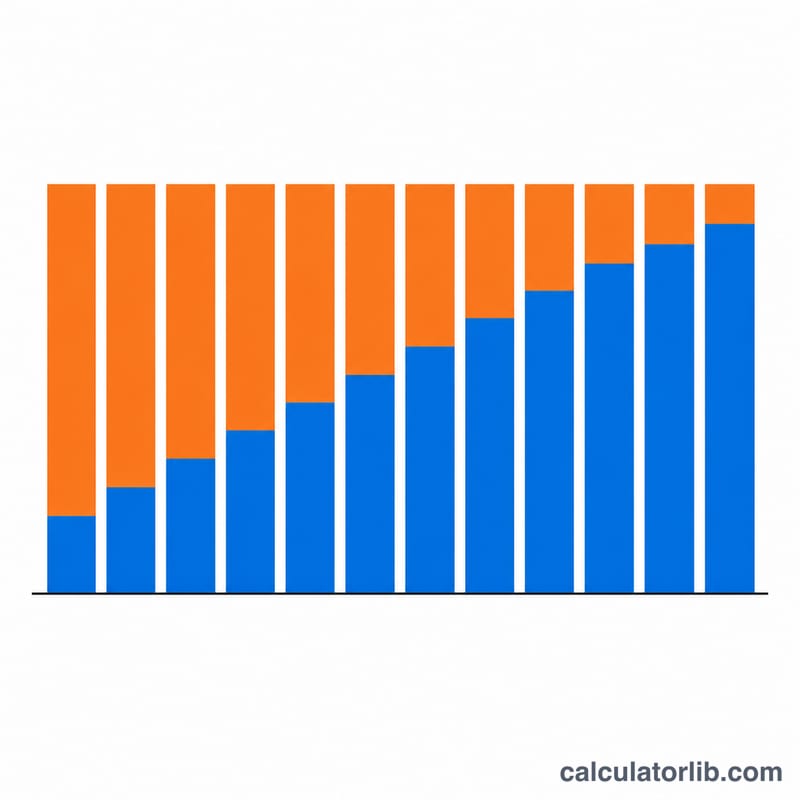
Monthly payment (\(M\)) is the fixed amount due each month under a fully amortizing loan. It depends only on the loan amount \(P\), the monthly rate \(r = \text{APR}/1200\) and the number of payments \(n\). Early payments go mostly toward interest. Later payments go mostly toward principal. The total payment stays the same every month. The figure does not include fees, insurance or other charges unless you have added them to the loan amount.
Total interest equals \(M \times n - P\). This is what borrowing costs you over the full term. It rises with a higher APR, a longer term or a larger loan amount, and it falls if you repay early, provided the loan allows prepayment without penalty.
Total repaid equals \(M \times n\). It is the loan amount plus all the interest.
Net monthly equals \(S - M\), where \(S\) is the monthly energy savings you entered:
- A positive value means the savings you expect are larger than the loan payment, so the battery is cash-flow positive month to month.
- A negative value means you pay that difference out of pocket each month during the loan term.
- A value of zero means the savings you expect exactly cover the payment.
A positive net monthly figure does not make the battery free. The full loan amount is still repaid, and interest is on top of it. The savings only offset those costs. Net monthly also depends entirely on the savings estimate you enter. If your actual savings differ because of tariff changes, usage patterns or battery degradation, the real net cash flow will differ too. After the loan is paid off, \(M\) drops to zero, and any savings that continue are no longer offset by a payment.
This is general information, not financial advice. Check the loan terms and savings assumptions for your own situation with a qualified professional.
FAQ
Does a positive net monthly mean the battery is free? Not quite, but it means your expected monthly savings cover the loan payment, so the system is cash-flow positive while you pay it off.
What APR should I use? Use the rate quoted by your solar installer or lender. Many solar loans run between 4% and 9% APR depending on credit and term.
What if my loan is interest-free? Enter 0 for the rate and the payment becomes simply the loan amount divided by the number of months.