What Is a Truck Payload Calculator?
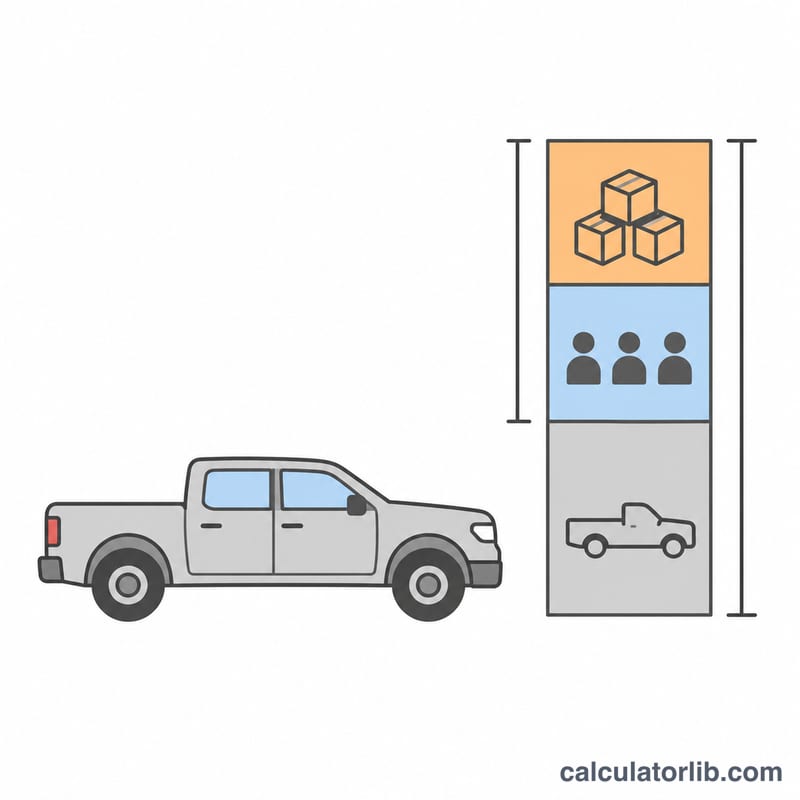
A truck payload calculator tells you how much weight your vehicle can safely and legally carry. Every truck has a factory-set Gross Vehicle Weight Rating (GVWR), the maximum the loaded vehicle may weigh. Subtract the curb weight (the empty truck with fluids) and what remains is the payload capacity. This tool turns those two numbers into an instant answer and also shows how much room is left after you add a driver and passengers.
How to Use It
Find your GVWR on the door-jamb sticker and your curb weight in the owner manual or by weighing the empty truck at a scale. Enter both in pounds, then optionally add the combined weight of the driver and passengers. The calculator returns your available payload and the cargo capacity that is still free.
The Payload Formula
The core relationship is simple:
$$\text{Payload} = \text{GVWR} - \text{Curb Weight}$$where \(\text{GVWR}\) is the maximum rated loaded weight and \(\text{Curb Weight}\) is the empty vehicle weight. After seating people, the cargo you can still carry is \(\text{Cargo} = \text{Payload} - \text{Passengers}\).
Worked Example
Suppose a pickup has a GVWR of 10{,}000 lbs and a curb weight of 6{,}500 lbs, carrying 500 lbs of occupants:
$$\text{Payload} = 10{,}000 - 6{,}500 = 3{,}500\ \text{lbs}$$$$\text{Cargo} = 3{,}500 - 500 = 3{,}000\ \text{lbs}$$So this truck can legally haul 3{,}500 lbs total, leaving 3{,}000 lbs for cargo once everyone is aboard.
Truck GVWR Classes and Typical Payload Ranges
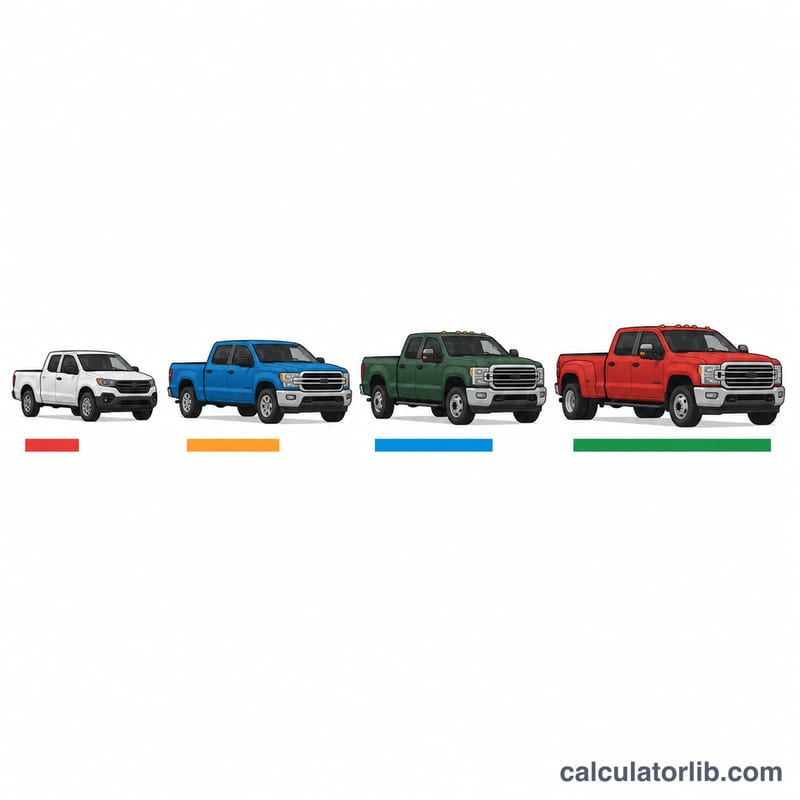
In the United States, the Federal Highway Administration (FHWA) and the Department of Transportation (DOT) sort vehicles into weight classes by Gross Vehicle Weight Rating (GVWR). GVWR is the maximum the manufacturer allows the loaded vehicle to weigh, including the truck, passengers, cargo and tongue or pin weight. These classes are a US system. Other countries use their own categories, such as the EU's N1/N2/N3 vehicle categories and licence classes based on 3,500 kg. However, the payload formula used here works the same everywhere.
| US class | GVWR range (lbs) | Common pickup tier | Broad typical payload (approx.) |
|---|---|---|---|
| Class 1 | ≤ 6,000 | Many mid-size/compact pickups | About 1,000–1,700 lbs |
| Class 2a | 6,001–8,500 | Half-ton (1500/150 series) | About 1,400–2,500 lbs; some specially equipped trims reach about 3,000+ lbs |
| Class 2b | 8,501–10,000 | 3/4-ton (2500/250 series) | About 2,500–4,000 lbs |
| Class 3 | 10,001–14,000 | 1-ton (3500/350 series, especially dual-rear-wheel) | About 3,500–7,500 lbs |
| Class 4 | 14,001–16,000 | Larger chassis cabs (e.g., 450-series) | Depends on body/upfit |
| Class 5 | 16,001–19,500 | Medium-duty chassis cabs | Depends on body/upfit |
| Class 6 | 19,501–26,000 | Medium-duty box/delivery trucks | Depends on body/upfit |
| Class 7 | 26,001–33,000 | Heavy trucks; US commercial driver's licence (CDL) usually required | Depends on body/upfit |
| Class 8 | > 33,000 | Semi tractors, dump trucks | Depends on body/upfit |
The pickup names "half-ton", "3/4-ton" and "1-ton" are old labels. They no longer match actual payload. A modern half-ton truck often carries well over 1,000 lbs. Payload can change a lot within a single model line depending on cab style, bed length, engine, 2WD vs. 4WD, trim level and options. The ranges above are only rough guides. A single-rear-wheel 1-ton can fall in Class 2b or Class 3 depending on its rating.
Here is an example: a truck with a GVWR of 7,000 lbs and a curb weight of 5,200 lbs.
$$\text{Payload} = 7{,}000 - 5{,}200 = 1{,}800 \text{ lbs}$$With 400 lbs of passengers, the cargo capacity left is \(1{,}800 - 400\) = 1,400 lbs.
The sticker on the driver's door jamb is the figure to trust. The Tire and Loading Information placard says "the combined weight of occupants and cargo should never exceed XXX lbs". That number is the payload for your specific truck as built. The certification label shows the GVWR and the front and rear GAWR (gross axle weight ratings). Use these numbers instead of brochure figures or the typical values above.
Practical Loading Tips
- Count trailer tongue or pin weight as payload. The weight a trailer puts on the hitch is carried by the truck, so it uses up payload. A bumper-pull (conventional) trailer usually puts about 10–15% of its loaded weight on the hitch. A fifth-wheel or gooseneck puts about 15–25% on the pin. For example, a 7,000 lb travel trailer adds roughly \(7{,}000 \times 0.10 = 700\) to \(7{,}000 \times 0.15 = 1{,}050\) lbs. A 12,000 lb fifth-wheel adds roughly \(12{,}000 \times 0.15 = 1{,}800\) to \(12{,}000 \times 0.25 = 3{,}000\) lbs. Add the weight of the hitch itself as well.
- Include accessories. Some equipment is added after the truck leaves the factory, so it is not part of the factory curb weight. Examples include bed caps and toppers, ladder or bed racks, steel bumpers, winches, toolboxes, larger wheels and tires, bed liners and fuel transfer tanks. Each one reduces your payload. Weigh the truck with this equipment installed, or subtract its weight before you load anything.
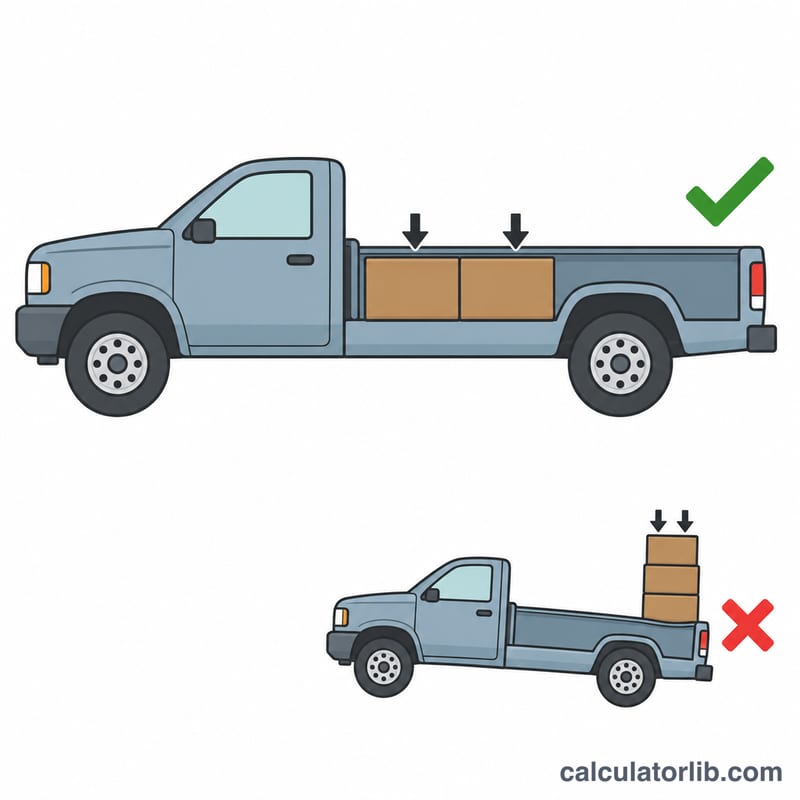
- Check each axle, not just the total. Keep the front and rear axle loads within their GAWR ratings, and keep the total within GVWR. Heavy cargo at the back of the bed or a heavy pin weight can overload the rear axle even when the total is under GVWR. Spread the load evenly and keep it forward of the rear axle where you can.
- Weigh the truck at a certified scale. Truck stops and some recycling or landfill sites have public scales. Weigh the truck fully loaded, with people, fuel, gear and the trailer hitched. Get separate readings for the steer axle, drive axle and trailer axles. Then compare each reading with the door-jamb ratings.
- Leave a safety margin. Don't load to the exact limit. Cargo estimates are often too low, water and fuel tanks fill up, and passengers vary. Leaving some capacity unused helps braking, handling and tire life.
- Don't try to raise GVWR with upgrades. Airbags, helper springs, stiffer leaf springs and bigger tires can make a truck sit level or ride more firmly. They do not change the GVWR, which the manufacturer sets and certifies. Brakes, frame, axles, wheels and other parts also limit it. The legal and insurance rating is still the number on the label.
- Check the other ratings too. When you tow, also stay within the Gross Combined Weight Rating (GCWR), the trailer hitch rating and the tire load ratings. The lowest of these limits is the one that controls.
This is general information, not professional engineering or legal advice. Weight limits and enforcement differ by country and jurisdiction. Always follow your vehicle manufacturer's ratings and local regulations.
FAQ
Does payload include passengers? Yes. GVWR covers everything added to the truck, so occupants, fuel beyond curb spec, and cargo all count against payload.
Is payload the same as towing capacity? No. Payload is weight carried in or on the truck; towing capacity is weight pulled behind it and is governed by the GCWR.
What if curb weight exceeds GVWR? That should never happen on a stock truck. A negative result means your input figures are wrong, so recheck the door sticker.