What this generator fuel cost calculator does
Portable and standby generators rarely run at full power, and fuel use does not drop to zero when the load is light. This calculator estimates how much fuel your generator burns per hour, per day and over a set number of days, and turns that into a running cost using your local fuel price. It works for diesel, petrol or propane in litres or gallons, as long as the consumption rate and price use the same unit.
How to use it
Enter the fuel use at full load from the spec sheet (often listed at 100% load). Set the average load as a percentage of rated output, then the no-load fuel use: generators typically burn roughly 20–30% of their full-load amount just idling, so 25% is a reasonable default. Add the fuel price per litre or gallon, the hours you run each day, and the number of days.
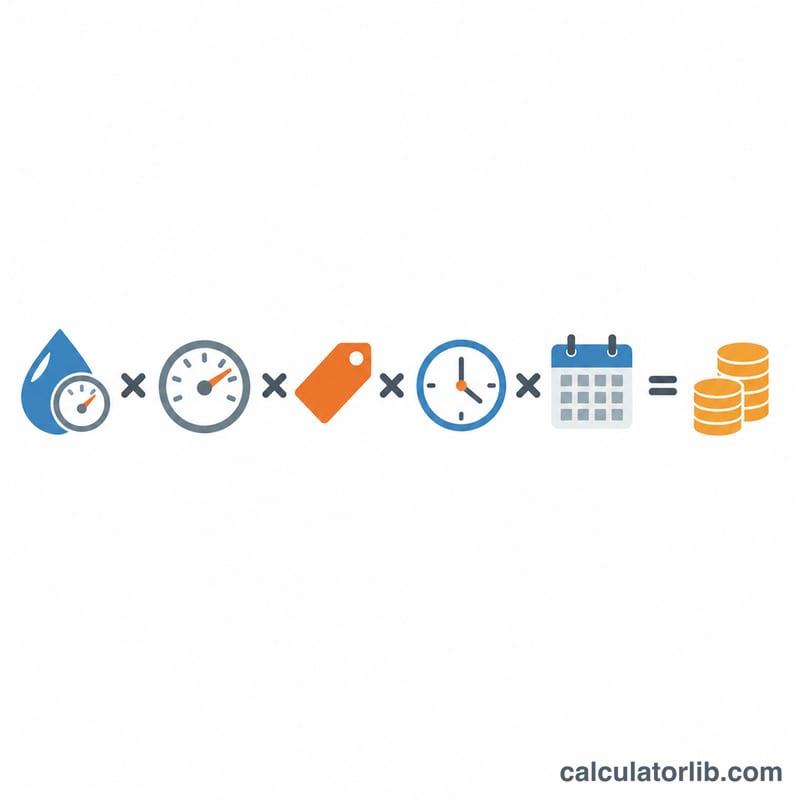
The formula
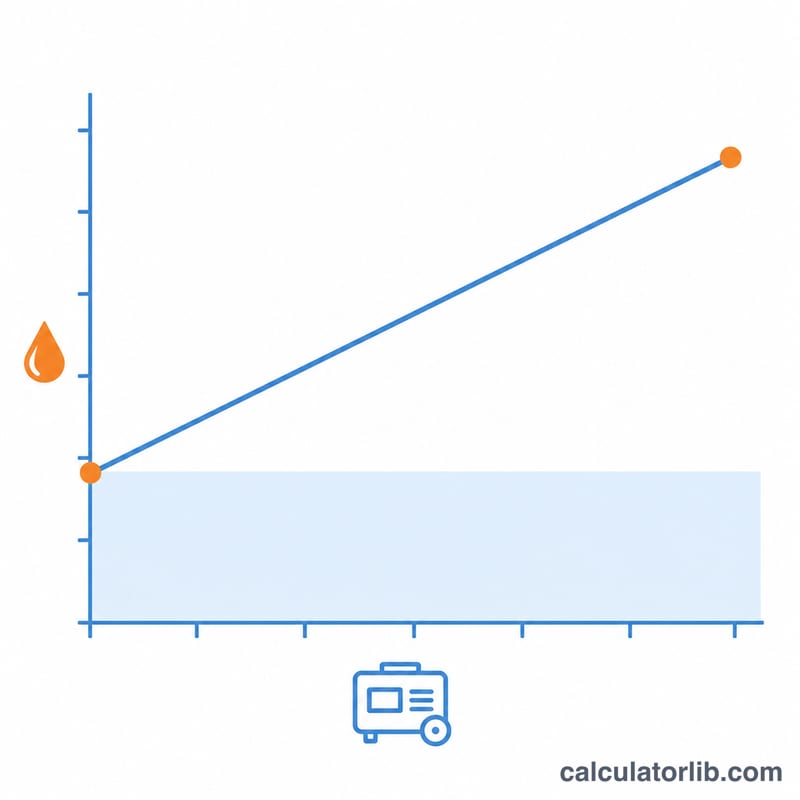
Fuel use is modelled as a straight line between idle and full load:
$$F_h = F_{full} \times \left( i + (1 - i) \times L \right)$$where \(F_{full}\) is the full-load rate, \(L\) is the load fraction and \(i\) is the no-load fraction. Cost per hour is \(C_h = F_h \times P\), with \(P\) the fuel price. Multiply by the hours per day \(H\) and the days \(D\) to get the totals.
Worked example
A generator burns 10 L/h at full load, runs at 50% load, idles at 25%, and fuel costs 1.50 per litre. It runs 8 hours a day for 30 days.
$$F_h = 10 \times (0.25 + 0.75 \times 0.5) = 6.25\,\text{L/h}$$$$C_h = 6.25 \times 1.50 = 9.375 \text{ per hour}$$$$C_{total} = 9.375 \times 8 \times 30 = 2250$$That works out to 50 L and 75 per day, or 1,500 L over the month.
Typical Generator Fuel Consumption by Size and Load
The table below shows typical, approximate fuel use for diesel generators. The values come from widely published industry approximation charts. They are not specifications for any particular model. Real consumption depends on engine design, age, maintenance, altitude, temperature and how the load is shared between phases. The US gallon figures follow the common published chart, and the litre figures are converted using 1 US gal = 3.785 L.
| Generator rating (kW) | 25% load | 50% load | 75% load | 100% load | ||||
|---|---|---|---|---|---|---|---|---|
| L/h | US gal/h | L/h | US gal/h | L/h | US gal/h | L/h | US gal/h | |
| 20 | 2.3 | 0.6 | 3.4 | 0.9 | 4.9 | 1.3 | 6.1 | 1.6 |
| 30 | 4.9 | 1.3 | 6.8 | 1.8 | 9.1 | 2.4 | 11.0 | 2.9 |
| 40 | 6.1 | 1.6 | 8.7 | 2.3 | 12.1 | 3.2 | 15.1 | 4.0 |
| 60 | 6.8 | 1.8 | 11.0 | 2.9 | 14.4 | 3.8 | 18.2 | 4.8 |
| 75 | 9.1 | 2.4 | 12.9 | 3.4 | 17.4 | 4.6 | 23.1 | 6.1 |
| 100 | 9.8 | 2.6 | 15.5 | 4.1 | 22.0 | 5.8 | 28.0 | 7.4 |
| 150 | 13.6 | 3.6 | 22.3 | 5.9 | 31.8 | 8.4 | 41.3 | 10.9 |
| 200 | 17.8 | 4.7 | 29.1 | 7.7 | 41.6 | 11.0 | 54.5 | 14.4 |
Fuel use does not fall in step with load. At 25% load a diesel generator still burns roughly 30–40% of its full-load fuel, because the engine has fixed losses. This is why the calculator has a no-load (idle) percentage input.
Note: These figures are for diesel only. Petrol (gasoline) and propane (LPG) generators burn noticeably more fuel per kWh than diesel units of similar size. Propane is also measured differently: by volume of liquid or by weight, depending on the supplier. Always use the fuel consumption figures from your generator's data sheet when you have them. They take priority over any general chart, including this one.
Cost at Different Load Levels
This comparison uses the article's example generator. It burns 10 L/h at full load, has a no-load fraction of 25% (\(i = 0.25\)) and runs on fuel costing 1.50 per litre. We also assume a rated output of 30 kW so that we can work out energy and cost per kWh. The price is in a generic currency unit, so use whatever currency you pay in. Fuel use at each load fraction \(L\) is:
$$F_{\text{load}} = F_{\text{full}} \times \left(i + (1 - i)\,L\right)$$For example, at 50% load: \(10 \times (0.25 + 0.75 \times 0.50) = 10 \times 0.625 = 6.25\) L/h. The cost is \(6.25 \times 1.50 = 9.375\) per hour. Energy produced is \(30 \times 0.50 = 15\) kWh per hour, so cost per kWh is \(9.375 \div 15 = 0.625\).
| Load | Fuel (L/h) | Cost per hour | kWh produced per hour | Litres per kWh | Cost per kWh |
|---|---|---|---|---|---|
| 10% | 3.25 | 4.875 | 3 | 1.083 | 1.625 |
| 25% | 4.375 | 6.5625 | 7.5 | 0.583 | 0.875 |
| 50% | 6.25 | 9.375 | 15 | 0.417 | 0.625 |
| 75% | 8.125 | 12.1875 | 22.5 | 0.361 | 0.542 |
| 100% | 10 | 15 | 30 | 0.333 | 0.500 |
Running at 10% load costs about one third as much per hour as running at full load (4.875 vs 15). But each kWh costs more than three times as much (1.625 vs 0.50), because the fixed no-load fuel is spread over very little output. Over a full day, the 50% case comes to \(6.25 \times 1.50 \times 24 = 225\) (225 per day).
In practice, choosing a generator size that keeps the typical load at roughly 50–80% of the rating gives a much lower cost per kWh than running a large unit lightly loaded. Long periods at very light load can also cause wet stacking in diesel engines.
FAQ
Where do I find the full-load consumption?
Look in the generator manual or data sheet. Many list fuel use at 25%, 50%, 75% and 100% load. If you have those figures, you can enter the matching rate and set no-load use to 0% for a direct reading.
Why not just scale fuel use by load?
Engines need fuel just to keep turning, so a generator at 10% load uses much more than 10% of its full-load fuel. The idle term accounts for this.
Does running at low load save money?
It costs less per hour, but fuel per kWh goes up. Matching the generator size to the load is usually the cheapest option.