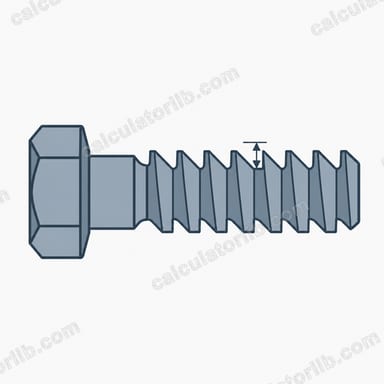
What is the buttress thread pitch diameter?
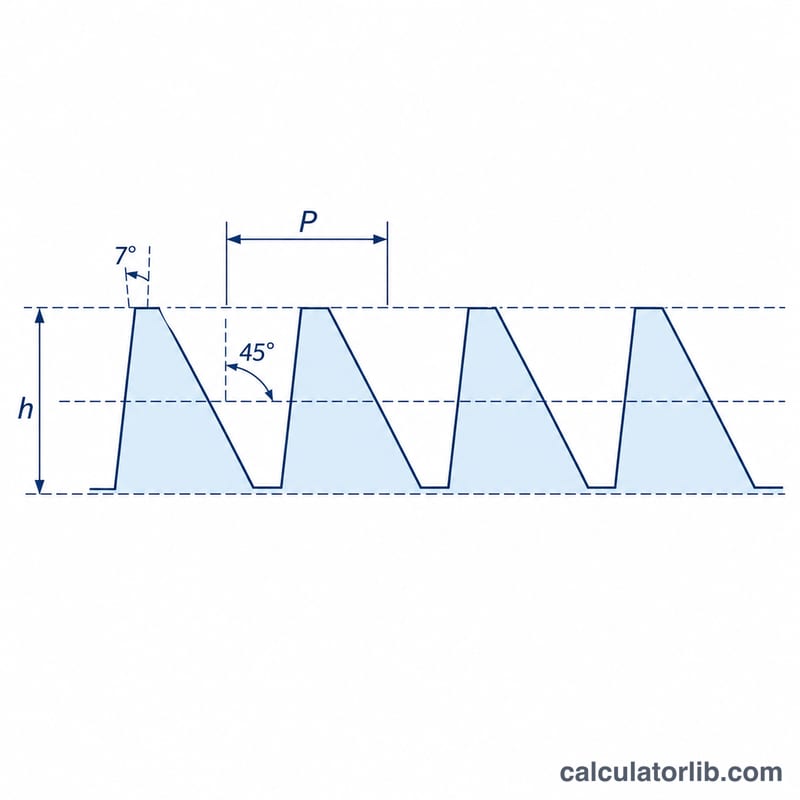
A buttress thread is an asymmetric screw thread designed to carry high axial loads in one direction, used in vices, jacks, lead screws and hydraulic rams. Its pressure flank is nearly perpendicular to the axis (about 7°) while the trailing flank is steep (45°). The pitch diameter \(d_2\) is the imaginary diameter where the thread tooth and the groove between teeth are of equal effective width; it is the dimension that actually governs fit and load transfer between a screw and its nut.
How to use this calculator
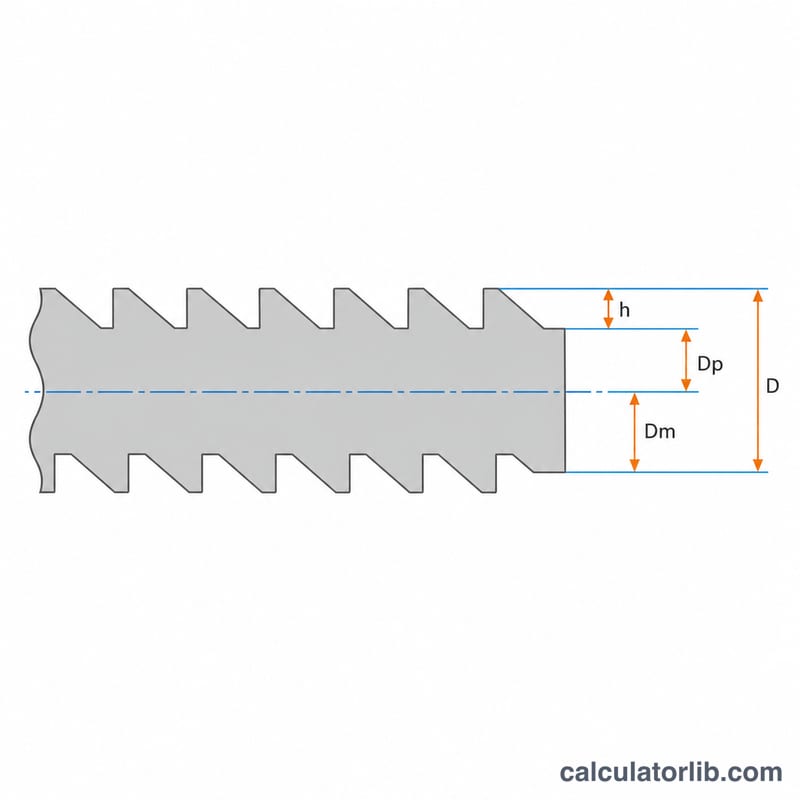
Enter the nominal major diameter \(D\) (the outside crest diameter) and the pitch \(P\) (the axial distance from one thread crest to the next). Keep both values in the same units. The calculator returns the pitch diameter, the radial thread depth and the minor (root) diameter, which you can use for design drawings, gauge selection and inspection.
The formula explained
For the standard 7°/45° buttress form the radial thread depth is a fixed fraction of the pitch, and the pitch line sits at the middle of that depth:
$$d_2 = D - 0.66271\,P$$where \(D\) is the major diameter, \(P\) is the pitch and \(h = 0.66271\,P\) is the thread depth. The minor diameter follows as \(d_3 = D - 2h\), because the radius is reduced by the full thread depth on the profile and the diameter changes by twice that amount.
Worked example
Take a buttress thread with \(D = 40\) mm and \(P = 6\) mm. First the depth:
$$h = 0.66271 \times 6 = 3.9763\ \text{mm}$$Then the pitch and minor diameters:
$$d_2 = 40 - 3.9763 = 36.0237\ \text{mm}$$$$d_3 = 40 - 2 \times 3.9763 = 32.0475\ \text{mm}$$More Worked Examples
Each example below uses \(h = 0.66271P\), \(d_2 = D - h\) and \(d_3 = D - 2h\). Intermediate values are kept at full precision, and final results are rounded to 4 decimal places.
Example 1: Inch thread, D = 2 in at 6 TPI
- Convert TPI to pitch: $$P = \frac{1}{6} = 0.16667\ \text{in}$$
- Thread depth: $$h = 0.66271 \times 0.16667 = 0.11045\ \text{in} \approx 0.1105\ \text{in}$$
- Pitch diameter: $$d_2 = 2 - 0.11045 = 1.88955\ \text{in} \approx 1.8895\ \text{in}$$
- Minor diameter: $$d_3 = 2 - 2 \times 0.11045 = 2 - 0.22091 = 1.77909\ \text{in} \approx 1.7791\ \text{in}$$
Rounding the pitch to 0.16667 in changes the results by less than 0.00001 in. At 4 decimal places they are the same as using exactly 1/6 in.
Example 2: Small metric thread, 20 × 4 mm
- Thread depth: $$h = 0.66271 \times 4 = 2.65084\ \text{mm} \approx 2.6508\ \text{mm}$$
- Pitch diameter: $$d_2 = 20 - 2.65084 = 17.34916\ \text{mm} \approx 17.3492\ \text{mm}$$
- Minor diameter: $$d_3 = 20 - 2 \times 2.65084 = 20 - 5.30168 = 14.69832\ \text{mm} \approx 14.6983\ \text{mm}$$
Result: the pitch diameter is 17.3492 mm and the minor diameter is 14.6983 mm.
Example 3: Large lead-screw thread, 100 × 12 mm
- Thread depth: $$h = 0.66271 \times 12 = 7.95252\ \text{mm} \approx 7.9525\ \text{mm}$$
- Pitch diameter: $$d_2 = 100 - 7.95252 = 92.04748\ \text{mm} \approx 92.0475\ \text{mm}$$
- Minor diameter: $$d_3 = 100 - 2 \times 7.95252 = 100 - 15.90504 = 84.09496\ \text{mm} \approx 84.0950\ \text{mm}$$
Result: the minor diameter is 84.0950 mm. The core of a lead screw is set by its minor diameter, so this is the value to use when checking the screw's root strength or buckling. All three examples give basic sizes only. Apply the tolerances from the relevant standard before finalising drawings or gauges.
FAQ
Does this work for inch threads? Yes. Enter the major diameter and pitch in inches (pitch equals \(1/\text{TPI}\)) and every result comes back in inches.
Why 0.66271? It is the standard engagement-height constant for the 7°/45° buttress profile, giving the radial distance from crest to root used in design tables.
Is pitch diameter the same as effective diameter? Yes, the two terms are interchangeable and describe the diameter that controls the mating fit.