What is propeller pitch?
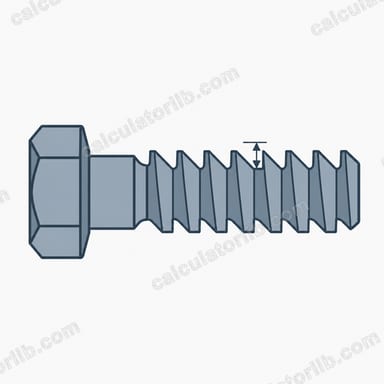
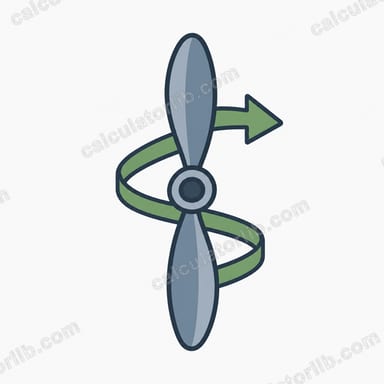
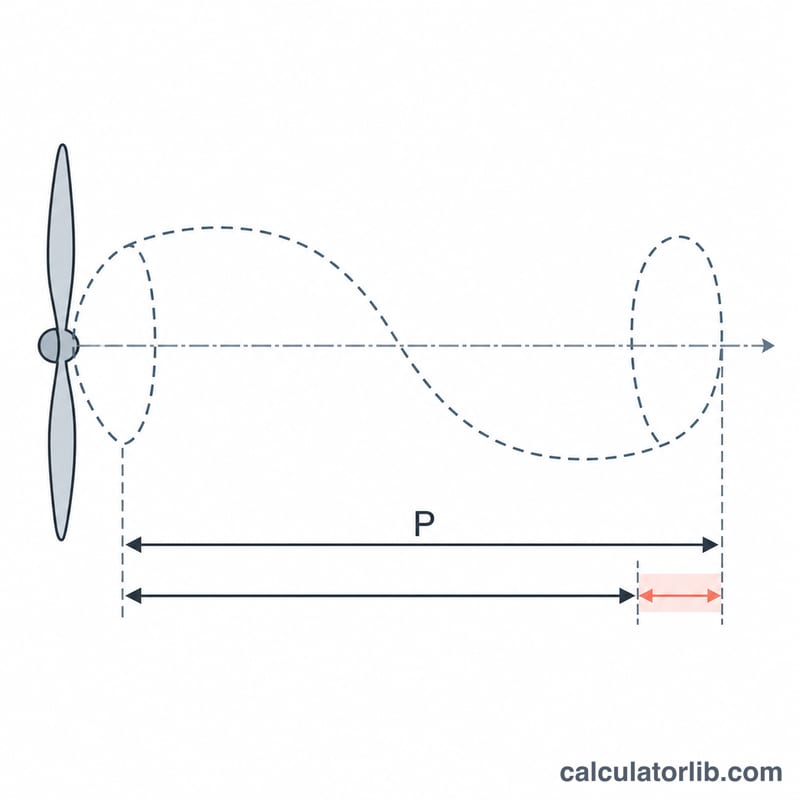
Propeller pitch is the distance a propeller would move forward in one revolution if it screwed through the air like a bolt through a nut, with no losses. In practice, air is not solid, so the aircraft advances less than the geometric pitch on each turn. That shortfall is called slip. This calculator works backwards from the true airspeed you want at a given RPM and estimates the geometric pitch your propeller needs. It also reports the theoretical advance, advance ratio, blade angle and tip speed.
How to use the calculator
Enter the propeller diameter in inches, the cruise RPM at the propeller (after any reduction gearbox), the true airspeed you want in knots, and an estimate of slip. Fixed-pitch propellers on light aircraft typically run 10–20% slip at cruise. Higher slip is typical for climb props and slow, heavily loaded aircraft.
The formula
One knot equals about 1215.22 inches per minute. The effective pitch is the actual advance per revolution, \(P_{eff} = \frac{V \times 1215.22}{N}\). The geometric pitch then corrects for slip \(s\):
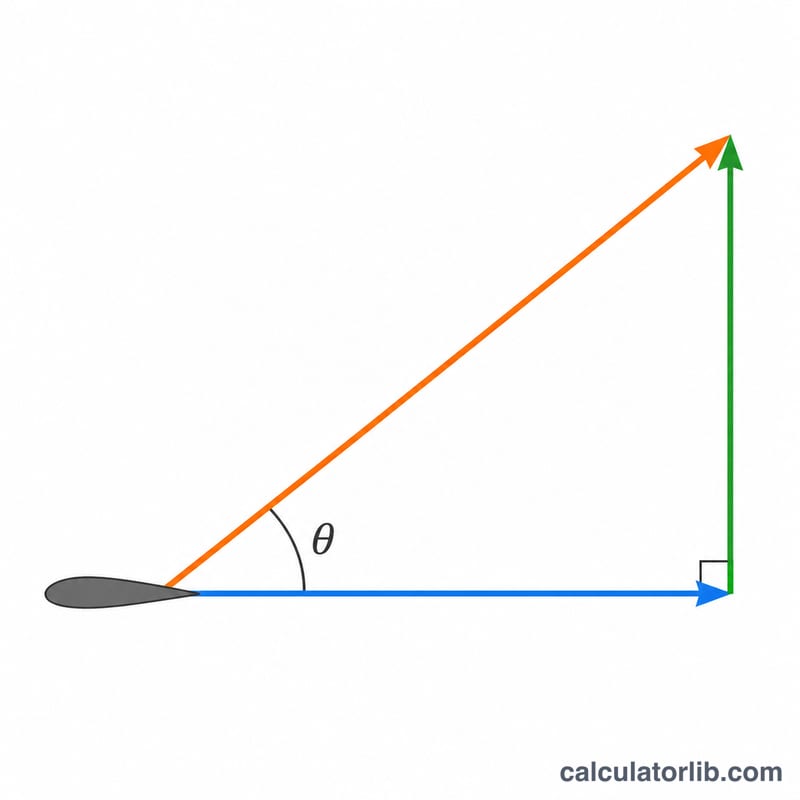
$$P = \frac{V \times 1215.22}{N\,(1 - s)}$$The advance ratio is \(J = P_{eff}/D\). The helical tip speed combines rotational speed \(\pi D N / 720\) (ft/s) with forward speed. Dividing it by the sea-level speed of sound, 1116.45 ft/s, gives the tip Mach number. The blade angle at 75% radius is \(\beta = \arctan\left(\frac{P}{0.75\pi D}\right)\).
Worked example
Take a 72-inch propeller turning 2400 RPM, a target of 120 knots, and 15% slip:
$$P_{eff} = \frac{120 \times 1215.22}{2400} = 60.76\,\text{in}$$$$P = \frac{60.76}{0.85} = 71.48\,\text{in}$$The zero-slip speed is \(120/0.85 = 141.2\) knots and \(J = 0.844\). The helical tip speed is about 780.7 ft/s, or Mach 0.70, which is comfortably below the 0.85 noise and efficiency limit.
Pitch Across Typical Aircraft Scenarios
The table shows five typical light-aircraft setups. Every value comes from the formulas used by this calculator. True airspeed is converted at 1215.22 in/min per knot, and the speed of sound is the standard sea-level value of 1116.45 ft/s.
- Effective pitch is \(1215.22\,V/N\), the distance the propeller actually moves forward in one turn.
- Geometric pitch is effective pitch divided by \((1 - s/100)\).
- Advance ratio is \(J = 1.6878\,V \cdot 720/(N D)\). This works out to effective pitch divided by diameter.
- Blade angle at 75% radius is \(\beta = \arctan\!\left(P/(0.75\,\pi D)\right)\).
- Helical tip speed combines the blade tip's rotational speed \(\pi D N/720\) with the forward speed \(1.6878\,V\).
| Scenario | Inputs (D, prop RPM, TAS, slip) | Effective pitch | Geometric pitch | Advance ratio J | Blade angle at 75% R | Helical tip speed | Tip Mach |
|---|---|---|---|---|---|---|---|
| Slow ultralight with gearbox | 60 in, 2600, 55 kt, 20% | 25.7 in | 32.1 in | 0.43 | 12.8° | 687 ft/s | 0.62 |
| Trainer climb prop | 72 in, 2400, 100 kt, 18% | 50.6 in | 61.7 in | 0.70 | 20.0° | 773 ft/s | 0.69 |
| Cruise prop | 72 in, 2500, 130 kt, 12% | 63.2 in | 71.8 in | 0.88 | 22.9° | 815 ft/s | 0.73 |
| Fast homebuilt | 68 in, 2700, 170 kt, 10% | 76.5 in | 85.0 in | 1.13 | 27.9° | 851 ft/s | 0.76 |
| High-RPM direct drive | 72 in, 2800, 160 kt, 12% | 69.4 in | 78.9 in | 0.96 | 24.9° | 920 ft/s | 0.82 |
Worked check (cruise prop). Here is the cruise-prop row worked through in full:
$$P_{\text{eff}} = \frac{1215.22 \times 130}{2500} = 63.19\ \text{in}, \qquad P = \frac{63.19}{1 - 0.12} = 71.81\ \text{in}$$
$$V_{tip} = \sqrt{\left(\frac{\pi \times 72 \times 2500}{720}\right)^{2} + (1.6878 \times 130)^{2}} = \sqrt{785.4^{2} + 219.4^{2}} \approx 815.5\ \text{ft/s}$$
Dividing by 1116.45 ft/s gives a tip Mach of about 0.73.
Tip Mach note: None of these cases goes over the 0.85 tip Mach limit at sea-level standard conditions. Two come close:
- The 72 in direct-drive prop at 2800 RPM reaches 0.82, so it has very little margin.
- The fast homebuilt reaches 0.76.
The geared ultralight stays far below the limit because the gearbox keeps its propeller RPM low. A larger diameter, higher RPM or higher airspeed would push the high-RPM case past 0.85.
Interpreting Your Results
Geometric pitch is the main result. It is the pitch the blade would need to reach your target true airspeed at the given RPM, once slip is included. It is usually quoted at 75% of the tip radius. Effective pitch is how far the aircraft actually moves forward in one turn of the propeller. The difference between the two is the slip.
Advance ratio (J) compares forward speed with how fast the blade tips are turning. For light aircraft, J is usually about 0.3–0.6 in climb and about 0.7–1.0 at cruise. Fast aircraft can go higher. A fixed-pitch propeller is most efficient over a fairly narrow band of J, so the J at your design point tells you which flight phase the propeller is optimised for.
Pitch-to-diameter ratio (P/D) shows what kind of propeller you have:
- About 0.6–0.75: a climb propeller. It gives good takeoff and climb thrust but a lower top speed.
- About 0.8–1.0 or more: a cruise propeller. It gives a higher cruise speed but weaker takeoff and climb.
Blade angle at 75% radius is the angle of the blade's pitch line at that station. It equals \(\arctan\!\left(P/(0.75\,\pi D)\right)\). Typical light-aircraft values run from about 15° to 30°. Low values mean a fine (climb) pitch, and high values mean a coarse (cruise) pitch.
Tip Mach is the helical tip speed divided by the speed of sound.
- Below 0.7: quiet and efficient.
- 0.7–0.85: acceptable, but noise rises noticeably.
- Above 0.85: compressibility losses, more noise and lower efficiency. Avoid this range.
Matching pitch to the engine:
- Too much pitch: the propeller absorbs too much power. The engine may not reach its rated static or climb RPM, so you lose takeoff and climb performance.
- Too little pitch: the engine can over-speed at cruise or in a descent, going past its redline RPM.
With a fixed-pitch propeller you are always trading climb performance against cruise performance. Check static RPM and full-throttle level-flight RPM against the engine maker's limits.
Altitude and temperature: The tip Mach shown uses the sea-level standard speed of sound, 1116.45 ft/s. The speed of sound falls as air gets colder, so it is lower at altitude. In the International Standard Atmosphere it is about 1085 ft/s at 8,000 ft. The same tip speed therefore gives a higher Mach number up high than the sea-level figure suggests. Also enter true airspeed, not indicated airspeed, because true airspeed is higher at altitude.
These results are first-order estimates. They are based on an assumed slip value and simple geometry. They do not replace data from the propeller or engine manufacturer, approved type data, or advice from a qualified propeller specialist.
FAQ
Does this replace the manufacturer data?
No. Use it for estimates and comparisons. Propeller selection for a certified aircraft must follow the type certificate and the propeller manufacturer's approved data.
Why keep tip Mach below about 0.85?
As blade tips approach the speed of sound, shock waves form. They sharply raise drag and noise and reduce thrust efficiency.
What slip value should I assume?
Use 10–15% for a well-matched cruise prop and 15–25% for climb props or slower aircraft. If you know your real cruise speed, you can refine the estimate by comparing it with the theoretical speed.