What this calculator does
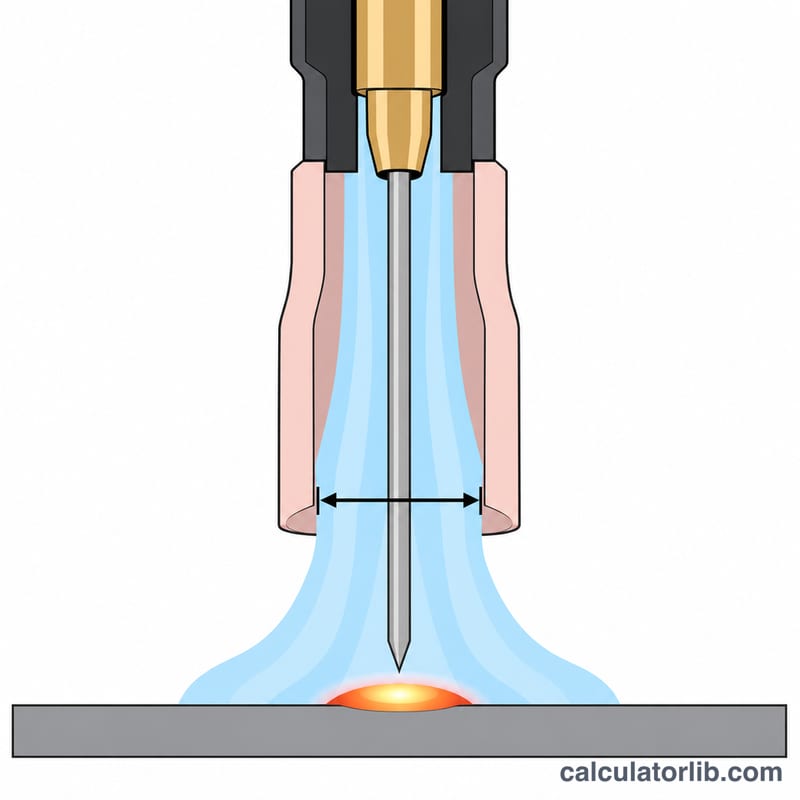
In TIG (GTAW) welding a shielding gas, usually argon, keeps oxygen and nitrogen away from the tungsten and the weld pool. If the flow is too low the weld gets porous and the tungsten oxidises. If it is too high you waste gas and can cause turbulence that pulls air into the shield. This calculator gives a practical starting flow from your cup size, gas type and air movement, and estimates how long a cylinder will last.
How to use it
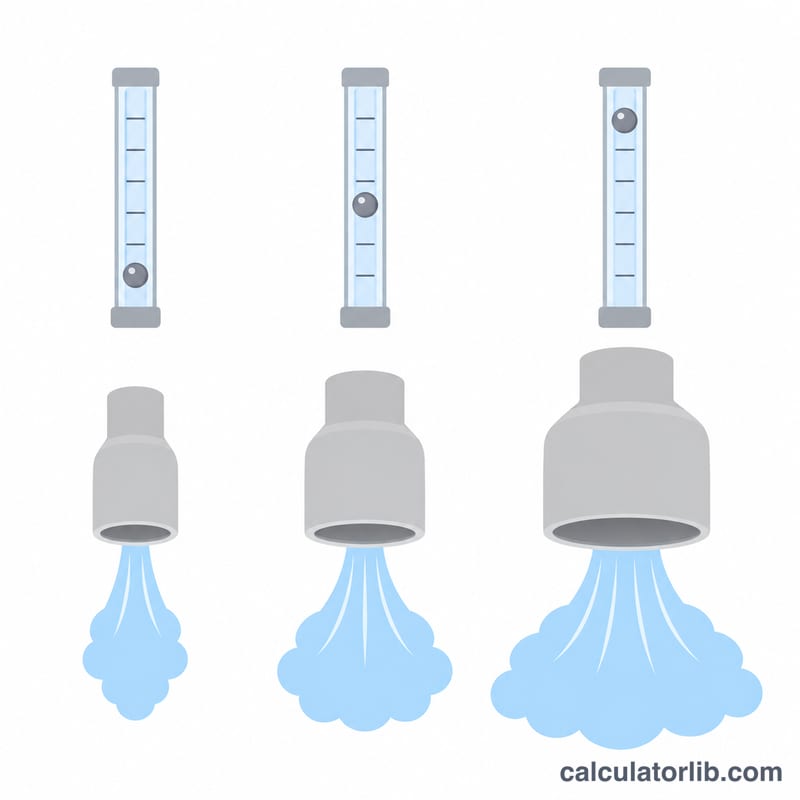
Pick your ceramic cup number, which is the inside diameter in sixteenths of an inch (a #8 cup is 1/2 in). Choose the gas and how much draft there is where you weld, then enter your cylinder capacity in cubic feet. The result is a starting point: fine-tune it on your flowmeter while watching the bead and the colour of the tungsten.
The formula
A widely used shop rule is about 2.5 CFH of argon per cup number in still air:
$$Q = 2.5 \times n \times f_{gas} \times f_{draft}$$Here \(n\) is the cup number, \(f_{gas}\) is 1.0 for argon, 1.4 for an argon/helium mix and 2.0 for helium (helium is light and rises away from the weld), and \(f_{draft}\) is 1.0, 1.25 or 1.5 for still air, a light draft or a strong draft. The metric flow is \(Q \times 0.4719\) L/min, and cylinder run time is \(t = V / Q\).
Worked example
A #8 cup with pure argon in a still shop, using a 330 cu ft cylinder:
$$Q = 2.5 \times 8 \times 1.0 \times 1.0 = 20\,\text{CFH} \approx 9.44\,\text{L/min}$$$$t = \frac{330}{20} = 16.5\,\text{h}$$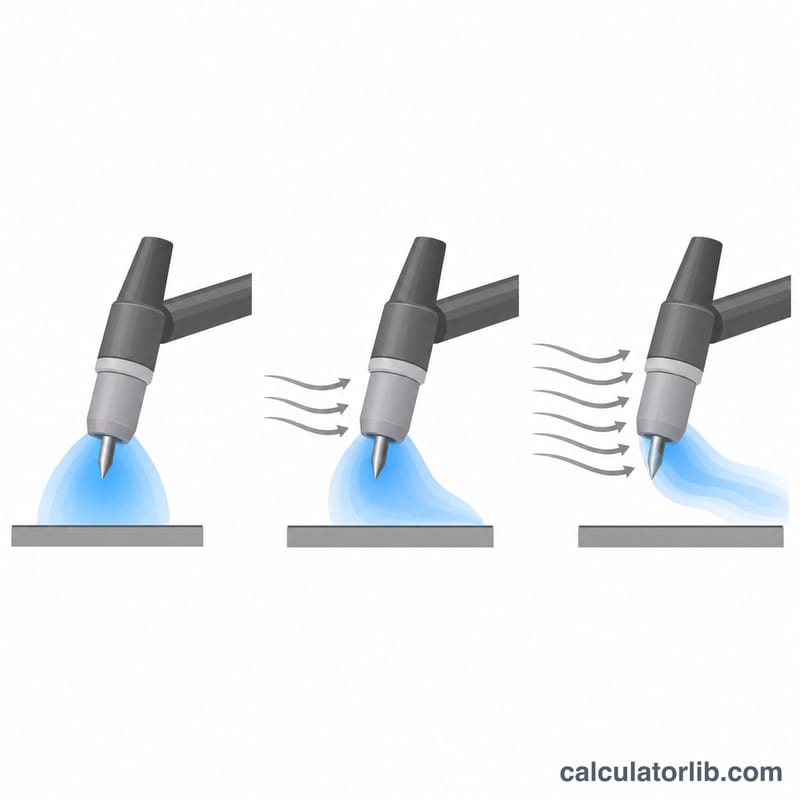
Starting Flow by Cup Size
TIG cup (nozzle) numbers give the inside diameter of the orifice in sixteenths of an inch, so a #8 cup is 8/16 = 1/2 in (12.7 mm). The calculator's starting flow is \(Q_{\text{CFH}} = 2.5 \times n\) for pure argon in still air, where \(n\) is the cup number. It converts to litres per minute with \(Q_{\text{L/min}} = 0.4719 \times Q_{\text{CFH}}\). For drafts, the still-air value is multiplied by 1.25 for a light draft and 1.5 for a strong draft. For example, a #8 cup in still air gives \(2.5 \times 8 = 20\) CFH, or \(0.4719 \times 20 \approx 9.44\) L/min. You can check this in the calculator: 20 CFH.
| Cup | Inside diameter (in) | Inside diameter (mm) | Still air CFH | Still air L/min | Light draft CFH (×1.25) | Light draft L/min | Strong draft CFH (×1.5) | Strong draft L/min |
|---|---|---|---|---|---|---|---|---|
| #4 | 1/4 | 6.4 | 10 | 4.72 | 12.5 | 5.90 | 15 | 7.08 |
| #5 | 5/16 | 7.9 | 12.5 | 5.90 | 15.6 | 7.37 | 18.8 | 8.85 |
| #6 | 3/8 | 9.5 | 15 | 7.08 | 18.8 | 8.85 | 22.5 | 10.62 |
| #7 | 7/16 | 11.1 | 17.5 | 8.26 | 21.9 | 10.32 | 26.3 | 12.39 |
| #8 | 1/2 | 12.7 | 20 | 9.44 | 25 | 11.80 | 30 | 14.16 |
| #10 | 5/8 | 15.9 | 25 | 11.80 | 31.3 | 14.75 | 37.5 | 17.70 |
| #12 | 3/4 | 19.1 | 30 | 14.16 | 37.5 | 17.70 | 45 | 21.24 |
These values are for pure argon. For an argon/helium mix the calculator multiplies the flow by 1.4, and for pure helium by 2.0, because helium is much lighter and leaves the weld zone faster. All figures are starting points, not fixed settings. Set the value on your flowmeter, then fine-tune it based on how the tungsten and weld bead look. Torch angle, stick-out, gas lens use and joint shape all change the flow you actually need.
Practical Tips for Setting and Saving Gas
- Set the flow with gas flowing. Read the flowmeter while gas is actually passing through the torch, either with the torch purge button or during pre-flow. A static reading with no flow can be misleading. Set the value the calculator gives you, then adjust from there.
- Reduce flow in small steps. Once welds look good, lower the flow a little at a time, for example 1–2 CFH (about 0.5–1 L/min) per step. Keep going down only while the tungsten stays bright and silvery after the arc stops and the bead stays clean and shiny. Stop at the lowest setting that still gives clean results.
- Signs the flow is too low. Watch for a tungsten that turns grey, blue or discoloured after the weld, a sooty or dull bead, or porosity (pinholes) in the weld. If you see any of these, turn the flow back up a step. Also check the cup size and that nothing is blocking the gas.
- Signs the flow is too high. Too much flow makes turbulence, which pulls air into the shield. Signs include porosity or oxidation despite a high flow setting, an unstable or wandering arc, and audible hissing at the cup. Turning the flow up further makes this worse. Lower the flow, or switch to a gas lens to get a smoother, laminar stream.
- Check fittings for leaks. Brush soapy water onto the regulator, hose connections and torch fittings with the gas on. Bubbles mean a leak. Leaks waste gas between welds and can draw air into the gas stream. Tighten or replace the fitting and test again.
- Keep post-flow reasonable. A common shop rule of thumb is about 1 second of post-flow per 10 A of welding current. At 150 A that is \(150 \div 10 = 15\) s. Post-flow long enough to protect the cooling tungsten and crater, but not so long that you waste gas at every stop.
- Block drafts instead of turning the gas up. The calculator's draft factors (×1.25 and ×1.5) show how much more gas wind costs you. Welding screens, curtains or a temporary windbreak are usually cheaper and work better than higher flow, which can also cause turbulence.
- Plan cylinder changes with pre-flow and post-flow in mind. The calculator's cylinder time, \(t = \text{cylinder volume} \div Q_{\text{CFH}}\), counts arc-on flow only. An 80 ft³ cylinder at 20 CFH gives \(80 \div 20 =\) 4 hours of continuous flow. Pre-flow, post-flow, purging and small leaks all shorten that in practice. Cylinder sizes in cubic feet are common in the US. In many other countries cylinders are rated in litres or cubic metres (1 ft³ ≈ 28.3 L), so convert before entering the value.
- Keep a spare cylinder for long jobs. If a job will use most of the estimated cylinder time, have a full spare on hand. Running out mid-weld leaves the tungsten and weld pool without shielding gas.
FAQ
Does a gas lens change the flow? A gas lens gives smoother, laminar flow, so you can often stick out more tungsten at a similar or slightly lower flow. Use the result as a ceiling and turn it down if the weld stays clean.
Why does helium need more flow? Helium is roughly ten times lighter than argon, so it escapes upwards quickly and needs about twice the flow to cover the same area.
Is the run time exact? No. It counts only arc-on time at a steady flow. Pre-flow, post-flow and leaks all shorten real cylinder life.