What is the fluid balance calculator?
The fluid balance calculator totals every source of fluid a patient takes in and every source they lose over a defined period, then reports the net difference. Clinicians use it to track hydration, guide intravenous therapy, and spot early signs of fluid overload or dehydration in hospitalized patients.
How to use it
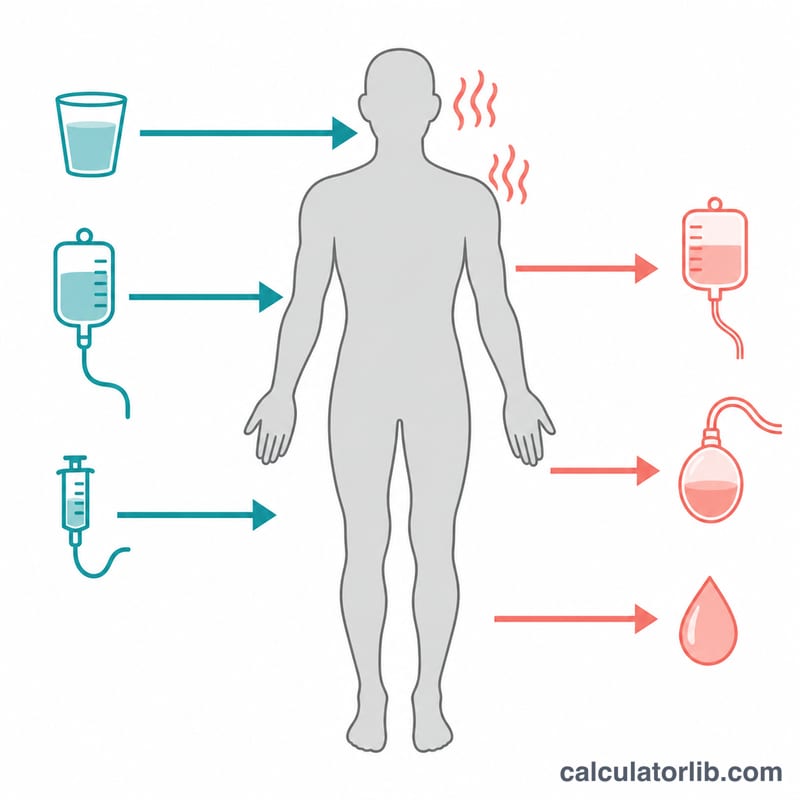
Enter all intake volumes in millilitres: oral or enteral feeds, intravenous fluids, and any other intake such as flushes or medications. Then enter measured output: urine, drainage or nasogastric losses, and other output. Finally, enter the patient weight and the number of hours covered so the tool can estimate insensible losses from skin and respiration.
The formula explained
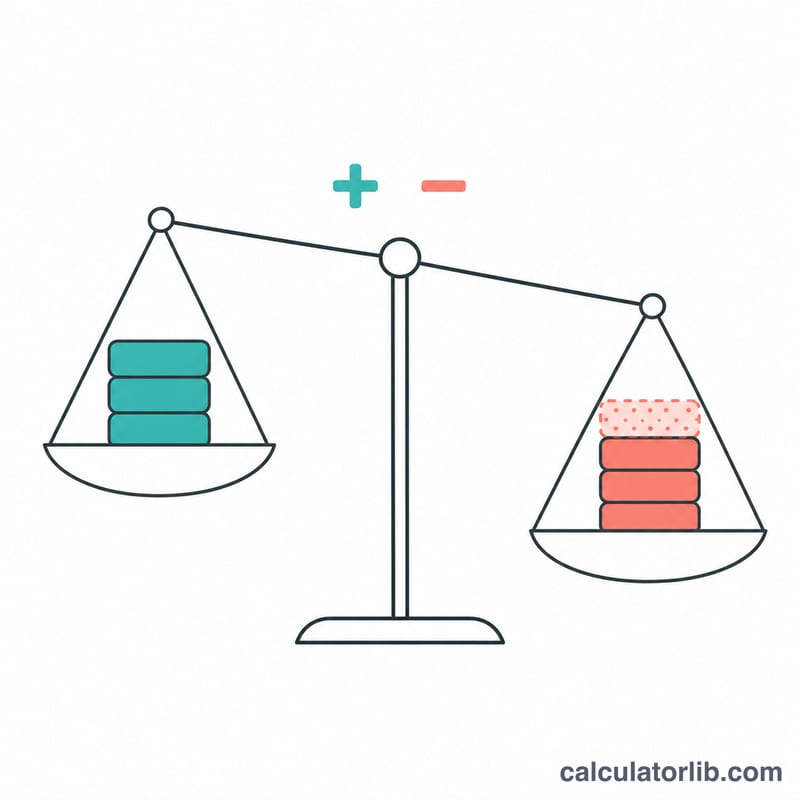
Net balance is simply total intake minus total output, where total output includes the estimated insensible loss:
$$ \text{Net} = \text{Intake}_{total} - \text{Output}_{total} $$Insensible loss is estimated at roughly \( 0.5 \) mL per kilogram per hour, so with weight \(W\) in kg and duration \(H\) in hours:
$$ L_{ins} = 0.5 \times W \times H $$A positive result means the patient gained fluid; a negative result means a net deficit.
Worked example
A 70 kg patient over 24 hours takes in 1000 mL orally and 1500 mL IV, and puts out 1200 mL urine and 300 mL drainage. Insensible loss and totals are:
$$ L_{ins} = 0.5 \times 70 \times 24 = 840\,\text{mL} $$ $$ \text{Intake} = 1000 + 1500 = 2500\,\text{mL} $$ $$ \text{Output} = 1200 + 300 + 840 = 2340\,\text{mL} $$ $$ \text{Net} = 2500 - 2340 = 160\,\text{mL} $$The patient is therefore 160 mL net positive over the 24-hour window.
Interpreting Your Fluid Balance Result
The calculator subtracts total output from total intake. Total output includes an estimate of insensible loss, calculated as \(L = 0.5 \times \text{weight (kg)} \times \text{hours}\) mL:
$$\text{Net Balance} = I - O$$A positive result means more fluid went in than came out, so fluid was retained. A negative result means more fluid was lost than taken in.
What different results usually mean
- Near zero (within a few hundred millilitres over 24 hours): intake and measured plus estimated losses roughly match. This is often what fluid monitoring hopes to see in a stable patient.
- Moderately positive or negative (about 500–1000 mL over 24 hours): the patient retained or lost a modest amount. This can be expected, for example during planned IV fluid replacement or diuretic therapy. It is usually a reason to look at the trend, not a finding on its own.
- Markedly positive or negative (well over 1 L in a day, or growing every day): this suggests significant fluid retention or depletion. It is usually a reason for clinical staff to review the patient.
These bands describe the result only. They are not diagnostic thresholds. What a given balance means depends on the patient's condition, their starting fluid status and the treatment goals.
Worked example (24 hours, 70 kg adult)
Intake: 1500 mL oral + 1000 mL IV + 0 mL other = 2500 mL.
Insensible loss: \(L = 0.5 \times 70 \times 24 = 840\) mL.
Output: 1600 mL urine + 200 mL drain + 0 mL other + 840 mL insensible = 2640 mL.
$$\text{Net} = 2500 - 2640 = -140\ \text{mL}$$The net balance is -140 mL. That is close to neutral for a 24-hour period.
Cumulative balance matters more than one period
A single shift or a single day can be misleading. Recording gaps, the timing of fluid boluses and diuretic doses can all distort it. Fluid charts are usually read as a running cumulative total over several days. A small daily positive balance that persists can add up to several litres of retained fluid.
Limits on accuracy
- Unmeasured losses are not included unless you enter them under "other output". These include diarrhoea, vomiting that was not measured, wound exudate, fistula losses and heavy sweating. Leaving them out makes the balance look more positive than it really is.
- Fever increases insensible loss. It is commonly described as rising by about 10–15% for each °C above normal body temperature. The fixed 0.5 mL/kg/h estimate does not adjust for this.
- Other factors also change insensible loss: high breathing rate, low room humidity, burns, and humidified or unhumidified ventilation.
- Recording errors add up over time, for example missed oral drinks, flushes or IV medicines that were not charted.
Cross-checking with body weight
Change in body weight is a common independent check. Short-term changes mostly reflect water, and about 1 kg of weight is roughly 1 L of fluid. For example, if the cumulative chart shows +2 L but the patient weighs the same, the chart may have missed some losses. Weigh at the same time of day, on the same scale, with similar clothing.
This is general information, not medical advice. A fluid balance figure should always be read alongside clinical assessment by qualified healthcare staff, such as vital signs, examination and blood tests. It should never be used alone to make treatment decisions.
Typical Intake, Output and Insensible Loss Values
The figures below are commonly cited reference values for adults. Children, older adults, pregnant people and patients with kidney, heart or liver disease can differ a lot. Local protocols and the clinical team's targets always come first.
| Quantity | Typical adult value | Notes / source |
|---|---|---|
| Total daily fluid intake | About 2–2.5 L/day | Includes drinks and fluid in food. Needs vary with body size, activity and climate. |
| Urine output | About 1–2 L/day | Depends on intake, kidney function and losses through other routes. |
| Minimum adequate urine output | About 0.5 mL/kg/h | Under the KDIGO acute kidney injury criteria, urine output below 0.5 mL/kg/h for 6 hours or more is one marker of AKI, also called oliguria. This rate is about 840 mL/day for a 70 kg adult. |
| Insensible loss (skin and breathing) | About 500–1000 mL/day | Roughly 0.5 mL/kg/h, which is the estimate this calculator uses. It is higher per kg in infants and children, and higher with fever, fast breathing, burns or a hot environment. |
| Routine maintenance fluid | 25–30 mL/kg/day of water | From NICE guideline CG174, Intravenous fluid therapy in adults in hospital (UK, England). It applies to adult IV maintenance, with lower amounts advised for some groups such as older or frail patients and those with kidney or heart impairment. |
Applying the per-kilogram values
For a 70 kg adult over 24 hours:
- Minimum adequate urine output: \(0.5 \times 70 \times 24 = 840\) mL
- Estimated insensible loss: \(0.5 \times 70 \times 24 = 840\) mL
- Maintenance water (NICE CG174): \(25 \times 70 = 1750\) mL to \(30 \times 70 = 2100\) mL per day
Sources: KDIGO Clinical Practice Guideline for Acute Kidney Injury (2012), which is international; NICE CG174, Intravenous fluid therapy in adults in hospital, which is a UK guideline; and standard physiology references for typical intake, output and insensible loss. Other countries and institutions may use different guidelines and targets.
This is general reference information, not medical advice. Individual fluid targets should be set by qualified clinicians.
FAQ
What are insensible losses? These are fluids lost invisibly through the skin and breathing. They rise with fever, sweating, and rapid breathing.
Is a positive balance always good? No. A large positive balance can signal fluid overload, while a negative balance may indicate dehydration. Interpret alongside clinical signs.
Can I use it for any period? Yes. Enter the hours that match your intake and output records, from a single shift to a full day.