
What Is the Fluid Density Calculator?
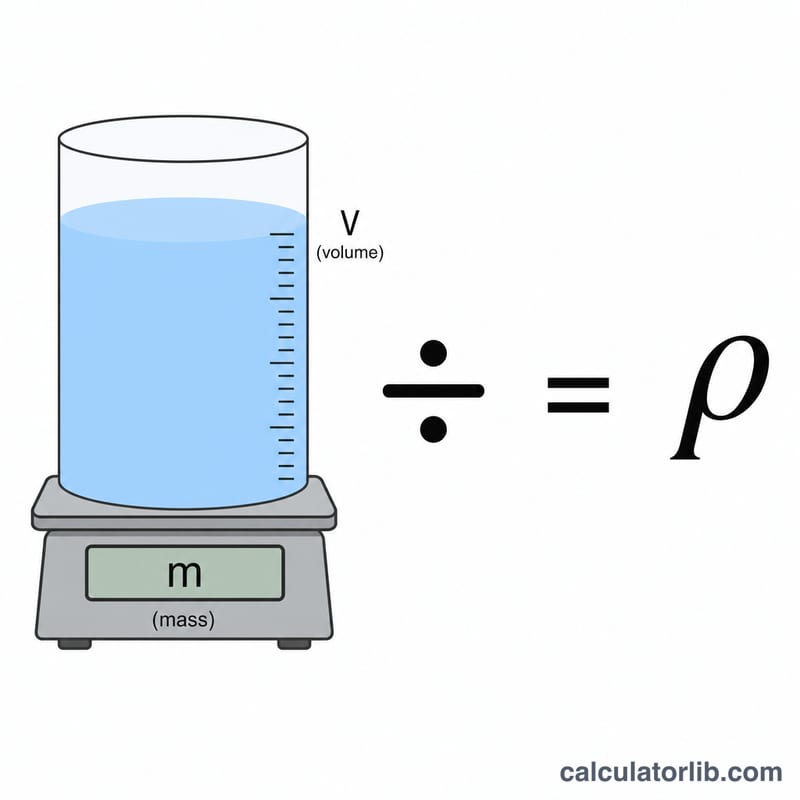
Density is a fundamental physical property that tells you how much mass is packed into a given volume of a substance. This calculator computes the density of a fluid (or any material) using the classic relationship \(\rho = m / V\), where \(\rho\) (rho) is density, \(m\) is mass, and \(V\) is volume. Results are shown in SI units of kilograms per cubic meter (kg/m³) and also converted to grams per cubic centimeter (g/cm³), the unit most often quoted in chemistry tables.
How to Use It
Enter the mass of your fluid sample in kilograms and its volume in cubic meters, then read off the density. If you measured in other units, convert first: 1 liter = 0.001 m³ and 1 gram = 0.001 kg. The calculator guards against division by zero, so a volume of 0 returns 0.
The Formula Explained
The defining equation is $$\rho = \frac{\text{Mass (kg)}}{\text{Volume (m}^3\text{)}}$$ Density is directly proportional to mass and inversely proportional to volume — squeeze the same mass into a smaller volume and density rises. To convert the SI result into g/cm³, divide by 1000, because 1 kg/m³ equals 0.001 g/cm³.
Worked Example
Suppose you have 1000 kg of water occupying exactly 1 m³. Then $$\rho = 1000 / 1 = 1000 \text{ kg/m}^3$$ which equals 1 g/cm³ — the well-known density of fresh water. A 800 kg sample of oil filling 1 m³ would give 800 kg/m³ (0.8 g/cm³), explaining why oil floats on water.
FAQ
What is the density of water? Pure water at 4 °C has a density of about 1000 kg/m³ (1 g/cm³).
Why is density important? It predicts buoyancy, helps identify materials, and is used to calculate mass flow rates and concentrations.
Can I use this for solids and gases? Yes — the formula \(\rho = m / V\) applies to any substance, though gases have very low densities and may need consistent unit handling.