
What is the Tinetti Balance and Gait Calculator?
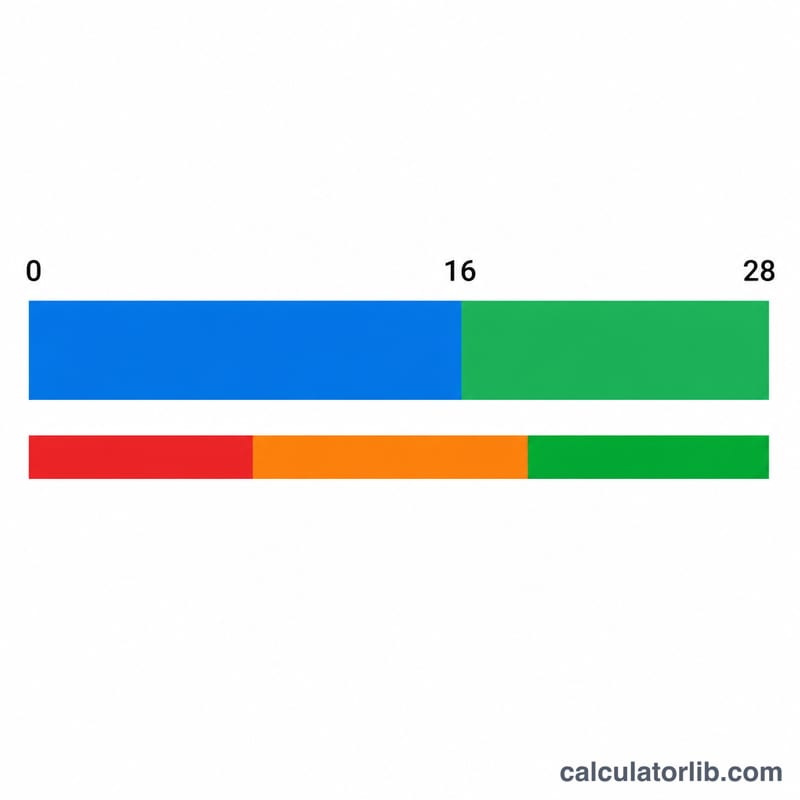
The Tinetti assessment, also called the Performance-Oriented Mobility Assessment (POMA), is a widely used clinical tool for estimating an older adult's risk of falling. It combines two subscales: a balance subscale scored from 0 to 16, and a gait subscale scored from 0 to 12. This calculator adds the two together into a single total score from 0 to 28 and immediately classifies the fall-risk category.
How to use it
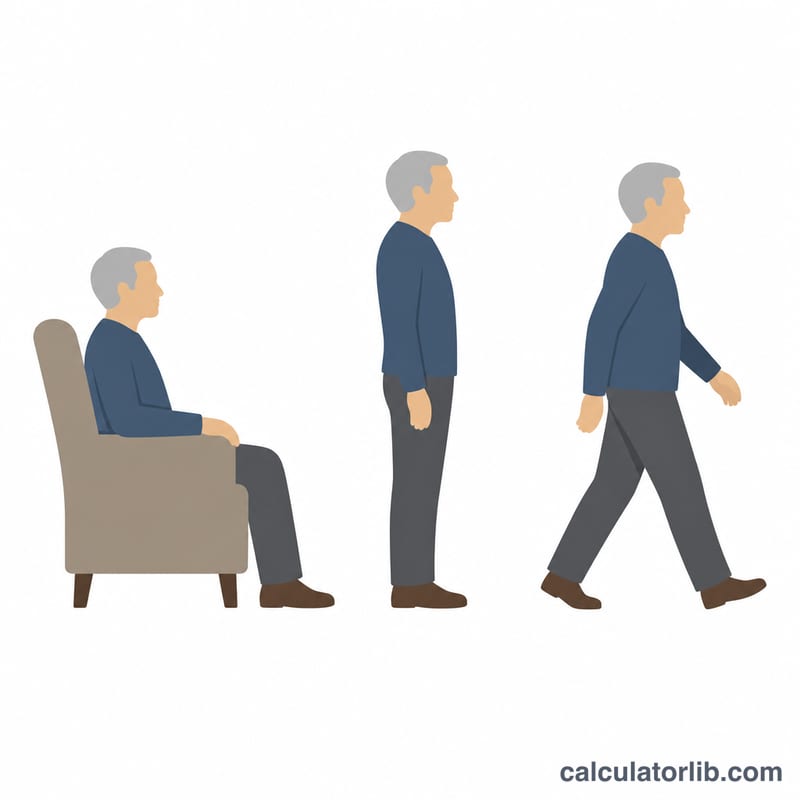
Complete the standardised Tinetti balance and gait observations with the patient, then enter the two resulting subscores. The balance subscale assesses items such as sitting balance, rising from a chair, standing balance, turning, and sitting down. The gait subscale assesses gait initiation, step length and height, symmetry, continuity, path, trunk stability, and walking stance. Enter the totals and the calculator returns the combined score and risk band.
The formula explained
$$\text{Total} = \text{Balance (0-16)} + \text{Gait (0-12)}$$ The maximum possible score is 28, which represents the best mobility. Interpretation thresholds are: a total below 19 indicates a high risk of falls, 19 to 23 indicates a moderate risk, and 24 to 28 indicates a low risk. Lower scores reflect greater impairment.
Worked example
A patient scores 12 on balance and 8 on gait. $$\text{Total} = 12 + 8 = 20$$ Because 20 falls in the 19-23 range, the result is a moderate fall risk, suggesting that interventions such as a physiotherapy review or gait aids may be beneficial.
FAQ
Is a higher Tinetti score better? Yes. Higher scores indicate better balance and gait; the maximum of 28 reflects normal mobility.
What score means high fall risk? Any total below 19 is generally considered high risk.
Can this replace clinical judgment? No. The Tinetti score is a screening aid and should be interpreted alongside a full clinical assessment by a qualified professional.