
What Is the Charlson Comorbidity Index?
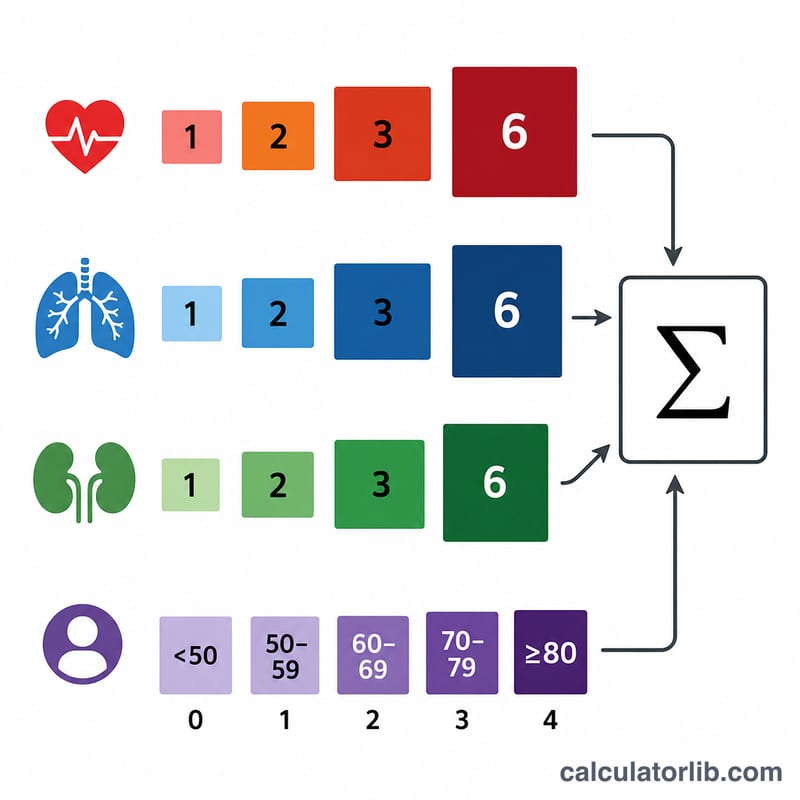
The Charlson Comorbidity Index (CCI) is a widely used clinical scoring system that predicts the ten-year mortality risk for a patient based on a range of comorbid conditions. Each condition is assigned a weight (1, 2, 3, or 6) according to its association with mortality, and an additional point is added for each decade of age over 40. The total score is used in research, prognosis, and risk adjustment.
How to Use This Calculator
Enter the patient's age, then check every comorbid condition that applies. The calculator sums the weighted condition points, adds the age adjustment (1 point per decade above 40, up to a maximum of 4), and reports the total CCI score plus an estimated ten-year survival probability.
The Formula Explained
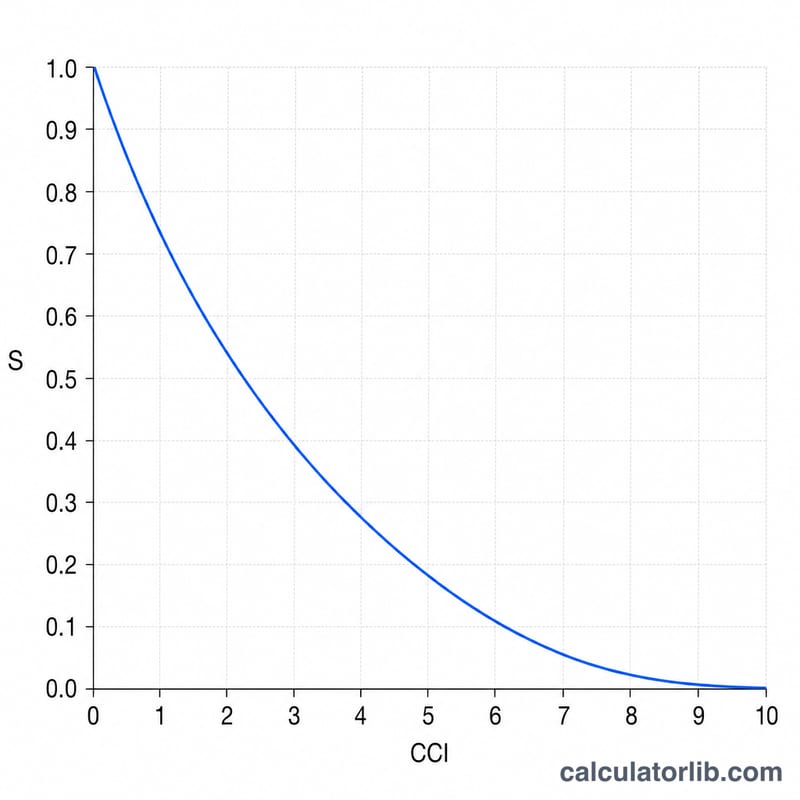
The index is computed as $$\text{CCI} = \sum(\text{weighted condition points}) + \text{age points}$$ The estimated ten-year survival uses the original Charlson regression: $$\text{Survival} = 0.983^{\left(e^{\text{CCI} \times 0.9}\right)}$$ expressed as a percentage. A higher CCI exponentially lowers predicted survival.
Worked Example
A 65-year-old patient (age band 60–69 = 2 points) with congestive heart failure (1), chronic pulmonary disease (1), and diabetes with end-organ damage (2) has condition points of 4 and a total CCI of 6. $$\text{Survival} = 0.983^{\left(e^{6 \times 0.9}\right)} = 0.983^{\left(e^{5.4}\right)} = 0.983^{221.41} \approx 0.0225$$ or about 2.25% ten-year survival.
FAQ
Is this calculator country-specific? No. The Charlson Comorbidity Index is a universal clinical tool used worldwide.
What is a "good" CCI score? A score of 0 indicates no comorbidities and the highest predicted survival; scores rise with added conditions and age, and survival falls sharply.
Should I rely on this for medical decisions? No. The CCI is a population-level prognostic tool and does not replace individual clinical judgment by a qualified professional.