
What Is the Pearl Index?
The Pearl Index is the most widely used measure of contraceptive effectiveness. It expresses the number of unintended pregnancies that occur per 100 woman-years of exposure to a given birth-control method. A lower Pearl Index means a more effective method — for example, modern hormonal implants have a Pearl Index below 0.1, while typical condom use is around 13.
How to Use This Calculator
Enter three numbers: the total number of pregnancies observed in your study group, the number of women participating, and the number of months each was exposed (followed up). The calculator returns the Pearl Index, along with the total woman-years of exposure that underlie the rate.
The Formula Explained
The Pearl Index is calculated as:
$$\text{Pearl Index} = \frac{\text{Pregnancies} \times 1200}{\text{Women} \times \text{Months}}$$
The constant 1200 comes from multiplying 12 (months per year) by 100 (woman-years). Dividing pregnancies by the product of women and months gives pregnancies per woman-month; scaling by 1200 converts this to pregnancies per 100 woman-years, the standard reporting unit.

Worked Example
Suppose a trial follows 100 women for 12 months and records 5 pregnancies. The denominator is \(100 \times 12 = 1200\) woman-months. The Pearl Index is:
$$\frac{5 \times 1200}{1200} = 5$$
That is, 5 pregnancies per 100 woman-years.
FAQ
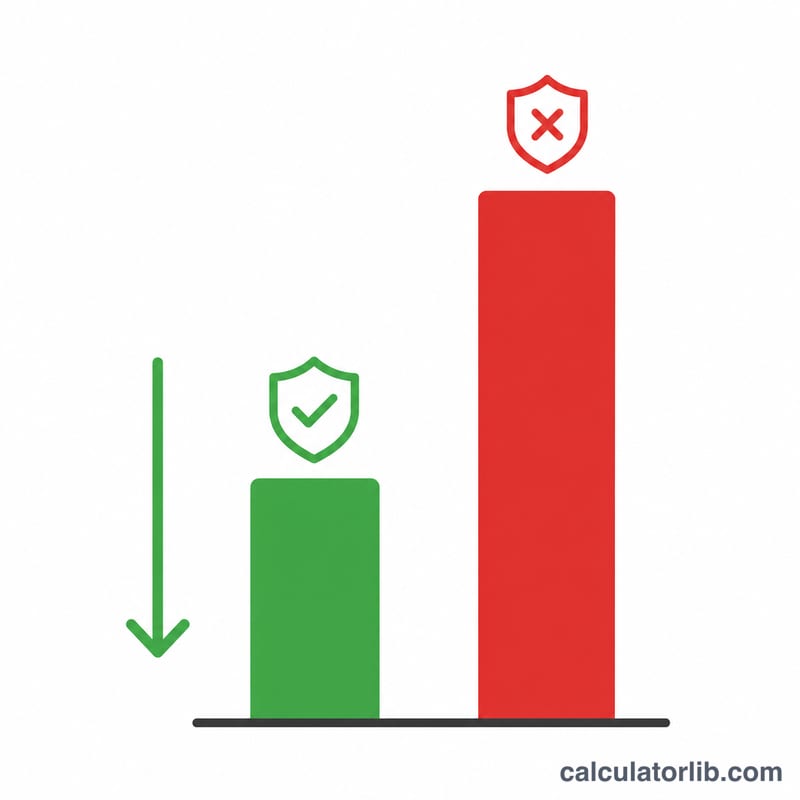
What is a good Pearl Index? The lower the better. Below 1 is considered very effective; values above 10 indicate a high failure rate in practice.
Is this perfect-use or typical-use? It depends on your input data. If pregnancies come from a study of consistent, correct use, the result is the perfect-use rate; otherwise it reflects typical use.
What are woman-years? One woman-year equals one woman observed for 12 months. The calculator shows total woman-years so you can judge the size of the dataset.