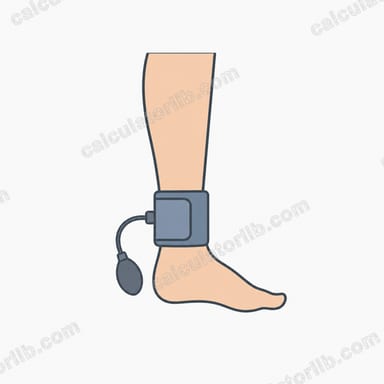

What is the Ankle-Brachial Index?
The Ankle-Brachial Index (ABI) is a simple, non-invasive test used to screen for peripheral artery disease (PAD). It compares the systolic blood pressure measured at the ankle with the systolic pressure measured in the arm. A reduced ankle pressure relative to the arm suggests narrowed or blocked leg arteries.
How to use this calculator
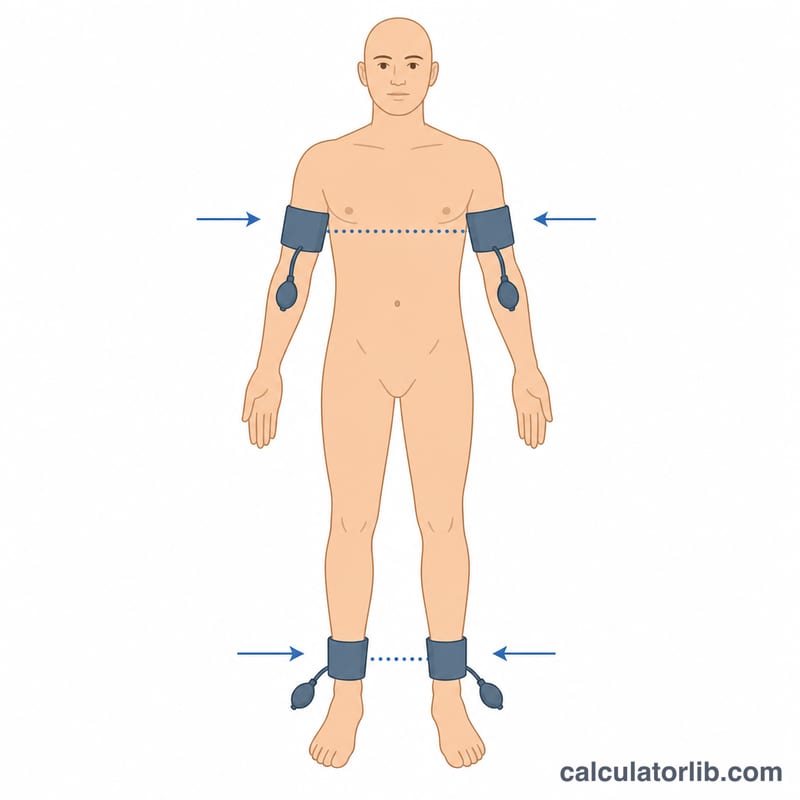
Measure systolic blood pressure (mmHg) at all four sites: right ankle, left ankle, right arm, and left arm — typically using a Doppler probe. Enter each value and the calculator computes the ABI for each leg using the higher of the two arm pressures as the denominator. The overall ABI reported is the lower of the two legs, which is the value most relevant for PAD screening.
The formula explained
For each leg, ABI = ankle systolic pressure ÷ highest brachial (arm) systolic pressure. The highest arm pressure is used because it best represents central aortic pressure. Generally: 1.00–1.40 is normal, 0.91–0.99 is borderline, 0.90 or below indicates PAD, and values above 1.40 suggest non-compressible (calcified) arteries.
$$\text{ABI} = \frac{\min\left(\text{Right Ankle},\ \text{Left Ankle}\right)}{\max\left(\text{Right Arm},\ \text{Left Arm}\right)}$$
Worked example
Suppose right ankle = 100 mmHg, left ankle = 120 mmHg, right arm = 120 mmHg, left arm = 125 mmHg. The highest arm pressure is 125. Right leg ABI = \(100 \div 125 = 0.80\); left leg ABI = \(120 \div 125 = 0.96\). The reported ABI is the lower value, 0.80, suggesting peripheral artery disease in the right leg.
Interpreting Your ABI Result
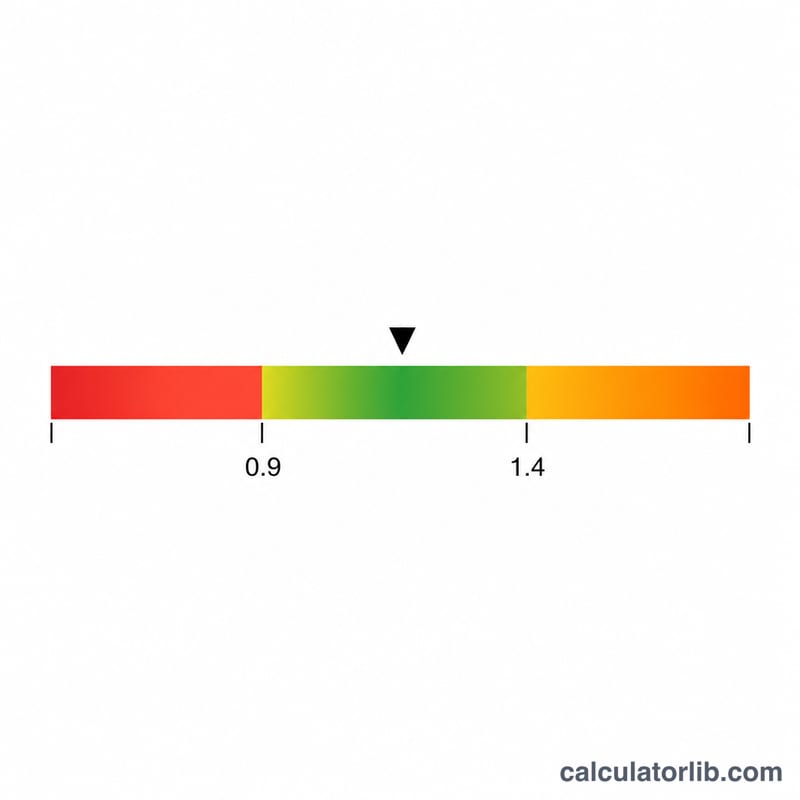
The Ankle-Brachial Index (ABI) compares the higher ankle systolic pressure on a limb to the higher of the two arm systolic pressures. The result is a unitless ratio that screens for reduced blood flow to the legs caused by peripheral artery disease (PAD). The American Heart Association / American College of Cardiology (AHA/ACC) define the following categories:
- 1.00–1.40 — Normal: Blood flow to the lower limbs is unobstructed.
- 0.91–0.99 — Borderline: A gray zone; mild narrowing may be present and follow-up or exercise ABI may be warranted.
- 0.80–0.90 — Mild PAD: Early arterial obstruction.
- 0.50–0.79 — Moderate PAD: Significant arterial obstruction, often with symptoms such as intermittent claudication.
- Below 0.50 — Severe PAD: Critical reduction in flow; risk of rest pain or tissue loss (critical limb ischemia).
- Above 1.40 — Non-compressible / calcified arteries: Vessels are too stiff to compress, often seen in diabetes or chronic kidney disease; the ABI is unreliable and additional testing (e.g., toe-brachial index) is needed.
For example, an ankle pressure of 110 mmHg over a higher arm pressure of 130 mmHg gives an ABI of 0.85, which falls in the mild PAD range.
These bands are screening categories, not diagnoses. An abnormal result should be confirmed and evaluated by a clinician, who may order imaging or other vascular studies before making a diagnosis or starting treatment.
ABI Reference Ranges
The following ranges summarize the interpretation thresholds used in AHA/ACC and ESC peripheral artery disease guidelines.
| ABI Value | Category | Clinical Significance |
|---|---|---|
| > 1.40 | Non-compressible | Arterial calcification / medial stiffening; ABI unreliable, consider toe-brachial index |
| 1.00 – 1.40 | Normal | No hemodynamically significant obstruction |
| 0.91 – 0.99 | Borderline | Equivocal; consider exercise ABI or follow-up |
| 0.41 – 0.90 | Mild-to-moderate PAD | Hemodynamically significant disease; claudication common |
| ≤ 0.40 | Severe PAD | Critical limb ischemia possible (rest pain, ulcers, gangrene risk) |
An ABI of 0.90 or lower at rest is the standard threshold for diagnosing PAD. Values are interpreted per limb, using the higher ankle pressure (dorsalis pedis or posterior tibial) for that leg over the higher of the two brachial (arm) pressures. Sources: AHA/ACC and ESC peripheral artery disease guidelines.
Key Terms Explained
- Ankle-Brachial Index (ABI)
- A ratio of the systolic blood pressure measured at the ankle to that measured at the arm, used to screen for peripheral artery disease.
- Systolic blood pressure
- The peak arterial pressure during each heartbeat, when the heart contracts and ejects blood. It is the value used in every part of the ABI calculation.
- Brachial pressure
- The systolic pressure measured at the upper arm over the brachial artery; the higher of the left and right arm readings is the denominator of the ABI.
- Doppler probe
- A handheld ultrasound device used to detect blood flow and the return of pulse as a cuff is deflated, allowing accurate measurement of ankle and arm systolic pressures.
- Peripheral artery disease (PAD)
- Narrowing or blockage of the arteries supplying the limbs, usually due to atherosclerosis, leading to reduced blood flow and an ABI of 0.90 or lower.
- Non-compressible / calcified arteries
- Arteries that have become stiff from medial calcification (common in diabetes or kidney disease) and cannot be fully compressed by a cuff, producing falsely high ABI values above 1.40.
- Intermittent claudication
- Muscle pain, cramping, or fatigue in the legs brought on by walking and relieved by rest — a classic symptom of PAD.
FAQ
Why use the highest arm pressure? It most closely approximates true central blood pressure, giving the most accurate denominator.
Is a high ABI always good? No — values above 1.40 may indicate stiff, calcified vessels and need further evaluation.
Is this a diagnosis? No. ABI is a screening tool; abnormal results should be reviewed by a healthcare professional.