
What is the SAS triangle area formula?
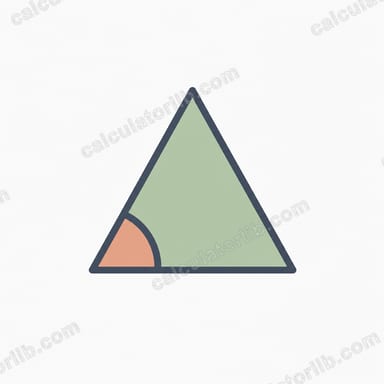
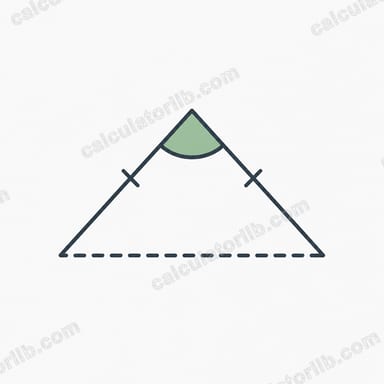
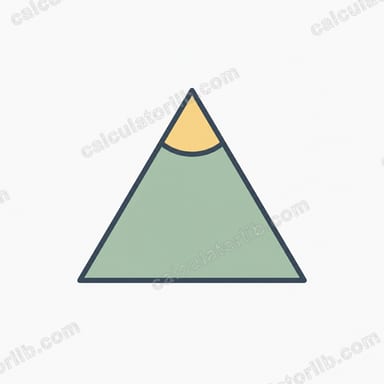
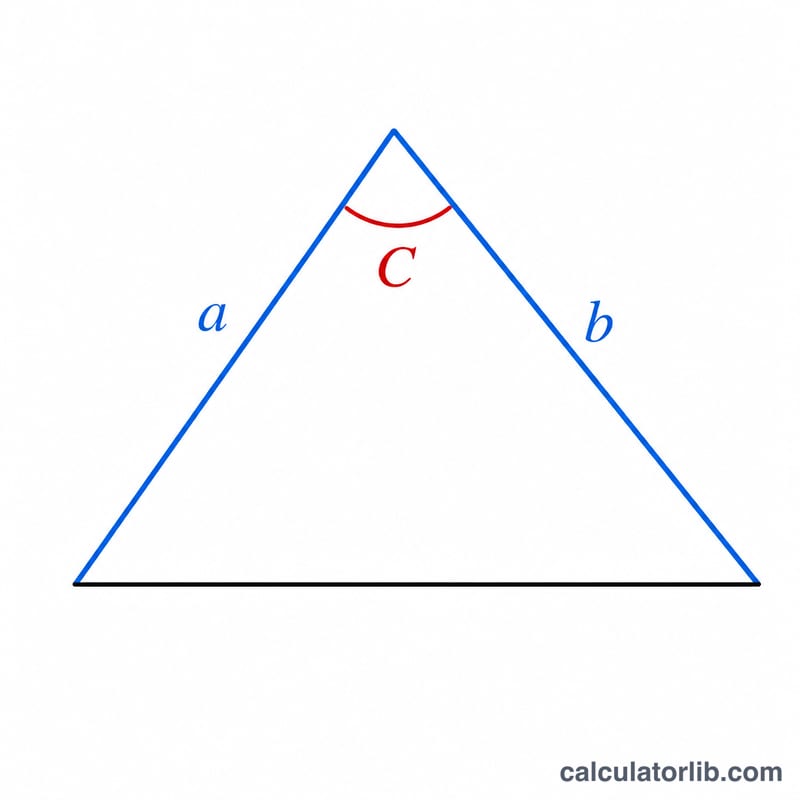
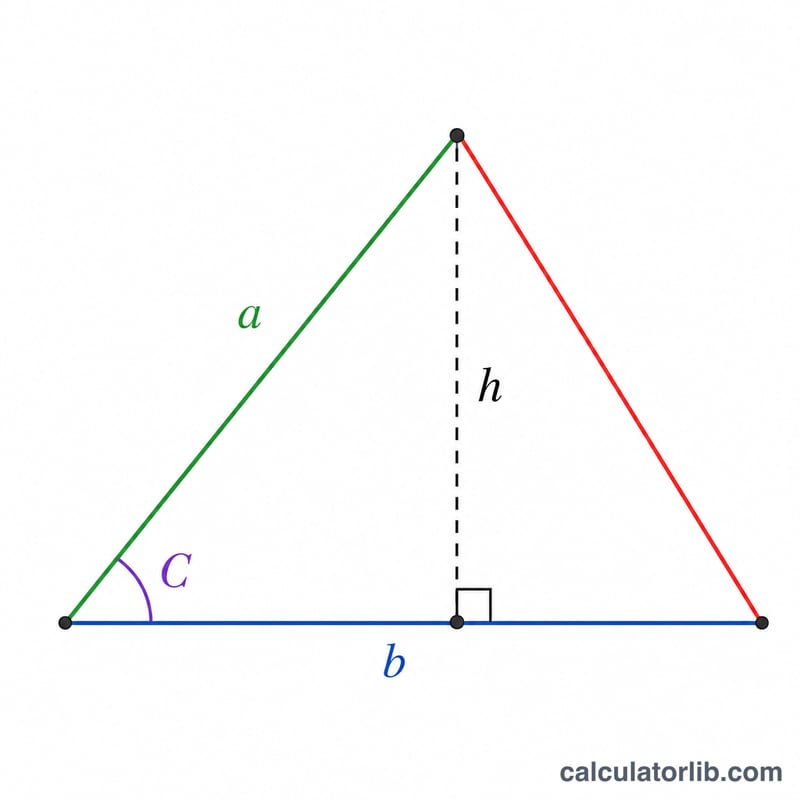
When you know two sides of a triangle and the angle between them — the "side-angle-side" or SAS configuration — you can find the area directly without first computing the height. The formula is \(A = \frac{1}{2} \cdot a \cdot b \cdot \sin C\), where a and b are the two known sides and C is the included angle. This is a universal geometric tool that works for any units (cm, m, inches), as long as both sides use the same unit.
How to use this calculator
Enter the lengths of the two sides a and b, then enter the included angle C in degrees (a value between 0 and 180). The calculator converts the angle to radians internally and returns the area in square units. Because sin(C) peaks at 90°, a right angle between the two sides gives the largest possible area for those side lengths.
The formula explained
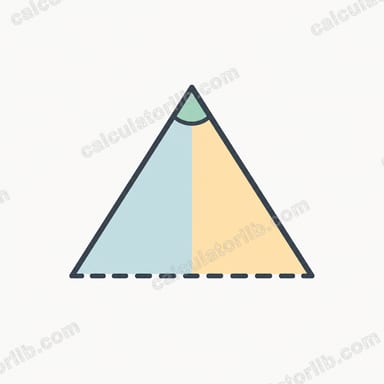
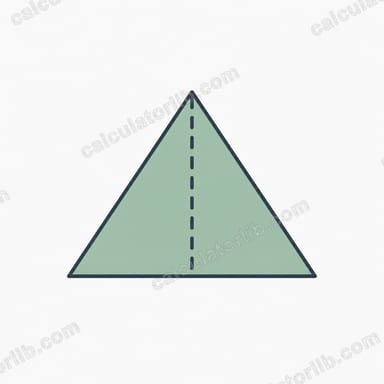
The standard area of a triangle is ½ × base × height. If you take side b as the base, the height is the perpendicular distance from the opposite vertex, which equals a·sin C. Substituting gives $$A = \frac{1}{2} \cdot b \cdot (a \cdot \sin C) = \frac{1}{2} \cdot a \cdot b \cdot \sin C.$$
Worked example
Suppose a = 5, b = 7, and C = 45°. Then sin 45° ≈ 0.7071, so $$A = \frac{1}{2} \times 5 \times 7 \times 0.7071 = 17.5 \times 0.7071 \approx 12.374 \text{ square units}.$$
FAQ
Does the angle have to be in degrees? This tool accepts the angle in degrees and converts it to radians automatically.
What if I have three sides instead? Use Heron's formula instead — this calculator is specifically for the two-sides-plus-included-angle case.
Why is the area largest at 90°? Because sin(C) reaches its maximum value of 1 at 90°, making the two sides perpendicular and maximizing the enclosed area.