
What It Does
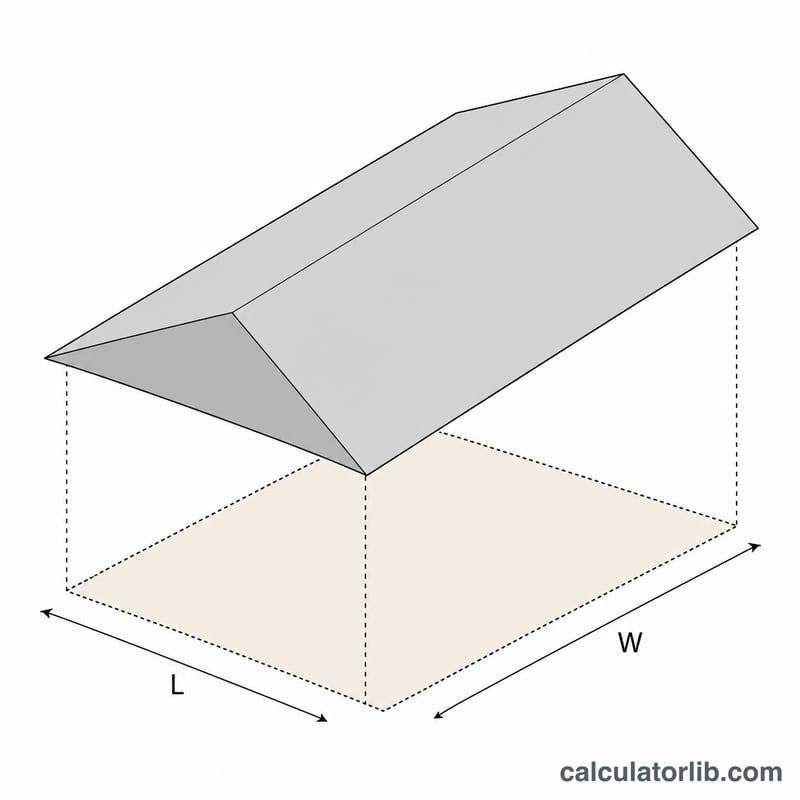
The Roof Surface Area Calculator estimates the actual sloped surface area of a gable-style roof from its building footprint and pitch. Because a pitched roof slopes upward, its true surface is always larger than the flat footprint below it. This tool also reports roofing squares (one square = 100 sq ft), the standard unit for ordering shingles and underlayment.
How to Use It
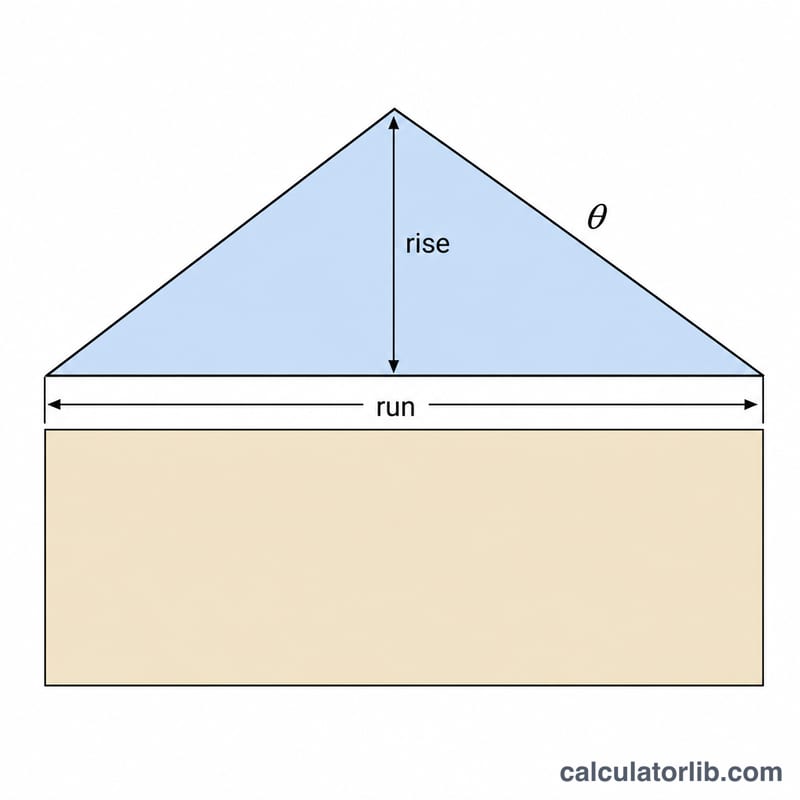
Enter the building length and width in feet to define the footprint. Then enter the roof pitch as rise over run — for example a 6/12 pitch means 6 inches of vertical rise per 12 inches of horizontal run. The calculator returns the footprint area, the slope factor, the total roof surface area, and the number of roofing squares.
The Formula Explained
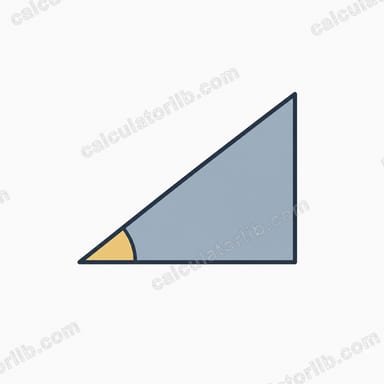
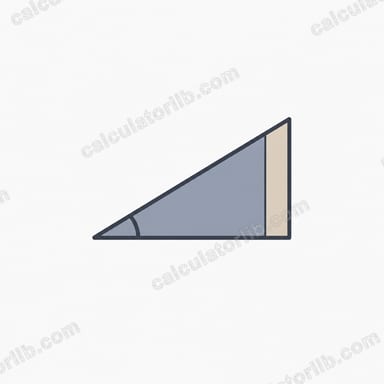
Roof area equals the footprint multiplied by a slope factor: $$A = (L \times W) \cdot \sqrt{1 + \left(\frac{\text{rise}}{\text{run}}\right)^2}$$. The slope factor accounts for the diagonal length of the roof slope versus its horizontal projection. A flat roof (0 rise) has a slope factor of 1, so its surface equals its footprint. A steeper pitch produces a larger slope factor and more material.
Worked Example
For a 40 ft × 30 ft building with a 6/12 pitch: footprint = 1,200 sq ft. Pitch = \(6/12 = 0.5\), so slope factor = \(\sqrt{1 + 0.25} = \sqrt{1.25} \approx 1.1180\). Roof area = \(1{,}200 \times 1.1180 \approx 1{,}341.6\) sq ft, or about 13.42 roofing squares.
FAQ
Does this include overhangs? No — it uses the building footprint. Add eave and gable overhangs to the length and width if you want them included.
What is a roofing square? A roofing square is 100 square feet of roof surface, the unit suppliers use to price shingles.
Is this for hip roofs? The slope-factor method works for any roof of a single pitch, including simple hip roofs, since total sloped area still scales by the same factor.