
What Is the Roof Shingles Calculator?
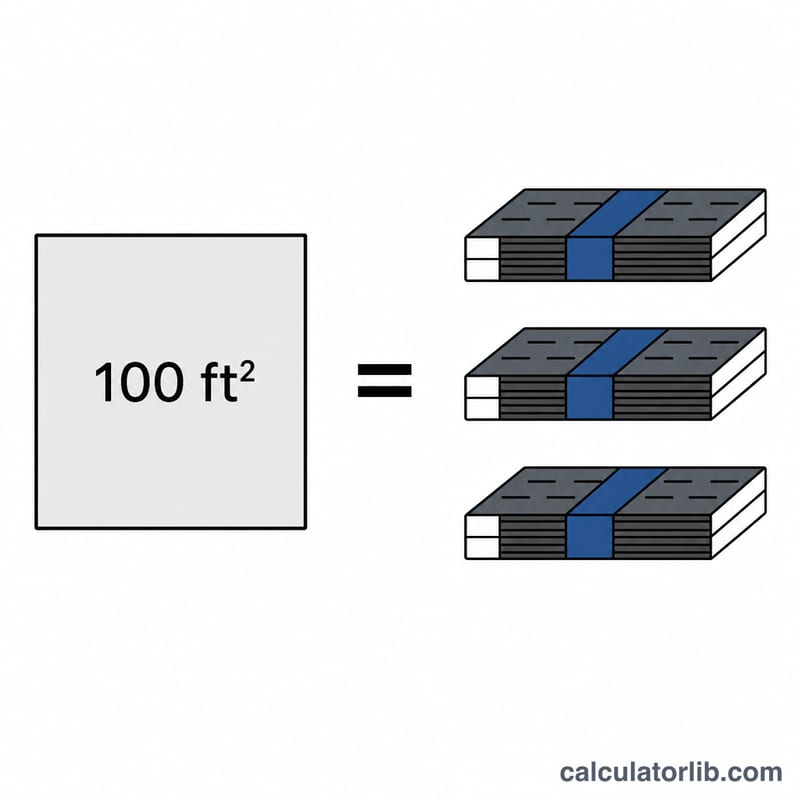
This tool estimates how many bundles of asphalt shingles you need to cover a roof. Roofing material is measured in squares, where one square equals 100 square feet of roof surface. Because standard 3-tab shingles are packaged three bundles per square, the calculator converts your roof area into squares and then into bundles, rounding up so you never come up short.
How to Use It
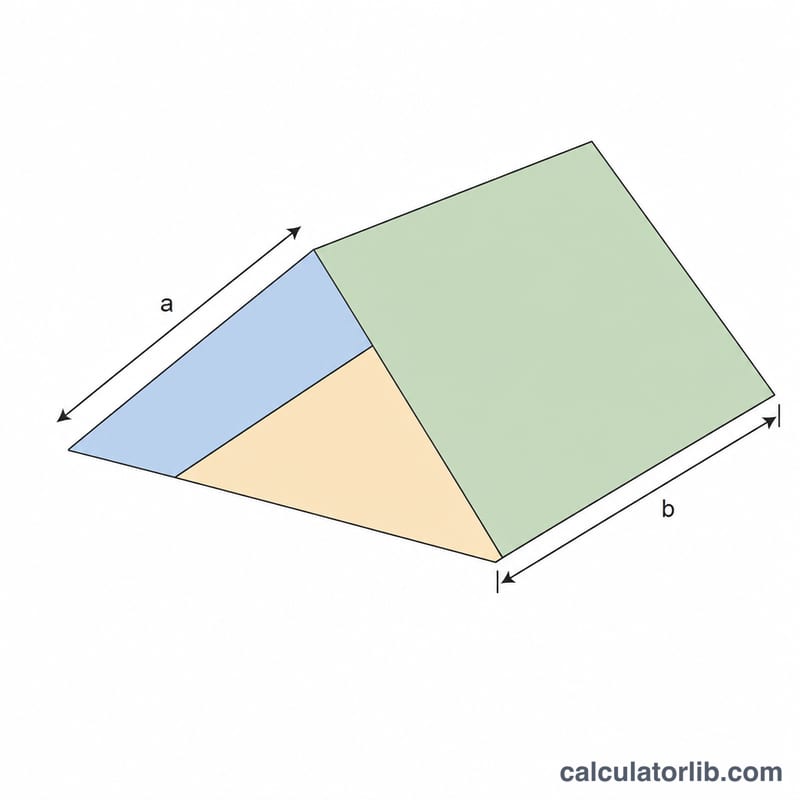
Enter the total roof surface area dimensions — the combined length and width (slope depth) of all roof planes. Add a waste allowance (typically 10%) to cover cuts, ridge caps, hips, valleys, and breakage. The calculator returns your base area, the area including waste, the number of roofing squares, and the total bundles to buy.
The Formula Explained
First the surface area is found: \(\text{area} = \text{length} \times \text{width}\). Waste is added: \(\text{roofArea} = \text{area} \times (1 + \text{waste\%})\). Then \(\text{squares} = \text{roofArea} \div 100\), and \(\text{bundles} = \lceil \text{squares} \times 3 \rceil\). The complete relationship is:
$$\text{Bundles} = \left\lceil 3 \times \frac{\text{Length (ft)} \times \text{Width (ft)} \times \left(1 + \frac{\text{Waste (\%)}}{100}\right)}{100} \right\rceil$$The ceiling function rounds up to the next whole bundle since you cannot buy a partial bundle.
Worked Example
For a roof measuring 40 ft × 30 ft with 10% waste: base area = 1,200 sq ft. With waste:
$$1{,}200 \times 1.10 = 1{,}320 \text{ sq ft}$$Squares = 1,320 ÷ 100 = 13.2. Bundles:
$$\lceil 13.2 \times 3 \rceil = \lceil 39.6 \rceil = \textbf{40 bundles}$$FAQ
How many bundles are in a square? Standard 3-tab and many architectural shingles use 3 bundles per square. Some heavier laminated shingles use 4 or 5 — check your product.
Why add a waste percentage? Cutting at edges, hips, valleys, and starter/ridge courses creates offcuts. 10% is typical for simple roofs; complex roofs with many valleys may need 15%.
Is this the same as ground footprint? No — enter the actual sloped roof surface area, which is larger than the building footprint because of the pitch.