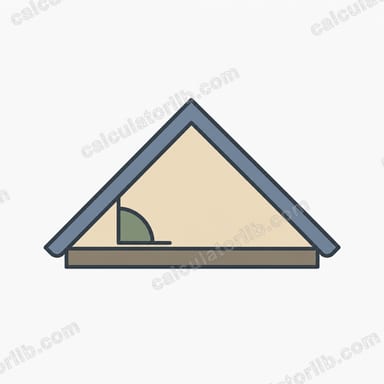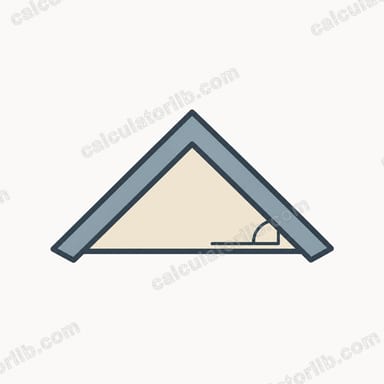

What is a roof pitch angle?
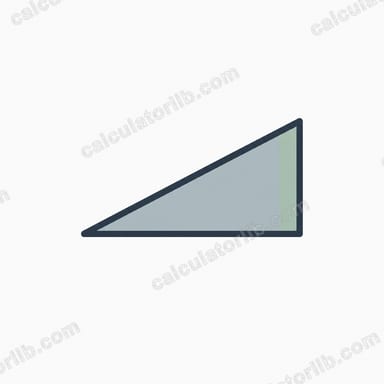
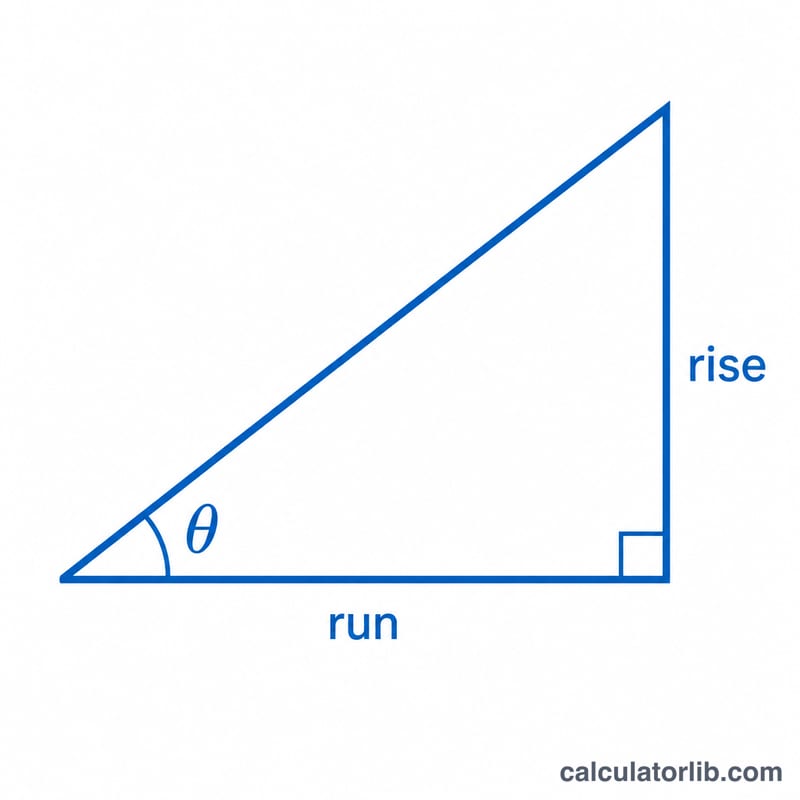
Roof pitch describes how steep a roof is. It is most often written as a ratio of vertical rise to horizontal run, conventionally normalized to a 12-unit run — for example a "6:12" roof rises 6 inches for every 12 inches of horizontal distance. This calculator converts any rise and run into the equivalent angle in degrees, the standard rise:12 pitch, the slope as a percentage, and the rafter-length multiplier.
How to use it
Enter the rise (vertical height) and run (horizontal distance) in the same unit — inches, centimetres, feet, it does not matter as long as both match, because the result is a ratio. Press calculate to see the angle and pitch. If you only know the pitch like "4:12," simply enter 4 as the rise and 12 as the run.
The formula explained
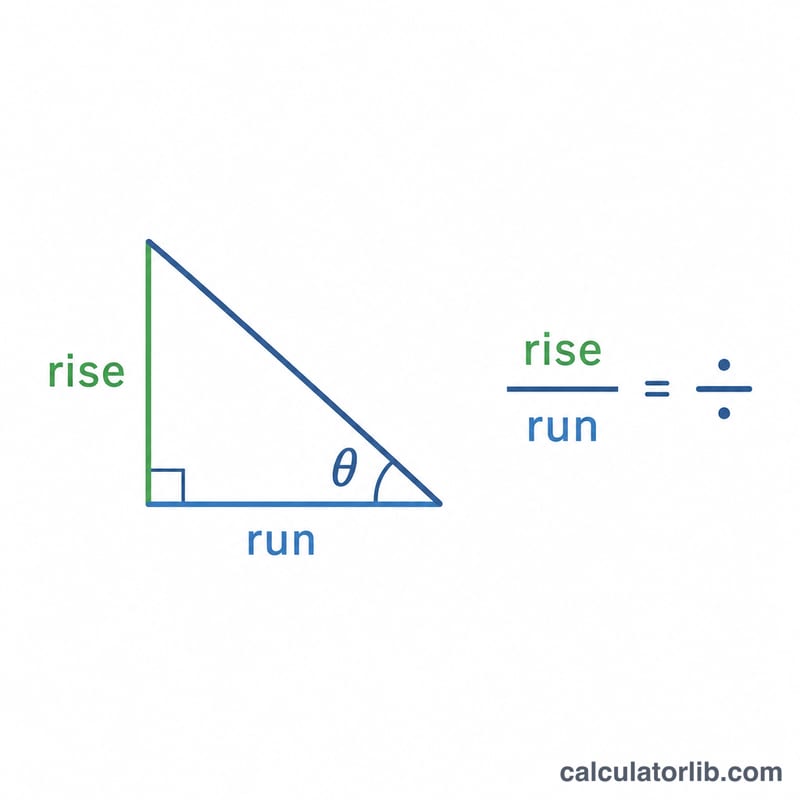
The angle is the arctangent of rise divided by run: $$\theta = \arctan\!\left(\frac{\text{Rise}}{\text{Run}}\right) \times \frac{180}{\pi}$$ converted from radians to degrees. The standard pitch is \(\text{Pitch} = \dfrac{\text{Rise}}{\text{Run}} \times 12\). The rafter multiplier \(\sqrt{1 + \left(\frac{\text{Rise}}{\text{Run}}\right)^{2}}\) tells you how long the sloped rafter is per unit of run — multiply it by the run to get the actual rafter length.
Worked example
For a roof with a rise of 6 and a run of 12: the ratio is 0.5, so the angle is \(\arctan(0.5) = 26.57°\). The pitch is \(0.5 \times 12 = 6\), i.e. a 6:12 roof. The slope is 50%, and the rafter multiplier is \(\sqrt{1 + 0.25} = 1.118\), meaning the rafter is about 11.8% longer than the run.
FAQ
What is a "normal" roof pitch? Most residential roofs fall between 4:12 (18.4°) and 9:12 (36.9°). Below 2:12 is considered low-slope and usually needs special membranes.
How do I convert pitch to degrees? Divide the rise by 12, take the arctangent, and convert to degrees — exactly what this tool does.
Does the unit matter? No. Because pitch is a ratio, any consistent unit for rise and run gives the same angle and slope.