
What is the BBT ovulation method?
Basal body temperature (BBT) is your body's resting temperature, measured first thing in the morning before you get out of bed. After ovulation, the hormone progesterone causes a small but sustained rise in BBT — usually 0.3 °C (about 0.5 °F) or more. By charting your temperature each morning across a cycle, you can identify the day this "thermal shift" occurred and confirm that ovulation has taken place.
How to use this calculator
Enter three values: (1) your baseline temperature, the average of the six low-phase days before the rise; (2) the cycle day on which you observed a clear, sustained jump; and (3) the temperature on that shift day. The calculator subtracts the baseline from the shift-day reading and checks whether the difference is at least 0.3 °C. If it is, ovulation is confirmed at the shift day and your fertile window is highlighted.
The formula explained
The test is simple: rise = shift-day temperature − 6-day baseline average. A rise of 0.3 °C or greater that stays elevated for at least three days marks a valid shift. Because eggs are released just before BBT climbs, ovulation is dated to the shift day, and the fertile window spans from two days before the shift through the shift day.
$$\begin{gathered} \Delta T = \text{Shift Temp} - \text{Baseline} \geq 0.3^{\circ}\text{C} \\[1.5em] \text{Ovulation Day} = \text{Shift Day} \\[0.6em] \text{Fertile Window} = \left[\,\text{Shift Day} - 2,\ \ \text{Shift Day}\,\right] \end{gathered}$$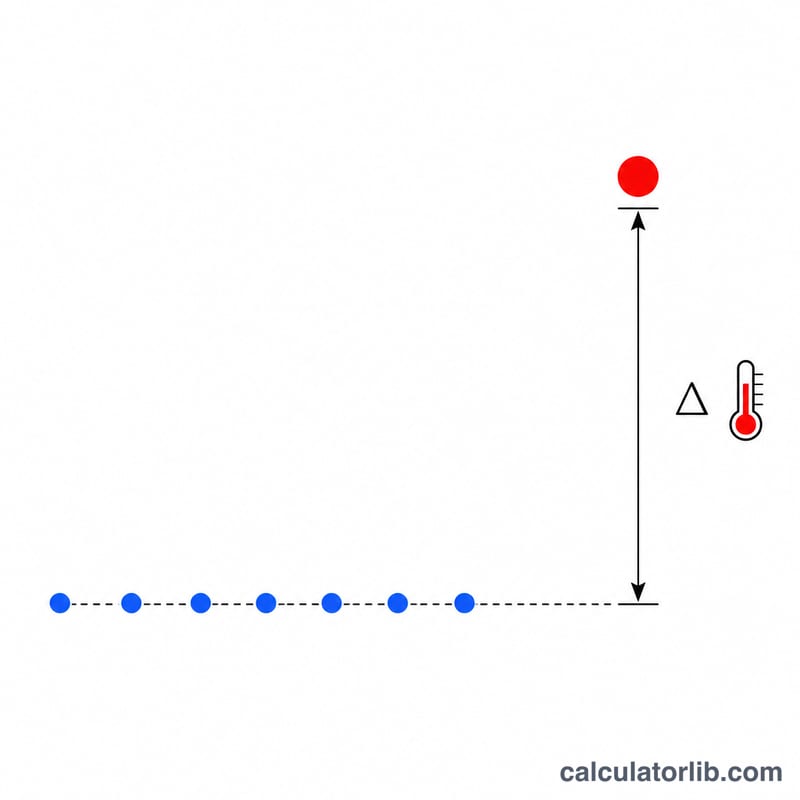
Worked example
Suppose your six low-phase mornings averaged 36.40 °C and on cycle day 14 your temperature jumped to 36.75 °C. The rise is \(36.75 - 36.40 = 0.35\,^{\circ}\text{C}\), which exceeds 0.30 °C, so a valid thermal shift is confirmed. Ovulation is estimated at cycle day 14, with a fertile window of cycle days 12–14.
Interpreting Your BBT Result
The basal body temperature (BBT) method confirms ovulation by detecting the small, sustained rise in resting temperature caused by progesterone after an egg is released. A reading is interpreted against your six-day baseline (the average of the six days immediately before the rise).
Confirmed shift. When your shift-day temperature is at least \(0.3^{\circ}\text{C}\) (about \(0.5^{\circ}\text{F}\)) above the baseline and that elevation holds for three or more consecutive days, a valid thermal shift is detected. This indicates that ovulation has already occurred — typically on the last day before the rise. Because the rise appears after the egg is released, the most fertile days are already closing by the time the shift is visible. Your charted fertile window therefore spans the day of the shift and the two days before it.
No valid shift. A single high reading, a rise smaller than \(0.3^{\circ}\text{C}\), or an elevation that drops back down the next day does not confirm ovulation. Brief spikes can come from a poor night's sleep, alcohol, illness, fever, or measuring at an inconsistent time. In these cases no valid shift is recorded — keep taking your temperature each morning at the same time before getting out of bed and continue charting until a sustained rise appears.
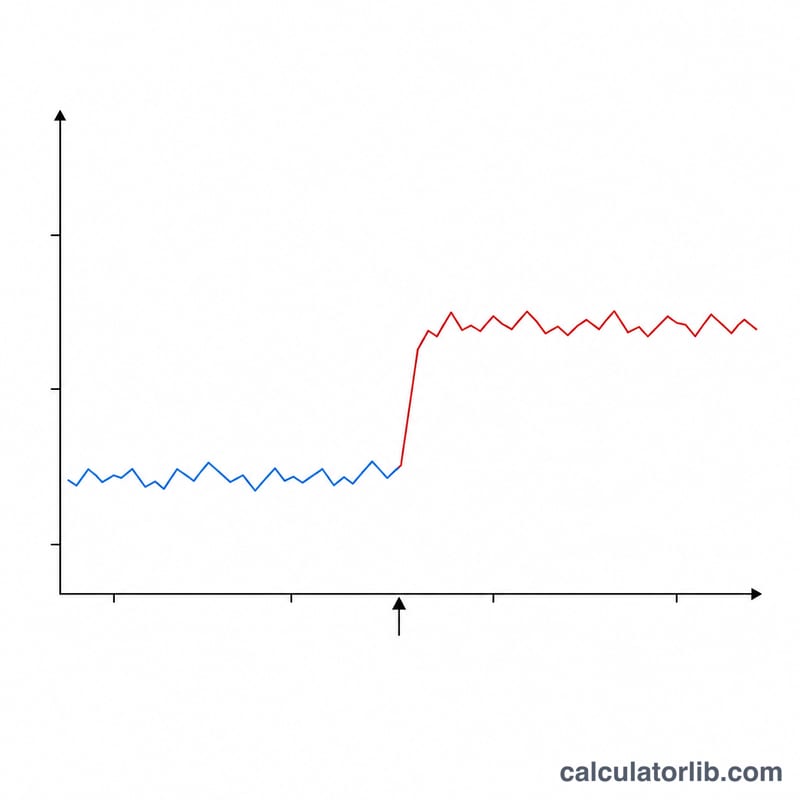
The biphasic pattern. A healthy ovulatory cycle usually produces a two-level (biphasic) chart: lower temperatures during the pre-ovulation (follicular) phase, a distinct step up around ovulation, and higher temperatures through the post-ovulation (luteal) phase until your next period. Seeing this two-tier shape over the cycle is the strongest visual confirmation that ovulation took place.
BBT confirms, it does not predict. Unlike ovulation predictor kits that detect hormone surges beforehand, BBT only tells you ovulation has happened once the temperature has already risen. It is most useful for confirming that you ovulate and for learning the pattern of your own cycle over several months, rather than for pinpointing a future fertile day in advance.
The luteal phase follows. After the shift, the elevated luteal phase typically lasts around 11–16 days. Temperatures usually stay high until just before menstruation, when they drop; a sustained high reading well beyond your usual luteal length can occur in early pregnancy.
This is general educational information about charting, not medical advice. Consult a qualified healthcare professional for guidance about your own cycle or fertility.
Typical BBT Values and Shift Thresholds
The values below describe the ranges and rules commonly used when reading a basal body temperature chart. Individual baselines vary, so the relative shift matters more than any absolute number.
| Measure | Celsius | Fahrenheit | Notes |
|---|---|---|---|
| Pre-ovulation (follicular) BBT | 36.1–36.5 °C | 96.9–97.7 °F | Lower, pre-shift baseline level |
| Post-ovulation (luteal) BBT | 36.4–37.0 °C | 97.5–98.6 °F | Raised by progesterone after ovulation |
| Minimum valid thermal shift | ≥ 0.3 °C above baseline | ≈ 0.5 °F above baseline | Smaller rises are not counted as a shift |
| Sustained-elevation requirement | 3 or more consecutive days held above baseline | Confirms ovulation occurred | |
| Typical luteal phase length | 11–16 days of sustained elevation | From shift until next period | |
For example, a baseline of 36.4 °C with a shift-day reading of 36.7 °C gives a rise of exactly 0.3 °C, which meets the minimum threshold provided it holds for at least three days.
Celsius to Fahrenheit BBT Conversion
BBT is recorded in °C in most countries and in °F in the United States. Convert with the standard formula:
$$^{\circ}\text{F} = ^{\circ}\text{C} \times \tfrac{9}{5} + 32$$| °C | °F |
|---|---|
| 36.2 | 97.16 |
| 36.3 | 97.34 |
| 36.4 | 97.52 |
| 36.5 | 97.70 |
| 36.6 | 97.88 |
| 36.7 | 98.06 |
| 36.8 | 98.24 |
| 36.9 | 98.42 |
| 37.0 | 98.60 |
Shift threshold equivalence. Because a difference scales only by the \(\tfrac{9}{5}\) factor (the +32 cancels when subtracting two temperatures), the minimum valid shift converts as:
$$0.3^{\circ}\text{C} \times \tfrac{9}{5} = 0.54^{\circ}\text{F}$$So the rule "at least 0.3 °C above baseline" is equivalent to "at least about 0.5 °F above baseline."
Key Terms Explained
- Basal body temperature (BBT)
- Your body's lowest resting temperature, measured immediately on waking before any activity. It is sensitive enough to reveal the small post-ovulation rise.
- Baseline
- The reference temperature level before ovulation, usually taken as the average of the six days immediately preceding the thermal shift.
- Thermal shift
- The sustained rise of at least 0.3 °C (≈ 0.5 °F) above baseline that signals ovulation has occurred when it holds for three or more days.
- Biphasic chart
- A two-level temperature pattern across the cycle — lower before ovulation and higher after — characteristic of an ovulatory cycle.
- Follicular phase
- The first part of the cycle, from the start of menstruation up to ovulation, marked by lower BBT readings.
- Luteal phase
- The phase after ovulation, when progesterone raises BBT; it typically lasts 11–16 days until the next period.
- Fertile window
- The days when conception is most likely — here charted as the shift day and the two days before it; biologically it reflects sperm survival before ovulation plus the egg's lifespan.
- Coverline
- A horizontal line drawn just above the highest pre-ovulation (follicular) temperatures; readings rising and staying above it mark the thermal shift.
FAQ
Does BBT predict ovulation in advance? No — the temperature rise happens after ovulation, so BBT confirms ovulation rather than predicting it. Combine it with cervical mucus or LH tests for advance warning.
What counts as a real shift? A jump of at least 0.3 °C above the prior six-day average that stays high for three or more days. Single-day spikes from illness or poor sleep don't count.
Is this medical advice? No. This tool is for educational charting support only. Consult a healthcare professional for fertility or contraception decisions.